
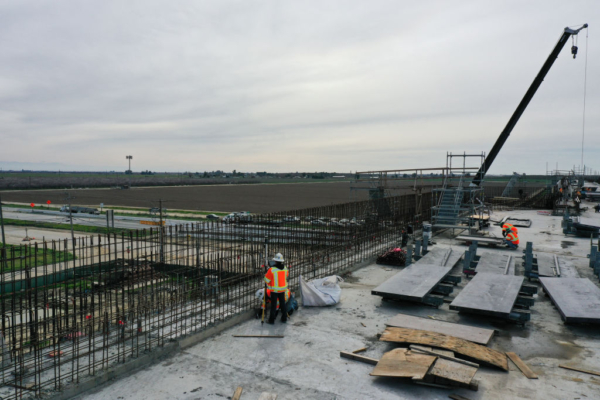
The California high-speed rail project has spent $15 billion since it was approved in 2008, yet it has not completed even a segment connecting cities. What has the California High-Speed Rail Authority done in the past 18 years, and where has the money gone? In the 2026-27 budget, the state government continues to allocate $1 billion for the high-speed rail project, and will continue to invest in the future. When will the California high-speed rail be completed?
With these questions in mind, 24-year-old independent journalist and internet celebrity Nick Shirley conducted interviews along the high-speed rail planning route, including state legislators, local officials, and ordinary residents. Last Tuesday (the 15th), he released a video hoping to reveal the truth about the progress of the California high-speed rail project.
Earlier this year, the California High-Speed Rail Authority (CAHSR) presented the latest draft plan to the state legislature, with costs skyrocketing from the initial $33 billion to $126.3 billion, with the first phase scheduled for completion in 2032, with the cost cap reaching $231 billion.
David Tangipa, a state assembly member from District 8 (Central California), told Shirley that what people call “California High-Speed Rail” is actually just some steel and concrete. He mentioned that based on the cost cap provided by the High-Speed Rail Authority, it will be the third most expensive project in the United States, behind the interstate highway system and the international space station. Yet, the interstate highway allows people to traverse the entire country, and the space station reaches outer space, while the high-speed rail project seems to have no clear purpose.
Governor Newsom previously stated in a video that this project may not be completed in our lifetime.
So where did this over $15 billion go? Tangipa explained that one-third of the total cost of the project was spent on so-called change order delays because the exact location of the infrastructure was uncertain, and they did not know how to build high-speed trains.
“For the winning contractors, as long as they don’t work for a day, they can get compensation of $170,000, and it’s $5 million a month. This February, a huge delay compensation was reached. If construction cannot proceed, the contractor will receive over $500 million in compensation,” Tangipa said.
California also did not purchase trains that meet high-speed rail standards. Tangipa also suggested that perhaps these individuals are well aware that there won’t be any trains running on the tracks, saying that it would be more cost-effective to simply buy a ticket from San Francisco to Los Angeles.
The main contractor for the high-speed rail project is Tutor Perini, headquartered in California. The husband and daughter of Congresswoman Dianne Feinstein, who passed away in 2023, are directors of the company. The company had no experience in constructing high-speed rail but suggested building the rail line along Highway 99.
A French company participated in the bidding, proposing to build the high-speed rail along Highway 5. The company had experience building a high-speed rail from Nice to Paris and pointed out that the population, cities, and stops along Highway 99 were too numerous to qualify as high-speed rail, and the current cost estimates made completion impossible.
Tangipa claimed that Tutor Perini initially bid at a low price, won the contract, and then raised project costs through submitted change orders to profit. He argued that the high-speed rail project involves the transfer and exchange of interests among the Feinstein, Pelosi, Brown, and Newsom families.
Tangipa cited many public buildings in California that require the construction of disability-friendly ramps, which are managed by the Pelosi family. Governor Pat Brown developed the Squaw Valley near Lake Tahoe to host the 1960 Winter Olympics, then granted the operating rights to the Newsom and Pelosi families.
How was the California high-speed rail line route determined? A farmer in the Central Valley said, “I voted in support at the time, but the description on the ballot was very vague, and no one knew the exact route. In my opinion, the high-speed rail route affects an area that doesn’t need high-speed rail. Agriculture has been the backbone industry of California since its founding, and California should be focusing on benefiting all residents, such as water infrastructure, rather than spending money on a railway that serves only a few people, which is regrettable.”
Shirley observed new housing being built along the high-speed rail planning route and questioned why the government did not choose to build the high-speed rail along Interstate 5, instead opting to cross through the Central Valley.
Lance Lippincott, the city manager of Shafter in Kern County, mentioned that usually, the government would purchase land needed for the high-speed rail route in advance because land values could increase by 10 to 11 times after development. However, this has not been done, and there is minimal communication between the state government and local authorities.
“The high-speed rail overlaps with existing Amtrak services, and it’s hard to understand why a new line is being built in the same area,” Lippincott said. “This is not an isolated incident; it’s quite common throughout the entire Central Valley region.”
Darin DuPont, a candidate for State Senator in District 14, expressed concerns about the high construction cost of the high-speed rail project, fearing that ticket prices might deter residents of the Central Valley.
He criticized the lack of transparency in the high-speed rail project, stating, “They refuse to disclose the flow of funds, they refuse to explain what the project is specifically doing, and the High-Speed Rail Authority is not willing to be transparent.”
Shirley visited the high-speed rail authority office in Sacramento, the state capital, which was empty just past 4 pm, despite working hours until 5 pm.
The California Senate recently approved a bill to continue investing in the California high-speed rail project over the next 20 years. Senator Dave Cortese, representing District 15 and chair of the Transportation Committee, stated, “This is a necessary and beneficial long-term commitment that we must make.”
In response to questions about the failure to complete a segment of the line in 18 years, Cortese responded, “It’s in progress.”
Will it be completed in 20 years? Cortese remarked, “Maybe, maybe not… I’ve overseen many transportation projects that took 20 years to get started, but they were all worth it.”
Cortese believes the high-speed rail will be completed in our lifetime and emphasized, “This is not just my personal commitment; it is the most significant development project in America and should be fully supported at the local and federal levels. It cannot be compared to any other economic development project, but unfortunately, some people have not given it the attention it deserves.”
Not everyone shares this “confidence.” Faced with huge costs and the potential for rising prices in the distant future, many Californians have long called for the high-speed rail project to be halted, including minority party members in the California legislature – Republican lawmakers.