
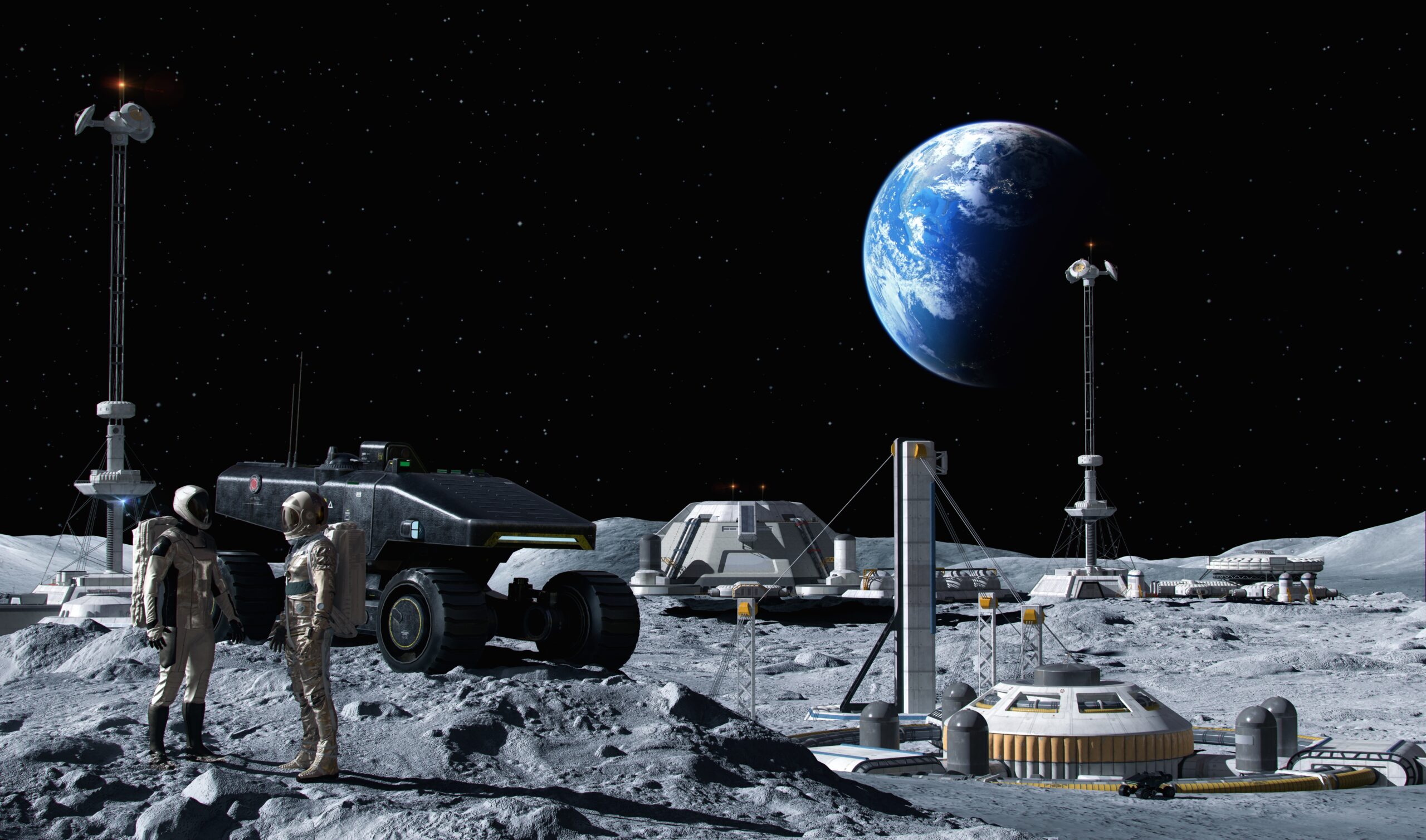
The moon wants your life. Or at least, it wants the lives of anyone daring enough to set foot on its surface.
Back when astronauts of the Apollo Program walked on the moon, their ability to do so relied heavily on a large amount of equipment and support from Earth to withstand the dangerous environment.
Now, more than half a century after the end of the US-Soviet space race, humans are preparing to return to the moon – this time not for the brief visits of the Apollo era, but for long-term stays.
In March 2026, NASA announced a $20 billion plan to build a base near the lunar south pole, which will become the first permanent human outpost beyond Earth.
This settlement may eventually expand to cover hundreds of square miles, initially powered by radioisotope generators and later by nuclear reactors to survive the region’s weeks-long nights.
However, according to reports from the BBC, building a base is just one part of the challenge. Keeping the people living inside alive may be even more difficult. The moon is not a gentle exploration target; lacking atmosphere and a global magnetic field to protect, it poses severe threats to human physiology.
The more than twenty years humans have spent on the International Space Station have taught us a lot about surviving in space. To enable astronauts to stay on the moon’s surface for an extended period, they must overcome six major hazardous limits:
One of the moon’s deadliest dangers is its nearly nonexistent atmosphere. If a spacesuit or habitat shell were to rupture causing a rapid pressure drop, human physiology would face devastating effects.
Spacesuits allow astronauts to survive by essentially encasing them in a thin layer of pressurized air, but any breach in the system can lead to failure. The speed of failure depends on the size of the breach: a pinhole leak may allow air to escape slowly, giving astronauts time to react, but a large tear could render the spacesuit unable to sustain life in a matter of seconds.
Brain hypoxia and loss of consciousness
: Regardless of how long it takes, as oxygen is lost, your brain will quickly succumb to hypoxia, lacking the gases required for operation. In the vacuum environment on the moon’s surface, gas exchange in the alveoli will immediately reverse direction, with oxygen rapidly diffusing back into the lungs and being expelled from the body. The brain will deplete oxygenated blood supply within 10 to 15 seconds, causing astronauts to lose consciousness. Without repressurization, permanent damage or death could occur within approximately 90 seconds.
Fluid boiling (Ebullism):
When ambient pressure drops below the Armstrong Limit (about 0.063 atmospheres), the boiling point of water falls below body temperature of 37 degrees Celsius. While blood vessel tension prevents immediate boiling of blood, fluids on the skin, tissue, and lung surfaces will rapidly vaporize, causing severe subcutaneous gas swelling and bloating of the entire body.
Pulmonary Barotrauma:
If, in the moment of depressurization, you instinctively take a “deep breath and hold it,” the situation could worsen. The vast pressure difference between the inside and outside of the lungs can quickly exceed the tension limit of lung tissue, resulting in pulmonary barotrauma and pneumothorax, where air may be forced into blood vessels causing fatal gas embolism.
Even if rescue personnel manage to repressurize the spacesuit or return you to a safe environment, the harm may already be irreversible.
The moon is an extreme world. Due to the lack of an atmosphere to store or convect heat, the surface temperature of the moon is entirely determined by the angle of direct sunlight:
Extreme surface temperatures:
In the sunlight zone, surface temperatures can soar above 120 degrees Celsius (248 degrees Fahrenheit), while during the weeks-long lunar nights, temperatures plummet to minus 130 degrees Celsius (-202 degrees Fahrenheit); in the permanently shadowed regions (PSRs) of impact craters – places that have not been exposed to sunlight for billions of years – temperatures can drop as low as minus 240 degrees Celsius (-400 degrees Fahrenheit).
Material fatigue of thermal control systems:
Without adequate protection, astronauts won’t last long. This is why spacesuits are equipped with sophisticated thermal control systems aimed at maintaining body temperature in a safe range, preventing astronauts from freezing in the cold or overheating under the hot sun. Spacesuits rely on multiple layers of insulating materials like Mylar, Kevlar, and other high-strength fibers, which also provide impact and abrasion protection – combined with liquid cooling and ventilation garments beneath these outer layers to regulate body temperature.
However, if astronauts are to live on the moon, they will have to rely on these spacesuits day in and day out. Exposed to such extreme temperatures for extended periods, the flexibility and structural integrity of materials will gradually deteriorate, significantly increasing the risk of thermal control system failure.
People often underestimate the speed of object movement in space. On Earth, most small celestial objects burn up in the atmosphere; however, on the moon, micrometeorites impact the surface at speeds of up to 11 to 72 kilometers per second (about 20 to 100 times the speed of a bullet).
At these speeds, even a dust particle measuring just a micrometer in size possesses high kinetic energy that can penetrate visors or tear spacesuit materials. If these miniature space missiles do not directly impact and end a life, the ensuing sudden decompression will surely do so.
In addition to posing a direct threat to astronauts, the long-term bombardment of micrometeorites can also damage the moon base facilities themselves. They gradually “sandblast” the exterior of the base, causing pitting on solar panels, scratching windows, and slowly eroding the protective structures’ outer walls. Over time, these damages could pose a serious threat to the personnel inside.
On Earth, we are protected by two invisible barriers: the atmosphere, which absorbs harmful ultraviolet radiation, and the magnetosphere, which deflects many high-energy charged particles from the sun and deep space.
The moon lacks both. Therefore, astronauts on the moon’s surface endure radiation levels about 200 times that of Earth. Anyone spending several months living there would accumulate significant radiation doses.
• Chronic accumulation:
Long-term exposure to high-energy heavy ion radiation directly damages DNA, significantly increasing the risk of genetic mutations and cancer.
• Acute solar particle events (SPE):
Spacesuits provide some protection, and gold-coated visors shield astronauts’ eyes from the intense glare and ultraviolet radiation of the sun, but the greatest danger comes from solar storms – solar flares release massive streams of proton radiation.
Even astronauts on the International Space Station sometimes have to seek shelter in the station’s most heavily shielded areas until the storm passes. However, on the moon, with no atmospheric layer or magnetic field providing additional protection, the threat is even greater. If there is a lack of adequate shielding made of lead, water, or lunar regolith, astronauts could suffer from Acute Radiation Sickness, leading to immune system collapse and organ failure.
“Developing better shielding technology and a reliable solar storm warning system will be absolutely crucial,” said Professor Damian Bailey, a biochemist and physiologist at the University of New South Wales.
Every breath astronauts take releases carbon dioxide, which must be promptly removed in the highly enclosed environment of spacesuits or habitats.
If carbon dioxide filtration systems like lithium hydroxide (LiOH) or metal-organic frameworks fail, or if the airflow circulation fans within spacesuits cease operation, exhaled carbon dioxide can form high-concentration pockets around the face mask. Inhaling high levels of carbon dioxide can lead to hypercapnia, acutely elevating blood acidity and causing symptoms such as headaches, dizziness, and blurred vision. As the concentration continues to rise, astronauts may experience confusion, impaired decision-making, and ultimately loss of consciousness.
Impaired decision-making due to terrain ruggedness and the presence of meteorite craters on the lunar surface is often a precursor to fatal accidents, with the severity of hazard comparable to that of the gas itself.
From a distance, lunar regolith appears as soft gray powdery snow. However, it is deemed by many experts as the most challenging engineering and medical issue in long-term lunar exploration:
• Lethal abrasiveness:
Lunar regolith is the product of meteorite impacts over billions of years, grinding the moon’s surface into ultrafine gray particles. Since there is no weathering or water erosion on the moon, each grain of regolith retains extremely sharp glassy angularities that rapidly wear down joint bearings, jam mechanical gears, and compromise the airtight sealing interface of spacesuits.
• Static cling:
Exposure to solar wind and ultraviolet radiation gives lunar regolith strong static electricity. “Apollo astronauts described it as sharp, static-charged talcum powder that adheres to everything,” Bailey said, it tightly adheres to all equipment and spacesuit surfaces and gets carried into habitats.
• Cellular toxicity and physiological hazards:
When inhaled, micrometer-sized lunar dust particles penetrate deeply into the alveoli, inducing chronic inflammation similar to silicosis; ultrafine particles can even breach the blood-air barrier, entering the bloodstream and causing long-term damage to the cardiovascular system.
In addition to the six major physical and physiological threats mentioned above, the low-gravity environment of the moon and the psychological pressure in extremely isolated enclosed environments are gaping chasms to be bridged in becoming interplanetary species.
Our muscles, bones, heart, blood vessels, and even the way blood is transported to the brain are deeply influenced by the gravitational environment in which we exist. With the moon’s gravity being only one-sixth that of Earth, we still do not know how the human body will react to long-term living in such conditions.
Furthermore, Bailey highlighted the psychological challenges. “I imagine being in a cramped habitat with only a few other people for several months, without fresh air, without trees, without rain, without bird songs, while Earth becomes a bright sphere hanging in the black sky. That kind of isolation and confinement may be as challenging as the physical environment.”
NASA’s ambitions may be bold – constructing a permanent outpost capable of resisting vacuum, extreme temperature differentials, high-energy radiation, and sharp lunar dust – but turning this vision into reality will not only be the ultimate test of aerospace engineering but also a comprehensive challenge to human willpower and scientific limits. ◇