
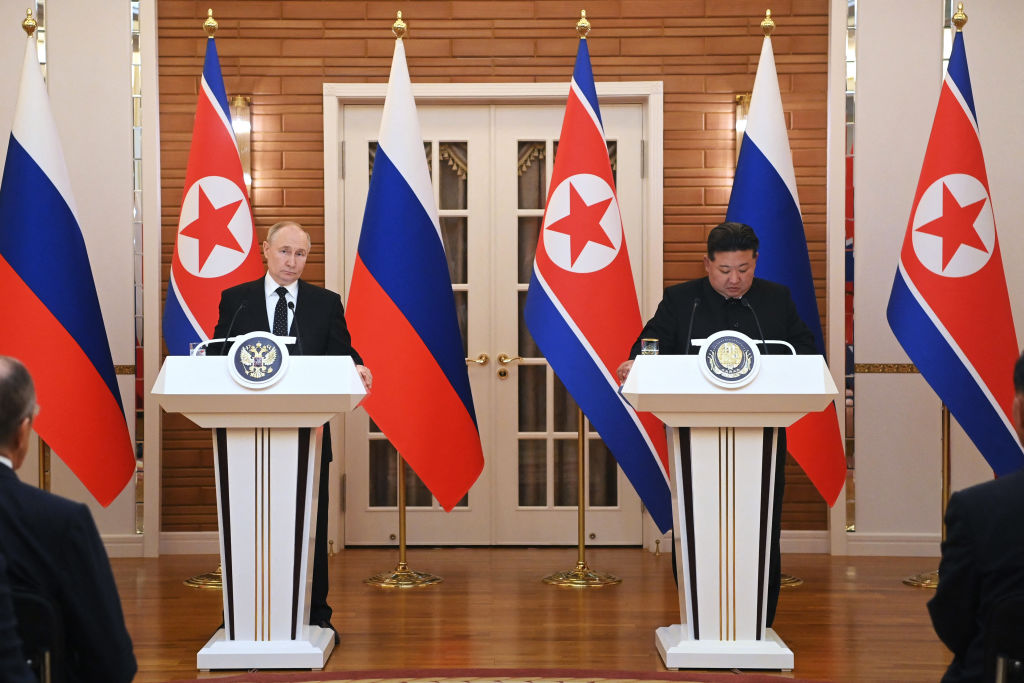
Since the outbreak of the Russia-Ukraine war, Russia has not only suffered heavy losses but also faced slow progress in the war, forcing Putin to seek military support from North Korea. So far, North Korea has provided Russia with troops, artillery, and missiles in exchange for billions of dollars in funding, naval reactors, advanced drones, and other sensitive technologies.
A recent analysis by Forbes suggests that China is not only concerned that deepening Russia-North Korea relations will exacerbate instability in Northeast Asia, damaging China’s international image, but also worried that a warming relationship between Russia and North Korea will weaken Beijing’s influence over North Korea. China is worried that on one hand, North Korea with Russia as a backing may not listen obediently anymore, and on the other hand, it may prompt the US, South Korea, and Japan to strengthen security cooperation. Sino-North Korean relations have always been filled with distrust. In the eyes of China, the relationship between China and North Korea is purely transactional, posing greater challenges than opportunities.
The article points out that the Russia-Ukraine war has brought huge economic and personnel pressure on Russia. The war costs about $290 billion annually, with Russian military losses of about 30,000 people per month, and some fronts facing setbacks or stagnation.
Russian citizens have also keenly felt the price of the war. In July of this year, Ukrainian drones attacked a petroleum pier and nearby ports in St. Petersburg. The government raised the value-added tax to 22% and food prices have risen by 18% this year.
In desperation, Putin has begun to rely on North Korea. South Korea’s Defense Intelligence Agency estimates that since October 2024, North Korea has dispatched over 16,000 soldiers to Russia, provided over 15 million rounds of ammunition, and supplied dozens of KN-23 and KN-24 missiles. Ukraine has hinted that North Korea could ultimately deploy up to 50,000 Korean troops.
So, how does China view the deepening Russia-North Korea relationship? In the past 18 months, ministerial officials from Russia and North Korea have visited each other 23 times, while China and North Korea have only had 8 exchanges.
The article suggests that although Russia-North Korea cooperation will increase pressure on the US and its Western allies, from China’s perspective, the formal trilateral alliance of China, Russia, and North Korea would limit its own strategic objectives. Therefore, China has never shown much interest in a deep trilateral military alliance with China, Russia, and North Korea.
The article points out that cooperation between Russia and North Korea is fundamentally transactional. North Korea helps Russia when needed, but this relationship is not entirely reciprocal. In 2014, North Korea was one of the few countries to acknowledge Russia’s annexation of Crimea, hoping to reap economic benefits from Russia. However, this ended up being a disappointment. In 2020, bilateral trade between North Korea and Russia was only $42 million, making Russia its 139th largest trading partner.
As the times change, North Korea is now selling arms to Russia and sending troops, earning between $7.7 billion and $14.4 billion in revenue annually. Russia also provides North Korea with sensitive technologies, including nuclear submarine-related technology, air defense systems, and drone technology.
The article suggests that China is increasingly concerned that with Russia’s help, North Korea’s nuclear and space assets are developing rapidly, becoming more aggressive and exacerbating regional instability. Additionally, as North Korea’s ties with Russia deepen, its strength and posture become more assertive, potentially leading to increased security cooperation between the US, South Korea, and Japan, stimulating South Korea and Japan to develop nuclear weapons. Furthermore, China does not want regional conflict to cause a refugee crisis.
Sino-Korean relations have always been filled with competition, tension, ridicule, and deep-seated mistrust, lacking mutual respect. China only wants stability from North Korea and does not want it to develop too strongly, as being a “little brother” is sufficient. In the eyes of the Chinese public, North Korea is seen as ungrateful, with Chinese netizens giving Kim Jong-un various nicknames on social media, such as “Kim Jong Unchained,” and the Chinese authorities turning a blind eye. Online surveys show that Chinese netizens have an extremely cold attitude towards North Korea.
In contrast, Chinese views towards Russia are quite different. During the Russia-Ukraine war, under the guidance and manipulation of Chinese public opinion, some Chinese people viewed Russia as a strategic ally.
The article suggests that while Russia-North Korea relations are currently close, they are mostly a temporary expedient, and the Russian people do not have much favor towards North Korea either. Russian public opinion towards North Korea has only slightly improved. Data from the independent Levada Center shows that this year, only one-third of Russians consider North Korea a close ally, a significant increase from 3% in 2021.
In conclusion, from China’s perspective, the challenges brought about by the increasingly close relationship between North Korea and Russia far outweigh the opportunities. As military and strategic connections between the two sides deepen, China now faces the dilemma of dealing with a fickle neighbor in Russia on one hand, and the risk of declining influence over North Korea on the other, pleasing neither side.