
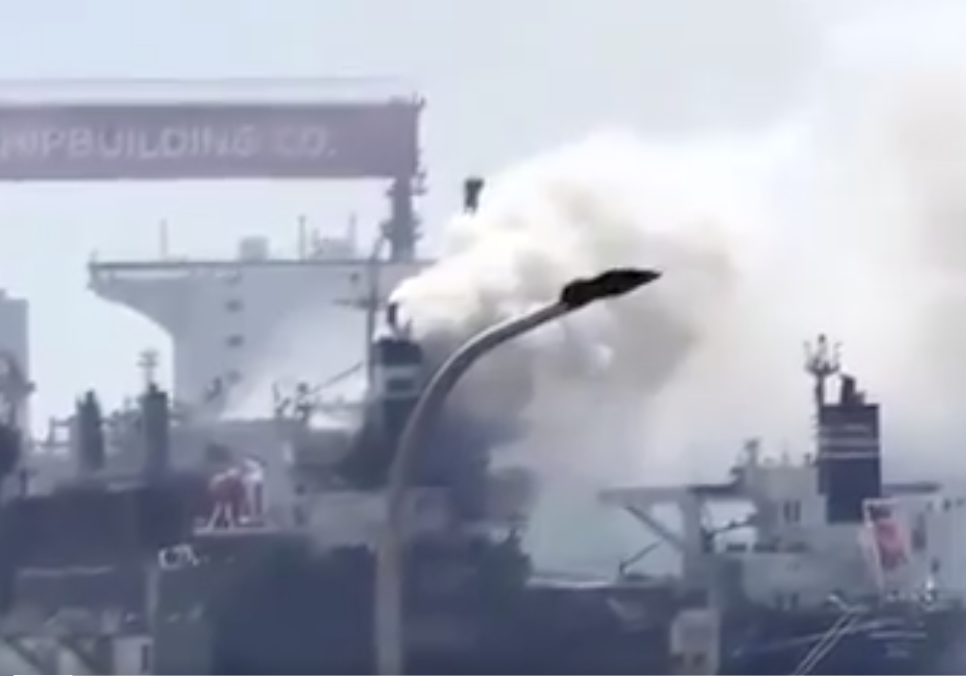
On September 11, 2026, a foreign cargo ship caught fire during maintenance at the Beihai Shipyard in Qingdao, Shandong Province. The official report stated that the fire resulted in 25 deaths and 5 injuries. The news was initially disclosed after instructions were given by the Chinese leader Xi Jinping. The official later released casualty and missing numbers, but the cause of the fire remains unknown. Vessel tracking data shows that both the registered shipowner and operator of the cargo ship are Chinese companies. However, the official only described the ship as a bulk carrier flying the flag of Liberia to avoid mentioning the shipowner. There are suspicions online that the ship belongs to a “shadow fleet,” but this has not been confirmed yet.
According to the official report released by CCTV, the accident occurred around 11:15 a.m. and the fire was extinguished around 2:30 p.m. The ship had a total of 42 people on board, with 12 safely evacuated, 5 injured, and 25 temporarily missing but later located with no signs of life.
The nationalities and identities of the deceased have not been disclosed by the authorities. Videos from the scene showed smoke billowing from the cargo ship. A witness said, “I live across the street, and when I saw the ship on fire, it was emitting smoke, and I couldn’t tell what the accident was.”
Some netizens questioned why there were 25 deaths if the fire didn’t seem too severe. On September 10 around 11:15 a.m., a Liberian-flagged cargo ship caught fire during maintenance at the China Shipbuilding Group’s Qingdao Beihai Shipyard. Out of the 42 people on board, 12 were evacuated, 5 were injured and received medical attention, and 25 were missing temporarily. The fire was brought under control around 2:30 p.m. By 7:24 p.m., all 25 missing persons were found with no signs of life.
Rescue workers had to enter the narrow hatch and work in the lower hold of the cargo ship. The assistant commander of the Qingdao Fire and Rescue Brigade, Hao Xiang, highlighted the challenges of rescuing people trapped amidst smoke and high temperatures inside the hold.
In the early hours of the 11th, journalists entered the burning cargo ship’s hold and discovered a welding gun. Firefighters described facing temperatures of 85°C during the firefighting operation.
According to online sources, the Qingdao Beihai Shipyard was established in 1898 and is now a second-tier unit under China Shipbuilding Group, serving as a major modern shipbuilding and marine equipment manufacturing base in China. The company focuses on shipbuilding and also engages in ship repair, marine engineering, and special vessel and equipment businesses. In recent years, the shipyard has been focusing on green vessels and ammonia-fueled ship types.
Observers noted the unusual handling of the incident by the authorities, such as delaying the disclosure of information, leading to online speculation. The cargo ship involved was named “OCEAN MELODY,” a 20-year-old bulk carrier flying the flag of Liberia and carrying 55,742 tons.
Hong Kong’s “Ming Pao” reported that AIS data showed the ship arrived in Qingdao on August 31, entered the shipyard on September 9, and caught fire within 24 hours of docking. The ship is managed by Shanghai Yuyang Kunpeng Ship Management Co., Ltd., with the registered shipowner being Hui Li Shipping Co., Ltd., both Chinese companies.
The “Nikkei Asia” report referenced ship tracking data from the London Stock Exchange Group (LSEG) confirming the involvement of the above-mentioned Chinese companies in the operation.
However, Chinese official media reports consistently referred to the ship as a “foreign cargo ship,” a bulk carrier flying the Liberian flag, operated by a Chinese company to downplay the involvement of Chinese entities.
On social media platforms, there were rumors suggesting that the cargo ship might be part of China’s “shadow fleet,” disguised with a Liberian flag, ostensibly transporting various minerals but actually carrying materials needed for Russian drones. These claims have not been substantiated but sparked discussions among the public, with some awaiting official confirmation and others finding the scenario too far-fetched.
The term “shadow fleet” refers to fleets that violate U.S. sanctions by transporting sanctioned oil for countries like Venezuela and Iran. These ships are usually old, have opaque ownership, lack top-tier insurance to meet international standards required by oil giants and many ports. They often fly the flag of a third country, especially small nations, or use makeshift flags to evade international sanctions.
Chinese shipowners have been repeatedly accused of involvement in operating these “shadow fleets.” For instance, Swedish authorities stated that they inspected a tanker suspected to be part of a Russian “shadow fleet,” with a Chinese captain arrested. In October 2025, France seized an oil tanker accused of being part of the Russian “shadow fleet” carrying Russian oil to India, whose captain was also Chinese.