
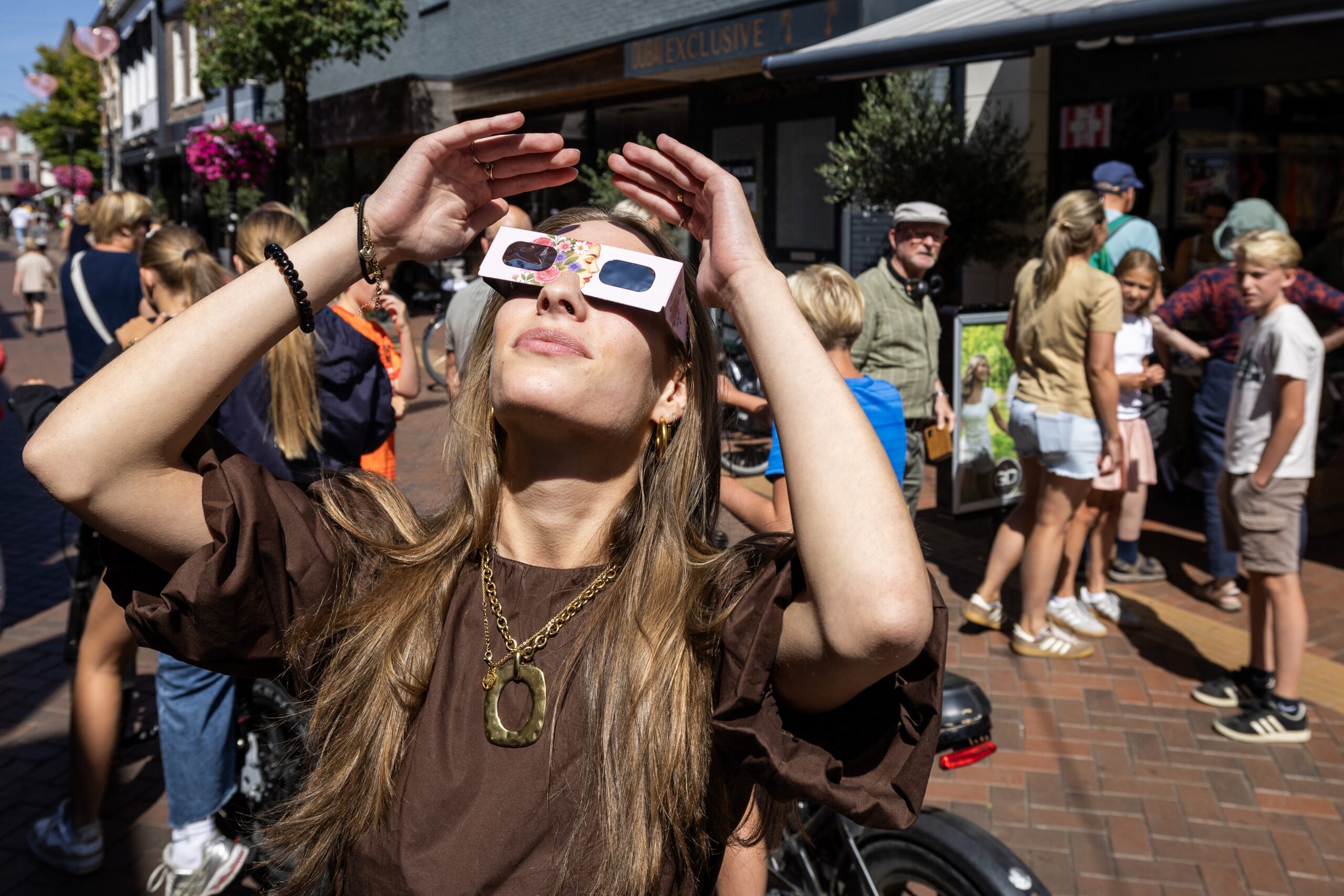
On Wednesday, August 12, millions of people gathered in Spain and Iceland to witness a rare astronomical phenomenon – a total solar eclipse.
This astronomical event has sparked a wave of observation in both countries. Spain is expected to welcome up to 6 million visitors, while Iceland, with a population of only about 400,000, is also preparing for an influx of up to 80,000 tourists. Many people have already prepared their protective eyewear and headed to observation points within the path of the total solar eclipse, ready to witness this seldom-seen spectacle.
In Spain, shortly after the end of the total solar eclipse, a rare phenomenon known as the “eclipse meeting sunset” will occur, attracting extra attention to the observation event.
Juan Cruz, the Secretary of State for Science in Spain, said, “I hope tonight will give birth to a new generation of outstanding astrophysicists. This is such a special moment.”
It is estimated that up to 6 million tourists will visit the northern regions of Spain and the Balearic Islands within the eclipse path, primarily in rural areas.
However, the massive crowds pose a safety challenge for the local authorities. Due to the total solar eclipse coinciding with one of the highest wildfire risk periods in Spain, authorities have initiated a large-scale deployment of law enforcement and public safety awareness campaigns.
Various regional governments in Spain have set up 660 official observation points along the eclipse path, as well as related parking and camping areas, and deployed over 35,000 police officers to mitigate the risk of wildfires and other safety hazards that may arise from a large number of people entering natural areas.
Nevertheless, the Spanish government sees this event as an opportunity to promote less-visited inland regions to tourists and redirect some of the crowds from the saturated coastal resort areas to alleviate issues of over-tourism in coastal regions.
This is not only the first total solar eclipse to be seen in the Iberian Peninsula since 1912 but also the beginning of the so-called “Iberian Eclipse Trilogy,” with another total solar eclipse expected on August 2, 2027, and an annular solar eclipse on January 2028.
Meanwhile, in northern Europe, Iceland is also caught up in eclipse fever. In the capital city of Reykjavík, solar eclipse viewing glasses were sold out days ago.
A narrow path of totality is expected to reach the westernmost coast of Iceland at 5:44 PM. In the westernmost area, the total eclipse phase can last up to 2 minutes and 13 seconds, after which the “moon’s shadow” (referring to the shadow of the moon blocking the sunlight and projecting onto the Earth’s surface during a total solar eclipse) will quickly move eastward. Due to anticipated traffic congestion, officials have urged the public to head to observation points early.
Krista Kern, a visitor from North Carolina in the United States, expressed her anticipation for the total solar eclipse to bring a “sensational feeling throughout her entire body,” exclaiming, “Oh my, this is so cool!”
However, she also admitted feeling nervous about Iceland’s unpredictable weather.
This solar eclipse has also attracted teams of researchers and individuals from the arts and cultural sectors to participate. NASA plans to dispatch WB-57 high-altitude aircraft from Iceland to follow the moon’s shadow, and NASA-funded research teams will release balloons to study the sudden darkness and cooling effect on the lower atmosphere.
Renowned Icelandic singer Björk will also perform as a DJ at a solar eclipse-themed event in the southern part of Reykjavík.
In addition to ordinary observers, this event has attracted a group of “eclipse chasers” from around the world who travel great distances to chase eclipses. Each time a total solar eclipse occurs, they endeavor to find ideal observation locations within the path of totality.
Retired plastic surgeon and amateur astronomer Gordon Telepun from the United States has captured six total solar eclipses. This time, he chose to observe in Mallorca, Spain.
He stated that Spain possesses all the conditions that eclipse chasers value: “The probability of good observation weather in August is quite high, the total eclipse duration exceeds a minute and a half, and traveling there is very convenient.”