
Hello audience, welcome to “Century Truth”.
Entering the year 2026 is like entering the year of the “Chi Horse Red Sheep Calamity” as mentioned in traditional Chinese culture. The Chinese Communist regime is facing unprecedented internal and external crises.
With the economy declining, diplomatic setbacks, and increasing military pressure, the problems seem to be coming from all directions. But is Xi Jinping really most concerned about these issues? Not necessarily.
For a highly authoritarian leader, the most fatal threats often come from those closest to him.
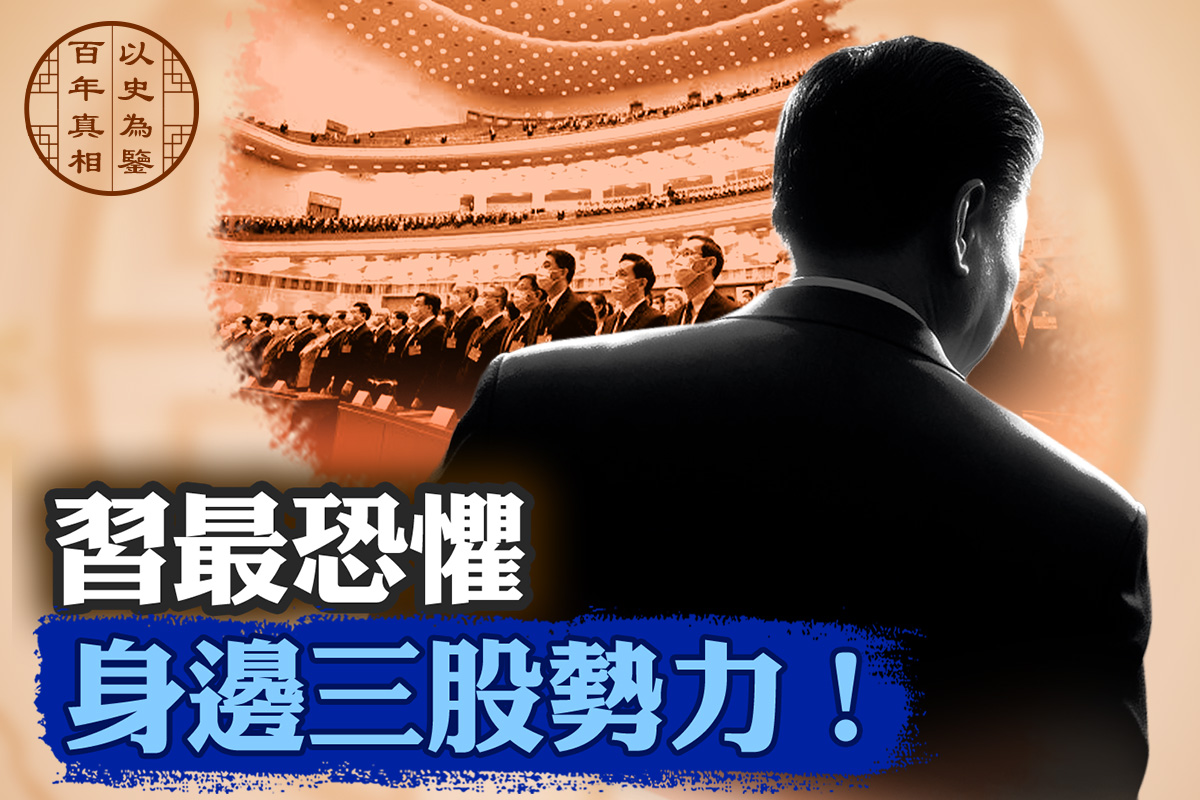
Today, based on public information, we will outline the three major crises that Xi Jinping is most worried about, which could even be a matter of life and death for him.
On March 7, 2026, Xi Jinping made a rare emphasis at the National People’s Congress army delegate meeting, stating, “The army holds the guns, there must be no one in the army with two hearts towards the party.”
This statement may seem like a political slogan, but it actually reveals an extremely sensitive signal – Xi Jinping’s lack of confidence in the loyalty of the army.
Why is that?
Because for any dictator, what truly determines life and death is not economic data but the barrel of a gun. Once someone in the military changes their loyalty, he may lose not only power but also his life.
However, the issue lies in who Xi Jinping considers not to have “two hearts.” Since taking office in 2012, Xi Jinping’s purges within the military have been relentless.
Preliminary statistics show that in his first term, Xi may have purged up to 160 military officers, over 110 in the second term, and as many as 190 high-ranking officers in the current term.
In the past 14 years, Xi Jinping personally promoted 81 senior generals, and nearly 60 of them have been purged. In the Xi era, there are now only a few active generals left in 2026.
This means that most of the people he promoted end up being among those he purges. Even his most trusted inner circle members have not been spared.
In the 20th Central Military Commission of the Chinese Communist Party, including Xi Jinping, there were originally 7 members. However, as of now, 5 of them have been purged, namely Li Shangfu, Miao Hua, He Weidong, Zhang Youxia, and Liu Zhenli.
This means that over 70% of the top military decision-makers in the CCP have been classified as “problematic individuals.” Especially He Weidong, who was personally promoted by Xi Jinping against the norm, was even appointed as the Vice Chairman of the Military Commission to assist Xi in promoting “political military building.”
In theory, He Weidong would be the least likely to have “two hearts.” But what was the outcome?
In October 2025, He Weidong was announced to be “seriously violating discipline and law, with a significant impact and seriousness,” resulting in his direct removal from office.
So the question arises, if even his most trusted individuals cannot be trusted, then who can be trusted?
For any leader, this situation is an extremely dangerous psychological state: the more you purge, the more insecure you become; and the more insecure you are, the more you have to purge.
What kind of situation will a dictator who cannot trust anyone eventually find themselves in?
If having “two hearts” in the military is a visible risk, then another threat is more covert and deadly, which is intelligence leakage.
Since 2025, the CIA has rarely released multiple Simplified Chinese recruitment videos. The total views have reached nearly 120 million. Among them, one video titled “Security Contact Guidance of the Central Intelligence Agency” has views of up to 64.97 million.
What does this mean? Apart from some overseas Chinese and surveillance officers of the Chinese national security agencies, there is a high possibility that a large number of viewers from within China, including officials within the CCP system, have watched these videos.
CIA Director Ratcliffe openly stated that these videos have already begun to show results. Even if only 0.01% of viewers take action, it could potentially yield dozens if not hundreds of “high-value assets.”
These individuals possess not only regular information but could also have access to details about the leader’s schedule and personal life, military deployments and operational plans, nuclear weapons and technological secrets, etc. Once this information leaks, the consequences could be unimaginable.
In recent years, a series of international events have demonstrated the importance of intelligence.
On February 28, 2026, the US-Israeli coalition carried out targeted killings of over 40 senior officials, including the Supreme Leader of Iran, Hassan Rouhani, due to obtaining sensitive intelligence on their meeting time and location.
On January 3, 2026, US special forces precisely captured Venezuelan President Maduro like a hawk seizing a chick. One of the key reasons was that someone from within Venezuela had informed the CIA about every detail of Maduro’s daily life, including what he ate, drank, where he slept, what his “safe house” looked like, etc.
In the Israeli-Palestinian conflict, Israel accurately targeted dozens of Hamas leaders because Israeli intelligence agencies had prior knowledge of their activities.
Looking back at contemporary China.
In 2022, shortly after the 20th National Congress of the CCP, the US Air Force University released a 250-page report on the PLA Rocket Force, detailed with deployment specifics.
In March 2026, another report on the management of PLA nuclear warheads was released, even involving core base data.
The precision of this information has exceeded speculation.
Where did the US obtain this information from? Who provided such detailed information to the Americans?
This also explains why Xi Jinping’s greatest concern is not the enemies overseas but those around him who show “absolute loyalty” on the surface but secretly leave themselves a way out and even provide intelligence to foreign countries, the so-called “two-hearted individuals.”
The third group that makes it difficult for Xi to sleep peacefully are those who have already been purged by him.
Since 2012, under the guise of “anti-corruption,” over 1000 high-ranking officials above the deputy provincial level and other middle-ranking and senior officials have been investigated within the CCP. These individuals come from the central and local high levels, the military and political-legal systems, state-owned enterprise leadership, and related power structures.
The issue lies in these individuals not being an ordinary group; those who can rise to such positions often have extensive networks of relationships, including family, disciples, capital, and complex chains of interests. In other words, they represent not just themselves but an entire interest group.
More crucially, it is their attitude towards Xi.
To many, the so-called “anti-corruption” is not just about fighting corruption but a tool for power struggles. While some are taken down, others remain unscathed. This selective crackdown has not resulted in compliance but rather accumulated resentment. Many not only do not accept it but harbor deep hatred towards Xi, wishing to eradicate him as soon as possible.
These purged high-ranking officials, as well as their families, friends, and associates involved in their interests, have resources, channels, and capabilities. They may be in China or may have already moved abroad. However, one commonality is that they are all waiting for an opportunity. Once the situation changes, these forces are likely to quickly gather and mount a counterattack.
There is a term called “leading the way party.” In 1900, when the Eight-Nation Alliance entered Beijing, there were individuals who willingly led the way and showed them the city gates. In modern warfare, this phenomenon has not disappeared. Whether in Iran or Venezuela, at critical moments, it is often “internal individuals” who determine the outcome.
So what about China today? If the situation suddenly changes one day, from Beijing to local areas, from within the system to abroad, will there be a large number of “pathfinders”?
Perhaps for Xi Jinping, this is the true problem that keeps him up at night.
Well, that’s all for today’s program. Thank you for watching.
If you enjoyed our program, please like, subscribe, and share.
Until next time.