
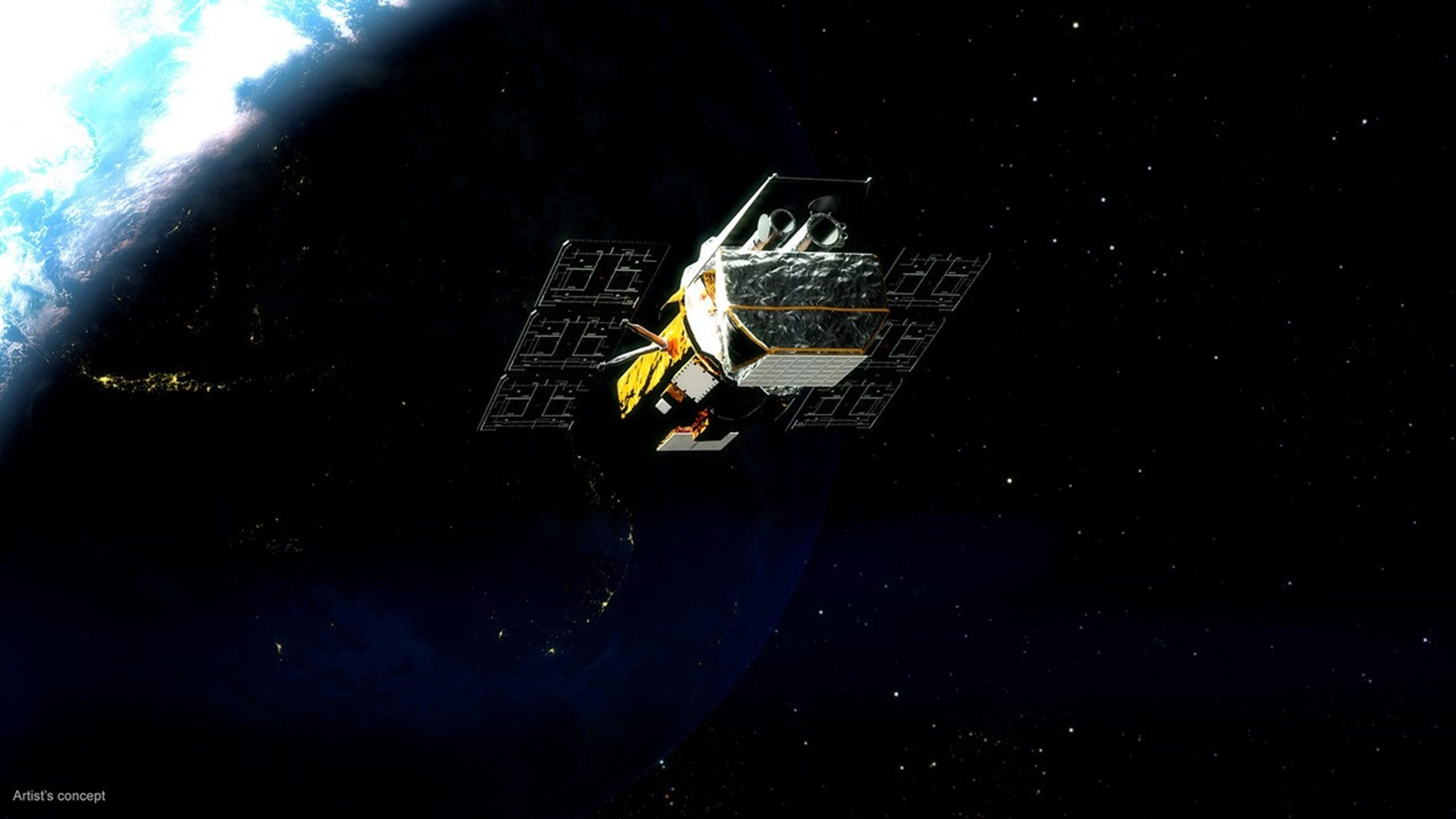
NASA recently announced that its first-ever Swift Observatory, which has been in operation for over 20 years, is set to re-enter the Earth’s atmosphere on November 4, marking the end of a significant era in astronomical research.
Swift Observatory, equipped with three distinct space telescopes, was launched into space in 2004. It has primarily been dedicated to capturing some of the universe’s most extreme energy bursts, specifically gamma-ray bursts. These phenomena are critical for understanding various cosmic events and objects.
On November 2, NASA released a statement detailing the expected timeline for the Swift Observatory’s re-entry. It is predicted that the spacecraft, which weighs approximately 3,200 pounds (around 1,450 kilograms), will penetrate the atmosphere around 3:30 AM EST on November 4. However, this timing comes with an 11-hour margin of error.
While the majority of the spacecraft is expected to disintegrate upon atmospheric re-entry, some components may survive the descent. Because the exact timing of its return is uncertain, the debris could potentially land in either the Northern or Southern Hemisphere.
NASA explains that due to the low inclination of Swift’s orbit, the area where surviving fragments might fall is restricted to between 20.6 degrees south latitude and 20.6 degrees north latitude. The risk to people on Earth is deemed extremely low, estimated at roughly 1 in 2,100. NASA and the United States Space Force will continue to monitor the re-entry process and provide updated predictions.
Initially, the Swift Observatory was developed at a cost of $250 million, with NASA’s original mission plan aiming for a duration of two years. Remarkably, it has far surpassed its expected operational lifespan, functioning for over two decades.
Throughout its mission, Swift has been capable of observing a vast spectrum of light and rapidly pinpointing transient gamma-ray burst events. It sends alerts to other observatories, coordinating follow-up observations and significantly enhancing our understanding of diverse cosmic phenomena. During its operation, Swift detected at least 1,400 supernovae, contributing immensely to our knowledge of stellar explosions.
The Swift Observatory was designed without a propulsion system, with anticipation of its eventual re-entry into the atmosphere. In recent years, intensified solar storms have increased atmospheric drag on the spacecraft, leading to an accelerated descent through the Earth’s atmosphere. Just this past June, the Swift Observatory was situated around 340 kilometers above Earth, but by October 20, its altitude had decreased to approximately 275 kilometers.
Before Swift’s impending re-entry, NASA sought to extend its operational life. Between 2025 and 2026, the agency commissioned a commercial space company, Katalyst Space, to deploy a robotic satellite equipped with a mechanical arm to capture Swift and boost it back to a higher orbit.
NASA allocated $30 million for this endeavor, which, if successful, would have extended Swift’s lifespan by at least another decade. However, the mission faced formidable challenges, as the original design of Swift did not include any interfaces for future docking or repairs.
Katalyst’s robotic satellite, LINK, was launched in July of this year. Unfortunately, after its ascent, LINK experienced a failure in its attitude control system, causing it to spin uncontrollably and preventing it from stabilizing its position. Due to this loss of control, LINK was unable to accurately approach Swift for docking. Even when LINK managed to get within approximately 12 to 15 kilometers of Swift, it still could not execute the necessary capture maneuver.
By mid-August, NASA announced the abandonment of the rescue attempt, effectively signaling the end of the Swift Observatory’s storied mission after more than 20 years of groundbreaking work in the field of astrophysics.