
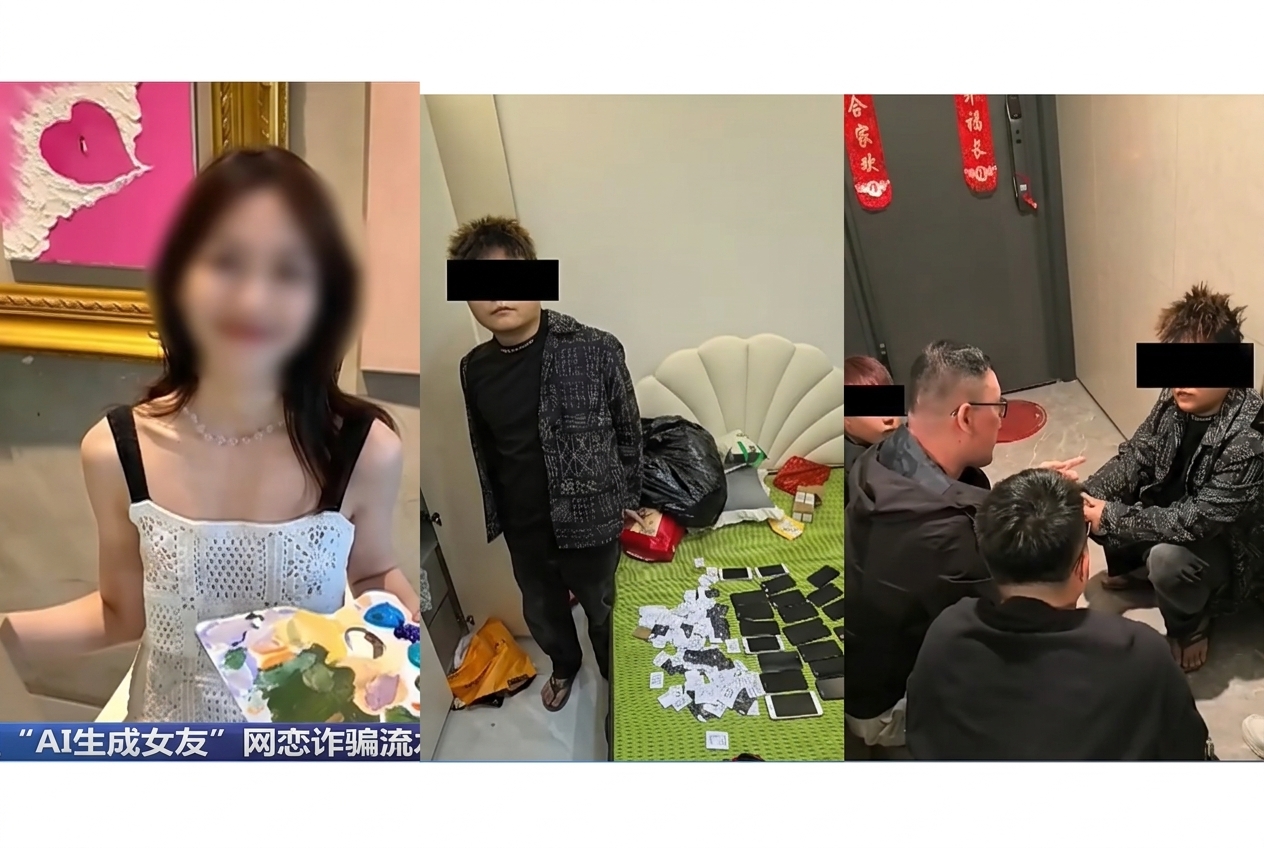
A recent case in Shanghai has highlighted the dangers of online romance scams, revealing a disturbing trend involving artificial intelligence. A man, who had developed a relationship with a woman he met online, was deceived out of more than 180,000 yuan (approximately $25,000) in just half a month. The shocking twist? The “girlfriend” was actually a virtual persona created by AI.
The man, identified only by his surname Liu, encountered a woman named “Tingting” on a short video platform. After connecting through WeChat, their relationship quickly escalated from online chatting to romantic discussions, including talk of marriage. The woman claimed to be an orphan raised by her aunt. However, their budding relationship took a turn when she suddenly announced that her aunt was suffering from a brain tumor, presenting supposed medical documentation and an ID photo as proof of her claim.
In a bid to help, Liu transferred funds, beginning with an initial amount of 40,000 yuan, and over the next few weeks, he sent total payments exceeding 180,000 yuan, even resorting to obtaining a small loan to facilitate these transfers.
Investigations by the Minhang police in Shanghai revealed that Liu was not the only victim. The fraud ring had ensnared numerous men across the country, ultimately resulting in the arrest of key members of the group, identified as Yang A, Yang B, Yang Ting, Zhong, and Cui. It was discovered that the gang had defrauded at least 15 individuals out of a staggering sum exceeding 1.8 million yuan, with the highest individual loss reaching over 380,000 yuan.
The investigation unveiled a highly sophisticated and systematic operation used by the fraudsters. Each member of the gang had specific roles, including dedicated “chatters” who followed a scripted plan designed to develop emotional connections with male targets over the span of a week. They employed AI-generated photos of everyday life and even meals to create a seemingly authentic persona. Each day’s interactions were carefully scripted; complaints about work were introduced on one day, while personal replies were crafted by actual people on another to enhance the feeling of realism.
As the relationship intensified, the scammers would claim to be facing harassment at work and express a desire to quit their job to start a business. They then requested small payments, often asking their victims to send a few hundred yuan for a flower basket. This minor transaction served as a tactical filter: those willing to make the payment were considered viable targets for further scams, while those who declined were marked as “hopeless” in the scammers’ database and were no longer pursued.
Once a victim was selected for larger fraud, they would be handed over to central members of the fraud network, who would leverage the fictitious illness of the aunt to request substantial sums of money. It was revealed that the diagnosis, identification documents, and even photos of a hospital bed were all forged by gang members—costing as little as 25 yuan to create one ID and only 10 yuan for photo editing.
Reports indicate that the use of AI technology in scamming has been increasingly widespread in online fraud cases. According to Wired magazine, a facial-swapping AI tool called Haotian can replace a user’s face during real-time video calls, blurring the lines between reality and deception, and this technology has been utilized in various online scams in Southeast Asia.
In this particular case in Shanghai, it wasn’t until Liu found himself unable to continue the payments that he demanded to verify his girlfriend’s claims via a live video call. However, all he received was an address for the hospital, which prompted his suspicions and led him to report the incident to authorities. Unfortunately, by that time, he had already lost a substantial amount of money, totaling approximately 180,000 yuan.
This alarming case not only underscores the psychological manipulation employed in online scams but also highlights the vulnerability of individuals drawn into these web-based relationships, especially as technology continues to advance and complicate existing risks.