
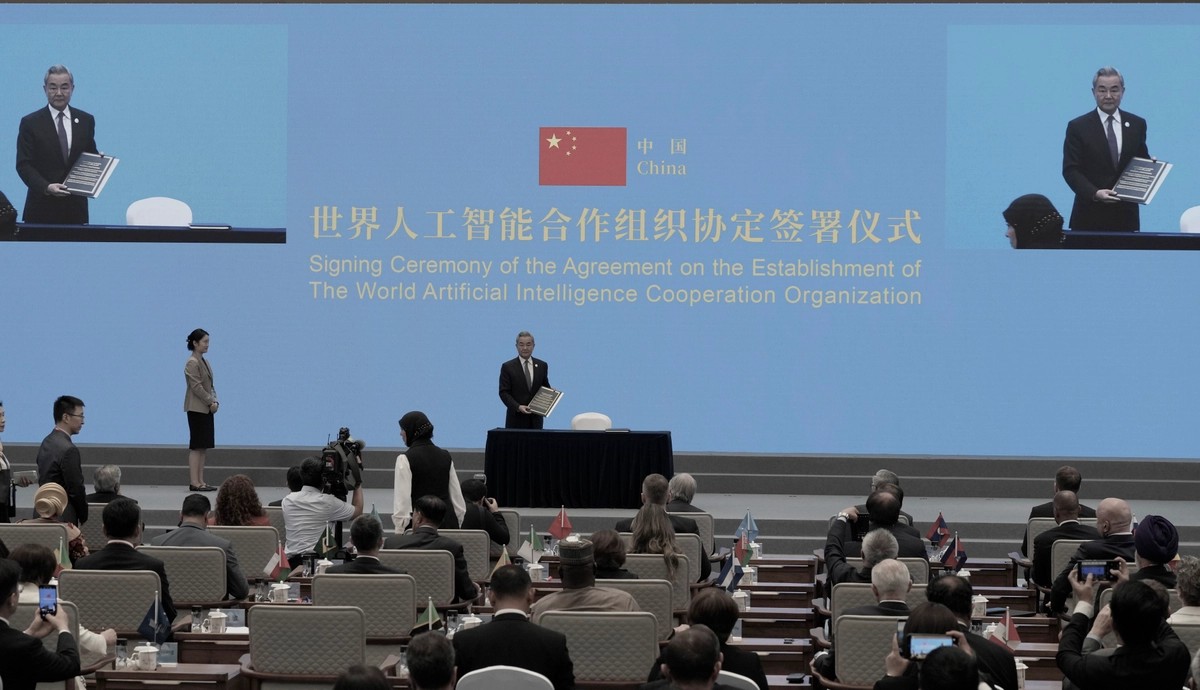
The World Artificial Intelligence Cooperation Organization (WAICO), an initiative promoted by the Chinese Communist Party, currently comprises 37 member states. This organization represents a strategic maneuver by Beijing to shape the global narrative around artificial intelligence (AI).
In an effort to bolster its influence, China is providing free open-source AI models and funding to partner nations including Russia and Iran. This financial support aims to establish AI centers within various international organizations such as the BRICS, the Shanghai Cooperation Organization (SCO), the Association of Southeast Asian Nations (ASEAN), the League of Arab States, the African Union (AU), and the Community of Latin American and Caribbean States (CELAC). By doing so, Beijing seeks to expand WAICO’s reach and facilitate collaboration in AI development.
On the surface, WAICO appears to promote openness and collaboration; however, the Chinese regime is intent on maintaining strict control over its cutting-edge AI technologies. On October 16, the Chinese government proposed export controls on its strategic AI systems, signaling its intent to limit the dissemination of advanced capabilities.
Consequently, the advantages of joining WAICO are often overstated while the costs are significantly higher. The risks associated with WAICO include dependency on Chinese technology, threats to member states’ data sovereignty due to spying by Chinese military and intelligence personnel, and the potential for AI to enable unprecedented intrusions into civil liberties on an international scale. Countries that align themselves with this alliance may ultimately find themselves compromising their own freedom and sovereignty.
China’s strategy with WAICO aims to undermine the diplomatic efforts of democratic nations concerning AI governance. In contrast, the United States has initiated its own version of international cooperation in AI through the “Pax Silica” agreement. This initiative provides member nations with preferential access to minerals, chips, and AI infrastructure, thereby aiming to stabilize the AI hardware supply chain. This approach seeks to integrate and safeguard a democratic supply chain that supports responsible AI practices.
Conversely, WAICO promotes Chinese AI companies and models, such as DeepSeek, Alibaba’s Qwen, Kimi from Moon Dark, GLM by Zhipu AI, and MiniMax from Xiyu Technology. Many of these models are open-source, and typically lack robust security measures, raising concerns about their potential misuse in hacking, the proliferation of weapons of mass destruction, and the enhancement of authoritarian regimes. The Chinese government accepts these risks, viewing the use of AI for authoritarian purposes as an integral part of its global expansion in the AI sector.
Founded in July of this year and headquartered in Shanghai, WAICO saw several notable officials, including UN Secretary-General António Guterres and representatives from founding members such as Russia, Pakistan, Indonesia, Kazakhstan, and Laos, attend its inaugural ceremony.
The day after, Xi Jinping, General Secretary of the Chinese Communist Party, delivered a keynote address at the 2026 World AI Conference. He advocated for “true multilateralism,” a notion analysts interpret as a defense of a parallel global order led by Beijing.
This new AI-driven global order may prioritize values such as democracy, human rights, and civil liberties—principles cherished by the United States—beneath the weight of China’s current suppression of these ideals within its own borders.
According to Alex Krasodomski from the Chatham House think tank in London, China is employing a competitive strategy with WAICO. He wrote, “China’s aspiration for WAICO is to counter the influence of the United States in setting global AI standards.” This suggests that China will utilize WAICO to undermine U.S. efforts aimed at ensuring AI aligns with democratic and human rights principles, thereby promoting Beijing’s own approach to technology.
Such a tactic is likely to empower authoritarian regimes around the world to exploit artificial intelligence to expand their own authority at the expense of civil liberties.
Analysts from the International Development and Security Cooperation think tank based in Manila issued a warning to the Philippines against joining WAICO, labeling it a “Trojan horse” full of “digital traps.” They argued that WAICO normalizes surveillance tools that directly infringe on the civil liberties of Filipino citizens while fostering a structural dependence on Chinese technology, effectively coercing premature relinquishment of sovereignty over domestic data before the local technological ecosystem has even established itself.
The experts noted that it remains unclear whether the Philippines has been invited to join WAICO. “This silence reveals WAICO’s true intent: to selectively construct alliances under the guise of technology, thereby establishing political coalitions,” they stated.
Kazakhstan is unique in its ability to sign both the U.S.-led “Pax Silica” agreement and China’s WAICO. The country’s AI management body is seemingly operating independently, navigating a development path that straddles the different models proposed by major powers, including the European Union.
Meanwhile, China has made substantial foreign direct investments in Kazakhstan, amounting to a record $2.8 billion last year. This financial commitment could significantly influence Kazakhstan’s decisions related to AI and WAICO, particularly as it pertains to governance models for civil liberties, where WAICO appears to hold sway.
Last year, Kazakhstan enacted a new AI law that came into effect in January, prior to its involvement with either WAICO or the Pax Silica agreement. This legislation references the EU’s AI Act but does not prohibit high-risk applications, such as the use of AI for large-scale biometric surveillance and predictive policing, aligning with the positions that WAICO may eventually adopt.
Kazakhstan is rich in uranium and tungsten deposits, and it has affordable energy prices, resources critical for the expansion of global AI infrastructure, and relevant to the goals of the Pax Silica agreement to ensure supply chain independence. These advantages, combined with Kazakhstan’s early participation in the AI space, position it with the leverage to potentially engage with both organizations simultaneously.
Indonesia also possesses crucial resources like nickel and copper for AI development. It is a WAICO member and aims to navigate the dual membership landscape freely.
However, U.S. resistance to simultaneous membership is growing. A draft letter from the U.S. State Department reported by Reuters in August indicated that participating in all organizations effectively means participating in none. This draft was intended for the 35 nations that signed a U.S. AI statement but was leaked.
At that time, Reuters reported that “The U.S. aims to pressure nations to take sides, cutting off China’s access to resources to contain its competition in the race for advanced AI, which could be utilized for military or economic dominance.”
To exert necessary pressure, the U.S. may only extend the full benefits of the Pax Silica agreement to nations that do not join WAICO. Countries that choose to engage with both organizations may be perceived as lacking consistent support for U.S. values and deviating from the core principles of the Pax Silica agreement.
As highlighted in a report from the U.S. State Department on October 26, “No country can be both a reliable partner of the Pax Silica while also substantially participating in initiatives that compete with it.”
The competition between WAICO and the Pax Silica agreement arises from their mutual objective to harness the power of AI to influence the future of global politics. The former, led by an authoritarian party, supports the principles of that party. In contrast, the latter champions the opposite ideology: adherence to democratic freedoms rather than dependency on the Chinese government. The stakes in this global competition are high, with profound implications for the future.