
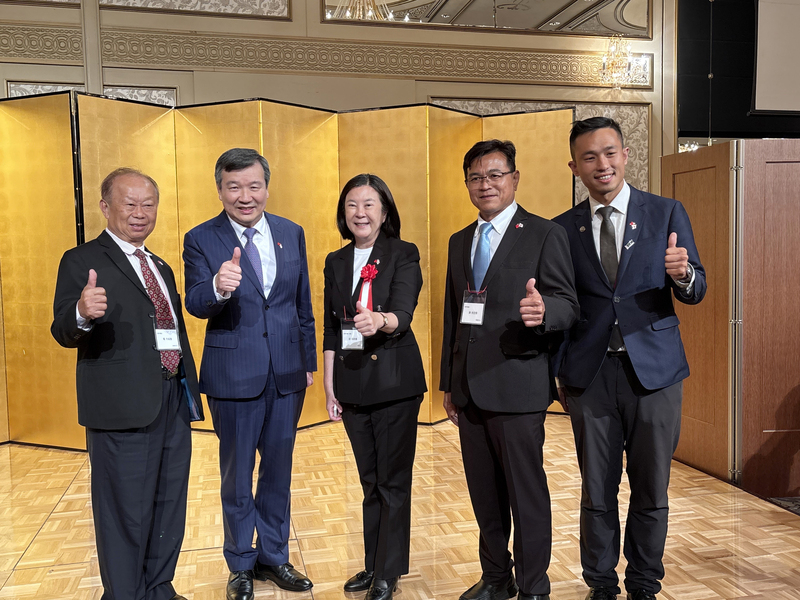
The 12th Taiwan-Japan Exchange Summit took place on November 2 in Nagoya, attracting approximately 300 attendees. Despite reports suggesting that representatives from the Chinese Communist Party had requested Nagoya’s mayor not to attend, Mayor Hiroshi Hirozawa made a personal appearance to deliver a speech. In his remarks, he emphasized the profound friendship that has developed between Taiwan and Japan over many years and pledged to continue fostering exchanges between the two sides.
Mayor Hirozawa highlighted the long-standing interactions between Taiwan and Japan across various sectors, including tourism, economy, and culture. He noted the vibrant exchanges between the citizens of both nations. He mentioned that in 2019, Nagoya established a tourism partnership with Taichung City in Taiwan. In recent years, events such as the Taichung Night Market have enabled the residents of Nagoya to experience Taiwanese cuisine and culture firsthand.
In addition, Hirozawa referenced the launch of a new route by STARLUX Airlines connecting Nagoya to Taiwan, expressing hope for more frequent exchanges between the two regions in the future. He shared his personal experiences, having visited Taiwan about six times, and remarked on the warm hospitality of the Taiwanese people, as well as their friendliness towards Japan, which consistently leaves a lasting impression on Japanese travelers.
He emphasized that the cherished relationship between Taiwan and Japan is both rare and valuable and that Nagoya City will fully commit to promoting further exchanges in the future.
Keiji Koya, the president of the Japan-Taiwan Friendship Parliamentary Alliance, also addressed the gathering. He informed the attendees that the alliance has grown to include 325 bipartisan lawmakers and has actively advocated for the rights of Taiwanese people living in Japan, aiming to rectify issues such as the designation of Taiwanese nationality as “Chinese” on residency and national qualification documents.
Koya recounted his own experience of being sanctioned by the Chinese Communist Party for frequently visiting Taiwan. He criticized Beijing’s contradictory stance of claiming Taiwan as part of China while simultaneously imposing sanctions on him for his visits. He reiterated his commitment to advancing economic cooperation between Taiwan and Japan and encouraged junior high and high school students in Japan to visit Taiwan for school trips, thereby deepening exchanges among the younger generations.
Lili Chiu, the president of the Tainan City Council in Taiwan, also spoke at the summit. Despite Taiwan being in the midst of local representative elections, she attended the summit with fellow council members Yang Chung-cheng, Chen Chiu-hung, and Shen Chen-tung. She noted that the Taiwan-Japan Exchange Summit serves as a bridge of friendship between local councils and representatives, creating opportunities for closer ties through mutual declarations and exchanges. She underscored that Taiwan and Japan are not only international allies but also crucial partners in cooperation.
Chiu particularly appreciated the summit’s resolution to promote visits by middle school students from Japan to Taiwan. She pointed out that this has been her long-standing advocacy, aimed at allowing young students to experience Taiwan’s history and culture firsthand, thereby fostering mutual understanding and rooting deeper friendships between the youth of both nations.
On a different note, Kobe City council member Hiroshi Kamihata expressed strong discontent regarding the controversies surrounding Taiwan during the recent Asian Games held in Nagoya.
Kamihata stated that Taiwan’s Minister of Sports, Li Yang, did not receive the respect deserved during his visit to Japan. He also condemned the mistreatment of Taiwanese supporters who used flags and towels to cheer for their athletes. He criticized the event’s organizers for yielding to the demands of the Chinese Communist Party, thus undermining the dignity and identity of the Taiwanese people.
He candidly referred to this incident as “a shame for Japan,” asserting that it betrayed the close ties that Taiwanese people have historically held towards Japan. He noted that it would not be surprising if the Taiwanese people lost trust in Japan as a result.
Moreover, Kamihata mentioned that he had submitted a petition to Japan’s Minister of Education, Culture, Sports, Science and Technology, Yoshihiro Katayama, urging improvements in the related circumstances. He received a personal phone call from the minister, indicating that the feedback had been forwarded to the relevant authorities.
He opined that holding the Taiwan-Japan Exchange Summit in Nagoya holds special significance. He expressed that despite pressure from the Chinese Communist Party, the summit proceeded successfully, showcasing the determination of local Japanese lawmakers to uphold the friendship between Taiwan and Japan.
During the summit’s opening, Nagoya City council member Kazuhide Fujita publicly apologized for the previous mistreatment of Taiwan at the Asian Games. Kamihata viewed this willingness to apologize as an acknowledgment of past mistakes, representing an important step in restoring the trust that Taiwanese people have in Japan.
He underscored that Taiwan and Japan share fundamental values such as freedom, democracy, and the rule of law. He firmly stated that no amount of pressure from the Chinese Communist Party could sever the deep ties that exist between Taiwan and Japan.
This year’s Taiwan-Japan Exchange Summit saw around 300 participants, with plans to host the next summit in Yokohama. The ongoing collaboration among local councils across Japan aims to further deepen Taiwan-Japan relations.