
The rapid advancement of artificial intelligence (AI) has transformed the way individuals access knowledge. In today’s world, when faced with a question, one can simply inquire of an AI system and receive quick answers. This ease of acquiring information raises an important question: is there still a need for people to invest time in learning?
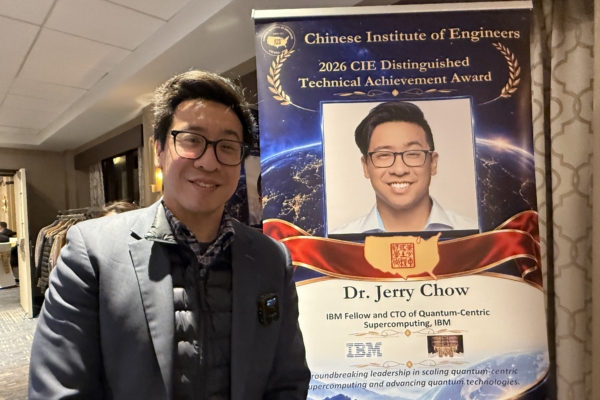
Jerry M. Chow, the Chief Technologist for Quantum Computing at IBM Research, asserts that while AI is indeed changing how we obtain knowledge, it is even more crucial to learn how to learn, how to think, and to continually ask questions rather than merely accumulating information.
Chow, who is also an esteemed IBM Fellow, delivered a keynote speech titled “The Future of Computing is Quantum” at the annual meeting of the American Chinese Engineers Association in Flushing on October 25. During this event, he elaborated on his views regarding education and the implications of AI in learning processes while also discussing his acceptance of the “Outstanding Technical Achievement Award.”
In his remarks following the award presentation, Chow urged young students not to rely solely on AI for completing assignments or solving problems. Instead, he encouraged them to harness AI effectively to enhance their learning experiences and dive deeper into unknown territories.
He noted that while AI and large language models are rapidly advancing, there remains significant progress to be made in technology development. Chow believes that quantum computing holds promise as a pivotal advancement in the next phase of computational technology, which, when combined with existing computational capabilities, can open up new possibilities.
Addressing the concern that AI might render traditional learning obsolete, Chow emphasized that AI should be viewed as a new tool to assist human learning. When utilized appropriately, AI can significantly accelerate the pace of learning. Traditional learning often involves repetitive practice, trial and error, and adjustments, and AI can facilitate more frequent opportunities for learning and exploration, thereby fast-tracking the acquisition of knowledge.
However, he cautioned against using AI merely as a shortcut for completing tasks without engaging in critical thinking or questioning the processes undertaken by AI. He stressed that such an approach deviates from the true purpose of learning.
As the capabilities of large language models and AI technologies evolve, Chow indicated that our understanding of “knowledge” is also changing. In the past, learning was primarily concerned with accumulating knowledge, whereas today, much of that knowledge is already embedded within AI models. Therefore, beyond merely acquiring information, individuals need to develop skills in learning how to utilize AI and cultivate critical thinking.
He particularly emphasized that these skills are vital for the younger generation currently undergoing education. AI should aid humans in continuously honing their critical thinking skills, rather than leading them to complacency due to the ease of obtaining answers.
Chow asserts that one of the key methods for young people to enhance their learning capabilities is through the continual practice of questioning. He remarked, “Learning how to learn hinges on the relentless inquiry. Even if the answers come from AI, one must still ask ‘why’ to comprehend the fundamental reasons behind those answers. By persistently questioning, more knowledge can be revealed.”
He elucidated that, by maintaining a habit of questioning and delving deeper into the root of issues, individuals can discover more insights, even when utilizing tools like AI.
Beyond discussing AI and education, Chow also explored the future direction of computational technology. He highlighted that while AI technology is rapidly evolving and transforming daily life, future computational capabilities will not rest solely on AI. Quantum computing holds the potential to work alongside traditional computers, high-performance computing, and AI to tackle complex problems that are presently difficult to solve.
Chow noted that IBM is driving “quantum-centric supercomputing,” aiming to integrate quantum processors with conventional CPUs, GPUs, and AI, allowing each technology to showcase its strengths, creating a complementary computing system.
This technology is expected to be applied in various fields, including new materials discovery, chemistry, pharmaceuticals, finance, and optimization challenges, ultimately delivering substantial economic value.