
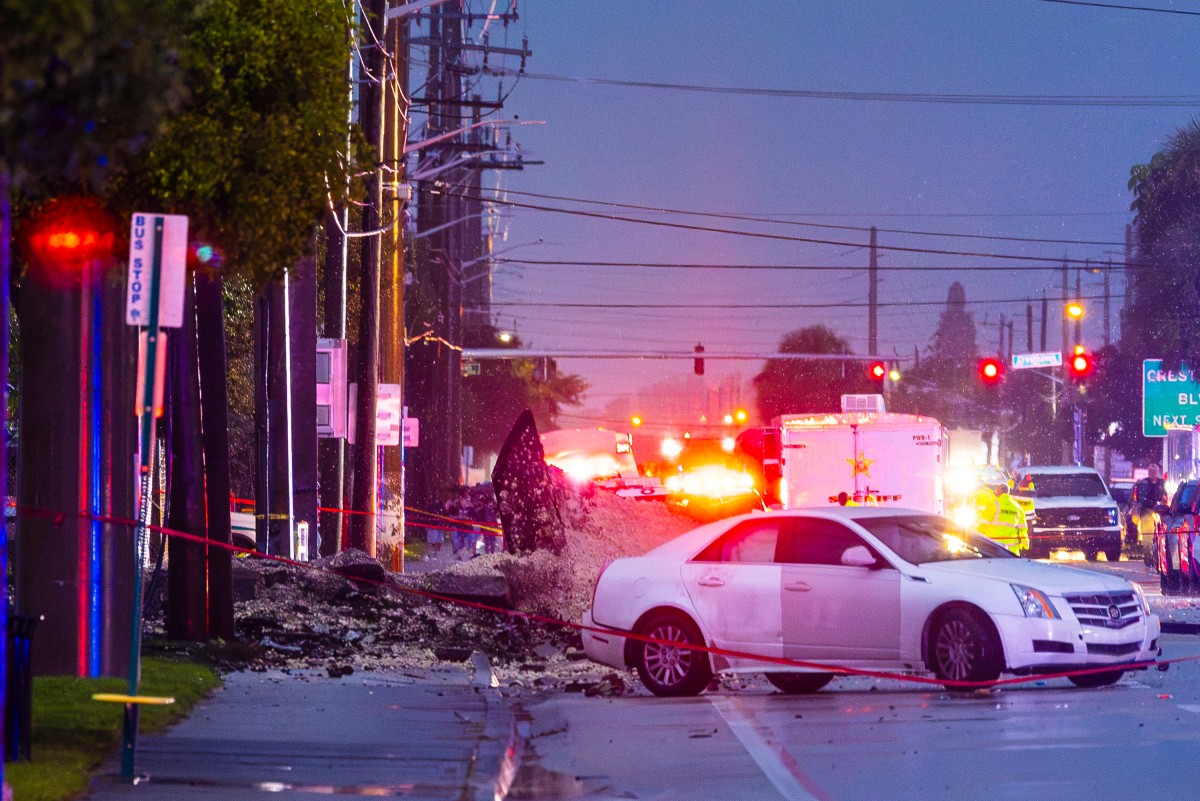
On Sunday, November 1st, a devastating plane crash occurred in South Florida, capturing the attention of the nation. The speed at which the aircraft descended in its final moments prompted the Florida governor to liken it to a missile falling from the sky. Although the authorities have not yet disclosed the cause of the crash, recordings from air traffic control communications provide insight into the events leading up to the disaster, including urgent distress calls from the pilot in the last seconds before impact.
Around 12:50 PM local time on Sunday, a Learjet 60 plunged into a residential area near Cresthaven, Florida, resulting in an explosion that claimed the lives of all nine individuals on board.
According to reports from the Associated Press, the jet was flying east at an altitude of 35,000 feet (approximately 11,000 meters) when the pilot began to report problems. Air traffic control recordings obtained from the aviation communication site LiveATC.net revealed that the pilot informed ground control that the aircraft was encountering icing and turbulence, leading to severe fluctuations in altitude—dropping and rising by as much as 700 feet (213 meters). The region was also experiencing heavy rainfall that day.
In a communication to air traffic control, the pilot expressed, “We are encountering light rime icing, and the situation is manageable; however, we are also dealing with moderate turbulence.”
Soon after, conditions rapidly deteriorated. The pilot requested permission to ascend an additional 2,000 feet (approximately 610 meters), but as the plane continued its alarming descent, the pilot swiftly declared an emergency situation.
Through radio communication, the pilot urgently reported, “We are descending at 8,000 feet per minute—Mayday! Mayday!—We are now descending at 10,000 feet per minute!”
“The aircraft is currently in an overspeed situation, descending at 20,000 feet per minute,” the pilot continued. Moments later, in a chilling announcement, they stated, “We are about to crash.”
Data transmitted from the aircraft indicated that it was nearing an altitude of 9,000 feet (2,743 meters) before it plunged at an astounding rate of over 32,000 feet per minute (9.75 kilometers).
Videos circulating on social media captured the jet colliding with the ground at a terrifying speed, resulting in a massive explosion that created a large crater and ignited fiery debris across the vicinity.
“This is a catastrophic crash,” stated Florida Governor Ron DeSantis at the scene, “It fell like a missile, leaving a massive hole by the roadside.”
Anthony Blackmon, a resident near the crash site, recounted to NBC’s affiliate WTVJ, “There were debris everywhere; pieces hit my house. Everything on the scene was on fire, even the road surface was burning.”
“It’s something I’ve only seen in the news, and I never thought it could happen so close to home,” Blackmon added.
During a press conference the following day, National Transportation Safety Board (NTSB) member Tom Chapman indicated that weather conditions would be a primary focus in the investigation of the crash.
“Everyone has seen the weather conditions on the ground. What we now need to determine is what the weather situation was like at cruising altitude,” Chapman stated.
He further noted that preliminary signs suggest the aircraft had begun to disintegrate before impact.
“We do have some indications that the plane was already experiencing structural failure prior to hitting the ground,” said Chapman. “Details are still pending confirmation. We may discover parts of the aircraft’s wreckage some distance from the actual impact site.”
Timothy Manville, who is overseeing the investigation for the NTSB, commented that the recovery operation at the crash site would extend over several days. Among the considerable challenges faced would be retrieving debris from the crater created upon impact.
“The largest obstacle we face is recovering significant wreckage from the impact crater,” Manville explained.
As of now, the aircraft’s co-pilot has been identified as 20-year-old Nathalia Gadelha Filgueiras. Her mother and stepfather confirmed to the New York Post that she was serving as the co-pilot on the ill-fated Learjet 60.
Local news reports revealed that Filgueiras received her pilot’s license in 2023 at the young age of 17, having been a senior student at West Boca Raton Community High School in Florida.