
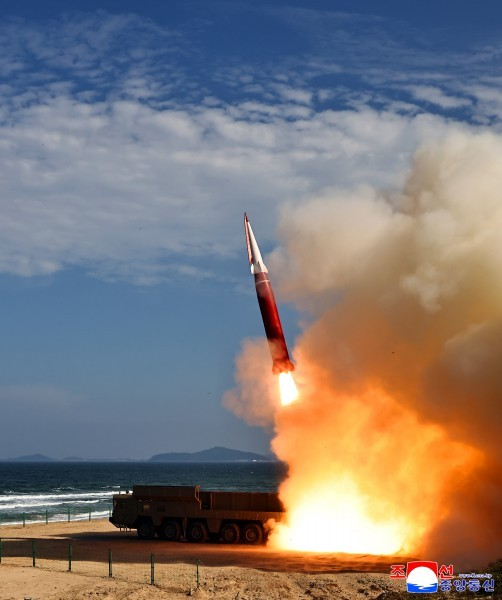
Reports indicate that North Korea conducted a test launch of cluster munitions on Saturday, October 31. According to state media in Pyongyang, a single bomb is capable of striking all targets within a 13-hectare area. The South Korean Joint Chiefs of Staff (ROK JCS) stated on Sunday that intelligence between South Korea and the United States is being shared closely, and they had prior knowledge of the developments, maintaining a state of readiness.
According to an English report from Korea JoongAng Daily, the trial conducted by North Korea’s National Defense Science Institute was aimed at “evaluating the operational suitability and effectiveness of cluster munitions warheads for tactical ballistic missiles.”
Cluster munitions, when detonated in the air, release multiple sub-munitions that spread out and explode, thereby increasing the area of effect and damage.
The report cites North Korean state media, which claimed that the standard model 2 cluster bomb warhead can destroy target areas of between 12 to 13 hectares when in peak density.
An official from North Korea’s missile bureau mentioned that there are four different types of these warheads. However, further details were not provided, nor was the specific type of missile used in this test disclosed.
Reports indicate that Kim Jong-sik, the deputy minister of the Defense Industry Department of the Workers’ Party of Korea, oversaw this test. Notably, Kim Jong Un did not attend.
Official photographs released by North Korea showcased a missile launching from a mobile launcher. Another image displayed multiple munitions striking an island target.
Upon detonation in the air, the cluster warhead released a substantial number of smaller explosive devices, expanding its area of effect significantly.
North Korean media stated that by the end of this year, all military units would be equipped to utilize all types of these cluster warhead munitions in accordance with operational objectives.
The Japan Times highlighted that the missile depicted in the images appears to be a Hwasong-11D.
On the same day, the South Korean Joint Chiefs of Staff reported detecting the launch of missiles from the vicinity of Pyonganbuk-do towards the Yellow Sea. Both South Korea and the United States are closely sharing intelligence and have remained vigilant concerning the situation.
The ROK JCS did not separately announce details regarding this test launch. Analysts noted that due to the short range and low flight altitude of the missiles, the military may require additional time to determine the specific model used in the launch.
Hong Min, a senior researcher at the Korea Institute for National Unification, opined that this test by North Korea represents a final evaluation phase before operational deployment.
Recently, North Korea has made multiple displays of new weaponry. On Thursday, October 29, North Korea held a drone technology exhibition that featured attendance from Kim Jong Un.
On the same day, during a summit in South Korea attended by German Chancellor Friedrich Merz, North Korea launched around ten ballistic missiles from its east coast towards the sea.
Furthermore, according to reports from Agence France-Presse (AFP), North Korea has recently tested attack drones, new precision-guided torpedo systems, and medium-range hypersonic missiles.
Analysts believe that North Korea is likely drawing lessons from Russia’s experiences in the Ukraine conflict. Simultaneously advancing its nuclear arsenal, the country is also strengthening its development of drones, naval capabilities, and conventional strike forces.