
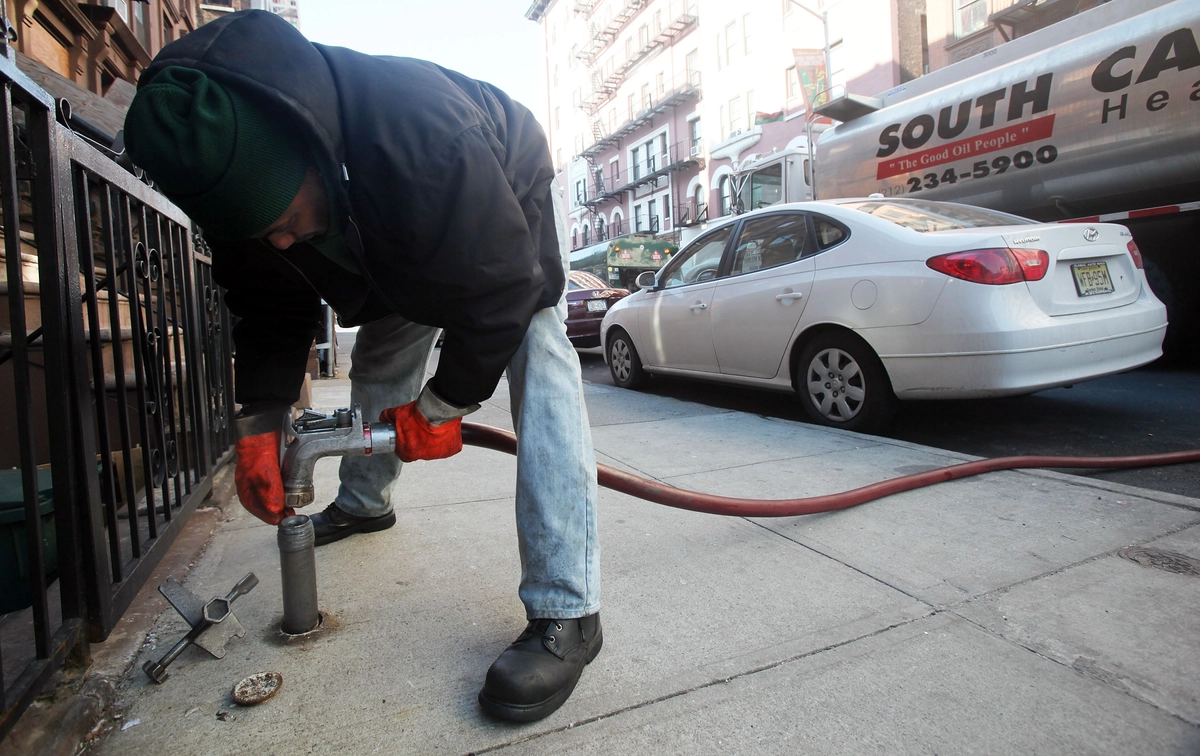
If your home is heated using oil, you may face a significant increase in heating costs this winter. The U.S. Energy Information Administration (EIA) forecasts that households relying on heating oil will see their expenses rise by approximately 21% compared to last winter.
This prediction is based on average costs for typical households, but your actual expenses will depend on various factors such as the size of your oil tank, your supplier, and prevailing weather conditions. The capacity of your oil tank determines how much fuel you can purchase in each delivery, but it does not dictate the total amount of fuel consumed throughout the heating season.
Despite the EIA’s alarming forecast, there is still time to plan before the coldest months set in.
According to the EIA’s “Winter Fuels Outlook,” the average heating bill for households using oil from November to March is expected to hit around $2,115, marking a 21% increase from the previous year.
The average price of heating oil is projected to reach $5.26 per gallon, representing a 34% increase compared to last winter.
However, due to milder winter weather expected in the northeastern United States, the consumption of heating oil is anticipated to decrease by approximately 9%, bringing it down to around 402 gallons. While this reduction may alleviate some of the burden from rising costs, it will not be enough to offset the majority of the price increases.
Heating oil belongs to the distillate fuel family and shares a fuel category with diesel. Many refineries around the globe have cut back on production, leading to a decline in global distillate output and driving up international market prices.
At the same time, the cost of imported heating oil in the U.S. has also risen as demand for American fuel supplies increases overseas. As winter approaches, U.S. distillate inventories are currently at low levels.
Unlike natural gas and electricity, heating oil prices are not subject to regulatory controls. This means that fluctuations in wholesale prices are quickly passed down to retailers, often fully reflected in retail prices within four to six weeks.
As a result, the quote you receive in October could look quite different by January, with prices varying in either direction.
Monthly forecasts released by the EIA indicate that heating oil prices are expected to gradually decline throughout the winter, but January will remain the most expensive month for heating oil due to the highest consumption levels during that period.
It is important to note that these projections assume households will purchase fuel at market prices during actual usage.
The forecasts do not take into account households that have pre-purchased oil or those that have locked in prices through contracts. Consequently, your actual expenses may be higher or lower than the averages mentioned.
In the United States, approximately 4.1 million households, accounting for about 3% of the total number of U.S. households, primarily rely on heating oil as their heating fuel, with the majority concentrated in the Northeast.
In contrast, the fluctuations in winter costs for other primary heating fuels are expected to be much smaller, with some fuel types predicted to see price declines.
However, these average figures alone do not provide sufficient justification for switching fuels.
Additionally, each household’s circumstances differ greatly in terms of size, insulation quality, equipment, and lifestyle habits. Therefore, a lower average fuel price does not necessarily translate to a reduced bill for any particular home.
Weather remains the most significant variable impacting heating oil bills.
The EIA anticipates that this winter, the northeastern U.S. will experience temperatures around 12% milder than last year. This forecast is based on the Heating Degree Days (HDD) index, which measures the degree to which average daily temperatures fall below 65°F (approximately 18.3°C) over a specific period.
In contrast, the weather in the western U.S. is expected to be considerably colder this winter.
Furthermore, the National Oceanic and Atmospheric Administration (NOAA) has indicated that this winter could see the emergence of a strong El Niño phenomenon, suggesting that actual weather could vary significantly from current predictions.
Cold weather could also further elevate fuel prices, particularly given the already low inventory levels.
The EIA forecasts that from November to March, the average price of heating oil will reach $5.26 per gallon, a 34% increase from the previous winter.
Prices in November are expected to average around $5.79 per gallon, gradually declining to approximately $4.84 by March of the following year.
It is anticipated that households using heating oil this winter will reduce their fuel consumption by about 9%, primarily due to the milder winter weather projected for the northeast.
However, the rise in the price of heating oil per gallon far exceeds the reduction in fuel usage, leading to an overall estimated increase of about 21% in total heating expenses for households.
For families relying on natural gas for heating, average costs are expected to be about $640, significantly lower than the projected $2,115 for those using heating oil.
Nonetheless, variations in home size, insulation performance, and heating equipment can cause significant discrepancies, meaning that this average cost comparison may not apply uniformly to every household.
Moreover, transitioning heating systems involves upfront expenditures on equipment purchase and installation.
In the heating oil market, prices are not regulated like those for natural gas and electricity, allowing fuel dealers to adjust retail prices in response to changes in wholesale prices.
Signing a fixed-price contract can help consumers shield themselves from rising costs; however, if market prices drop afterward, consumers may miss out on potentially lower prices.
There are programs available, such as the Low-Income Home Energy Assistance Program (LIHEAP), which offers assistance to eligible households with energy costs.
Each state sets its own application rules and grant amounts. It’s recommended that residents contact their state’s energy assistance department or local Community Action Agency to learn about eligibility criteria, specific grant standards, and application deadlines.