
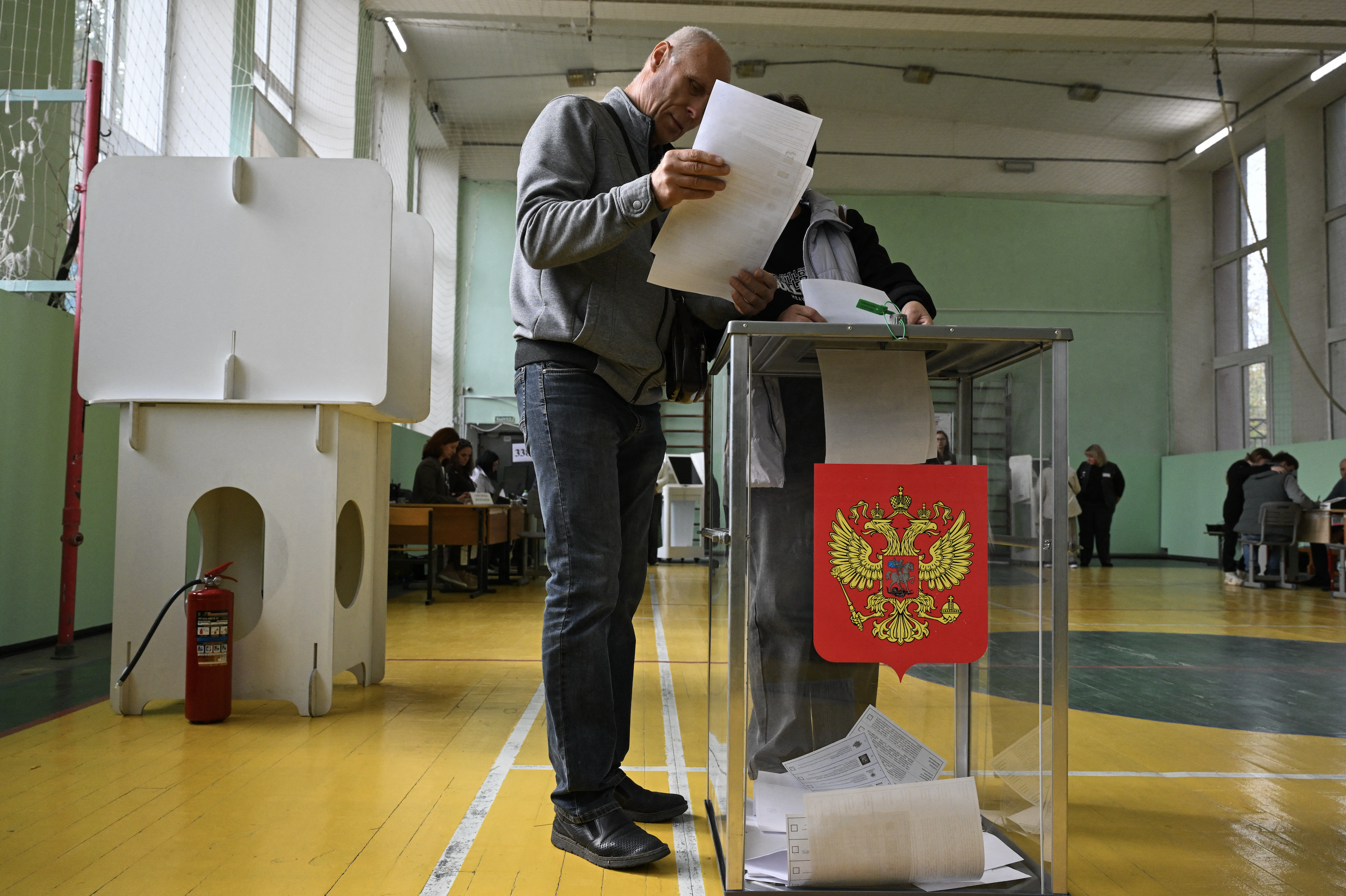
Russia held a three-day parliamentary election, with over 95% of the votes counted by Monday, September 21st, leading to a landslide victory for the “United Russia Party” led by Putin. However, analysis suggests that the election results also contain signals unfavorable to the Kremlin.
The Central Election Commission of Russia announced on Monday that President Putin’s United Russia Party received 57.83% of the vote, up from 49.8% in the 2021 elections, projected to win 225 seats.
The election for the State Duma, the lower house of parliament, began last Friday and concluded last Sunday.
The State Duma has 450 seats, with 225 allocated through party lists and another 225 elected from single-mandate districts. United Russia Party is expected to win in the majority of the single-mandate districts as well. In the 2021 State Duma elections, United Russia Party secured 326 out of the 450 seats, maintaining an absolute majority.
TASS reported that the final results of this election may be announced by Friday, with all votes and required legal procedures expected to be completed by then.
This election took place in a tightly controlled political environment in Russia. Since the invasion of Ukraine in 2022, several anti-war activists in Russia have been banned from running in elections, and political forces opposing Putin’s policies have faced further restrictions.
According to Al Jazeera, some candidates from the liberal Yabloko party expressed concerns that they may lose their freedom after the election. Previously, two senior members of the party were sentenced to long prison terms for publicly discussing the Russia-Ukraine war.
Nikolai Rybakov, the leader of the Yabloko party, symbolically invalidated his ballot by writing the party’s name and the slogan “For peace” on it, expressing his dissent.
The EU has condemned the election as being held under an atmosphere of “systematic and institutionalized repression.”
Currently, the Communist Party of the Russian Federation (CPRF) has about 13.84% of the vote, the Liberal Democratic Party of Russia (LDPR) around 8.9%, the “New People” party around 7.94%, and “A Just Russia” about 4.95%.
These parties typically do not strongly oppose the Kremlin on major policy issues in parliament, and are expected to gain seats in the State Duma.
Although the election results indicate a predictable trend, the think tank NEST, based in Berlin and co-founded by Kremlin critic Mikhail Khodorkovsky, pointed out that the consequences of the war are increasingly evident domestically, with people’s pent-up anxiety and frustration translated into votes for “within-the-system opposition parties” left on the ballot.
In Moscow, 30-year-old programmer Igor Safonov told AFP that he voted for the New People party because he “didn’t want to vote for United Russia Party.”
The Russian election has also sparked strong condemnation from Ukraine. Russia allowed residents in areas including Donetsk, Luhansk, Kherson, and Zaporizhia to participate in the voting. Russia annexed these Ukrainian territories in 2022, a move not recognized by the UN and most countries globally.
Crimea was annexed by Russia in 2014, similarly not widely recognized by the international community. The Ukrainian government denounced Russia’s holding of elections in these regions as illegal actions.
Russia, on the other hand, accused Ukraine of attempting to disrupt the elections.
Last Sunday, Ukrainian drones carried out attacks on Moscow and other areas in Russia. According to TASS, this was one of the largest drone attacks since the Russia-Ukraine war erupted in February 2022. Moscow region government and Russian election officials reported three deaths in the Moscow region, and two deaths in parts of Kherson controlled by Russia, including an election official.
A refinery facility in Moscow that had previously been attacked also sustained damage. On Monday morning, Yegor Kovalchuk, acting governor of the Bryansk region in Russia, stated that the area was targeted by Ukrainian drone attacks, resulting in one death and three injuries.