
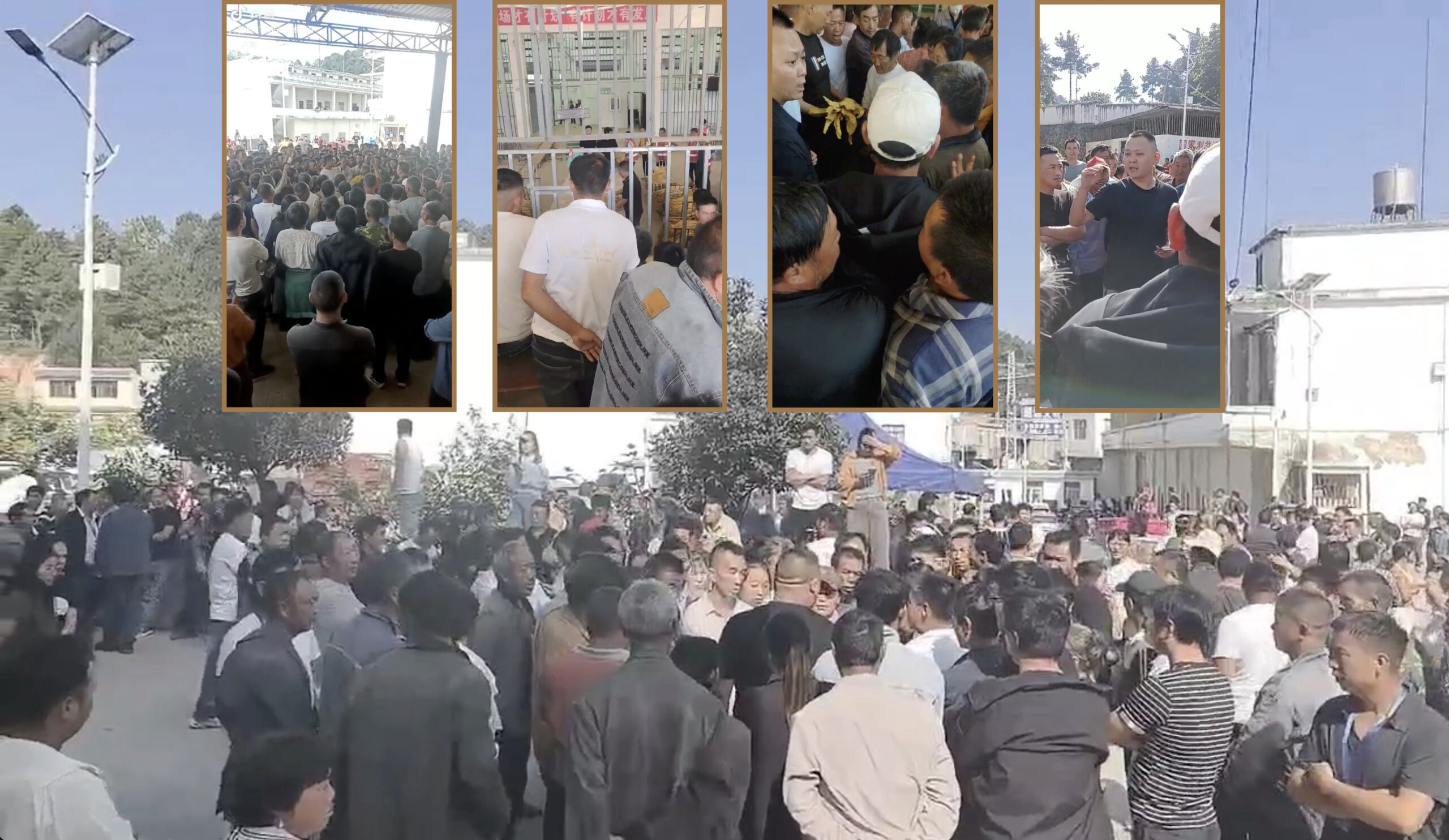
Recent tightening of official tobacco leaf procurement standards in various parts of China has sparked dissatisfaction among tobacco farmers. Some tobacco leaves have been downgraded and even refused for purchase, leading to protests by tobacco farmers in Yunnan. Farmers have expressed that this year, despite investing tens of thousands of yuan into tobacco, they may only receive back a fraction of their investment. Non-fulfillment of subsidies for many years has further worsened their financial situation.
In Yunnan province, tobacco farmers have gathered in protest due to stricter procurement standards and downgrading or refusal of tobacco leaves at purchase stations. Hundreds of farmers in Longjie Township, Yiliang County, and other areas like Yongfeng and Yunxian have protested against these actions.
During the procurement process this year, tobacco leaves have been strictly graded and undervalued, with some lower-quality leaves even being rejected. Farmers have reported instances where after grading and weight deductions, their final income was significantly reduced, leading to cases of farmers damaging or burning tobacco leaves in certain regions.
In addition to on-site protests, some tobacco farmers in Longjie Township have resorted to submitting formal petitions in writing. According to a petition submitted by tobacco farmers in Yiliang County, the procurement standards for tobacco leaves in 2026 differ significantly from those of the past decade. Farmers claim that they were not adequately informed about the new standards when signing planting and procurement contracts earlier in the year.
The petition indicates that this year’s standard adjustments are not minor tweaks but an overall overhaul of the grading system. Farmers state that the stringent grading and undervaluing of tobacco leaves, with some lower-quality leaves being refused, have led to financial losses for them.
Behind the protests and petitions that have swept through various areas of Yunnan, tobacco farmers have been sharing their firsthand experiences. Yang Diansheng, a tobacco farmer from Longjie Miao and Yi Township in Yiliang County, has been growing roasted tobacco for about 30 years and is currently in the midst of the harvesting season. He mentioned that this year’s tobacco leaf procurement has been notably stricter compared to previous years.
He revealed that recently, hundreds of local farmers went to the tobacco station to demand clarification on the significant disparities between the procurement standards and the contracts they had signed. According to him, similar activities have been taking place across Yunnan, indicating widespread discontent among farmers who have suffered substantial losses and organized to seek explanations.
Regarding the sudden tightening of procurement standards this year, Yang Diansheng believes it is related to the overall operating environment of the tobacco industry. He pointed out that surplus inventory in tobacco companies plays a significant role in the changes seen in procurement standards this year.
Yang Diansheng highlighted that the changes in procurement standards have been dramatic, shifting from a situation where profits were possible to one where many farmers are likely to operate at a loss. He shared his concerns about potentially losing money this year, emphasizing the challenging economic conditions faced by tobacco farmers.
In the face of adversity, tobacco farmers like Chen Yunhai have echoed similar struggles. Chen Yunhai, a tobacco farmer from Yiliang County in Zhaotong, expressed disappointment in this year’s procurement situation, remarking that the strict standards are making it nearly impossible for local farmers to break even.
Chen Yunhai, who planted 37 mu of tobacco this year, noted that despite completing two rounds of sales, his income has significantly decreased compared to the same period last year. He lamented the reduced purchasing prices for this year’s tobacco leaves, making it financially untenable for most local farmers.
Apart from the changes in procurement prices and standards, Chen Yunhai also mentioned a reduction in the official subsidies available to farmers in recent years. He highlighted how the promised subsidies from tobacco companies have not materialized, adding further financial strain on farmers already facing a challenging market environment.
For households relying on tobacco farming as their primary source of income, the outcome of tobacco sales directly impacts their everyday lives. The current procurement situation has not only made it challenging for farmers to turn a profit but has also made it difficult for them to recoup their basic investments, putting additional pressure on families to make ends meet.
These challenges in Yunnan are mirrored by the experiences of Peng Shaohua, a tobacco farmer in Liuyang, Hunan, who encountered different difficulties with this year’s procurement regulations. Peng Shaohua pointed out the stringent procurement requirements this year, where tobacco stations limited the quantity purchased per acre, creating obstacles for farmers like him who have planted significant areas.
Moreover, Peng Shaohua found that even if the surplus tobacco leaves were of better quality, they were often not accepted for purchase. This posed a dilemma for tobacco farmers like him, who had invested time and substantial amounts of money into their harvests.
The structural changes in the Chinese tobacco industry extend beyond individual farmers and confront the entire industry. Data from the China National Tobacco Association indicates a decline in tobacco planting areas and production volumes in recent years. As part of international commitments related to tobacco control, China has been encouraging tobacco farmers to transition to alternative crops.
Despite the reduction in tobacco cultivation areas, the tobacco industry remains a crucial source of revenue for the Chinese government. The escalating profit-sharing ratio for state-owned tobacco enterprises signifies a shift in financial dynamics within the industry, indicating a push towards increasing contributions to government coffers.
The evolving landscape of the tobacco industry in China not only impacts farmers but also reflects broader changes in consumption patterns and government economic policies. As the industry navigates these transformations, tobacco farmers find themselves at the forefront of economic challenges, grappling with uncertain futures in an industry undergoing significant shifts.