
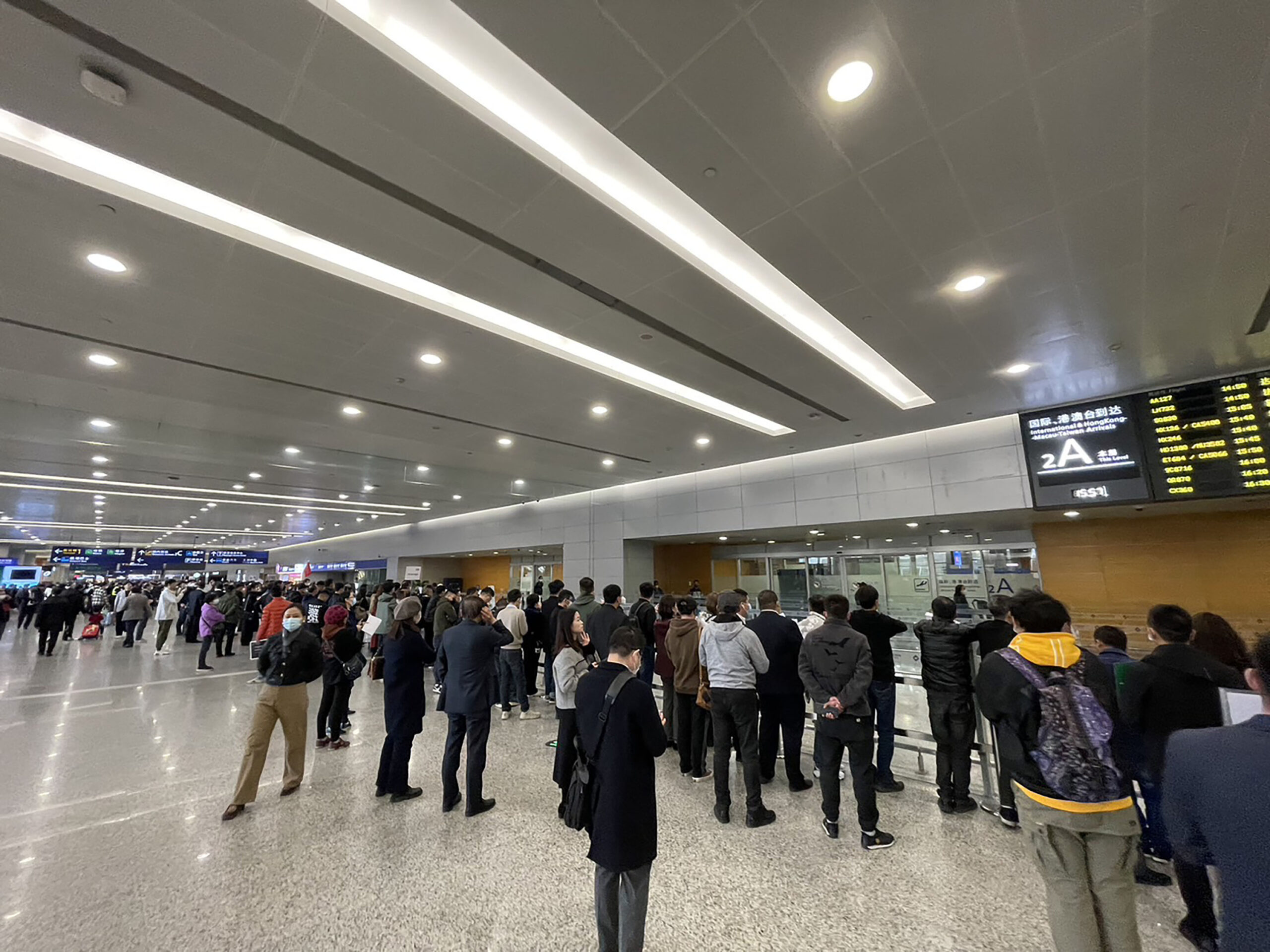
The new regulations on entry and exit management by the Chinese Communist Party have officially taken effect, with the immigration clearance process at the international airports in Shanghai and Beijing proceeding smoothly on the first day of implementation.
Some passengers have reported that there were no abnormalities during the clearance process on that day, while on-site staff mentioned an increase in the frequency of inquiries by border control officers. The new regulations allow authorities to request individuals to provide “electronic data and other information,” raising concerns among interviewees about potential inspections of personal communications and corporate data.
On the morning of September 15th, at around 10 o’clock, the departure hall of the second terminal at Shanghai Pudong Airport had a relatively normal flow of passengers heading to Tokyo, Singapore, and Seoul.
Ms. Zhao, who frequently travels between Shanghai and Hong Kong, stated, “I did not notice anything abnormal during my clearance, probably because I used the electronic channel and did not require manual document verification. Passengers holding the old version of paper passports had to go through the manual channel.”
Mr. He, a staff member at Shanghai Pudong Airport, informed the media that the inspection measures had already been in place, with September 15th marking the official adoption of the regulations at a legal level. He mentioned, “The situation today is similar to normal days, as the new regulations have been internally implemented for some time. Border control officers are conducting more detailed checks on first-time outbound travelers, including random inspections of passengers’ phones and computers.”
He stated that on that morning, there was an increase in the frequency of inquiries by border control officers. Although he did not witness any passengers being taken away for further investigation on-site, he added, “But that doesn’t mean no one was taken to the ‘small rooms’ that day.”
A netizen surnamed Yao, who arrived in Hong Kong from Shanghai on September 14, shared that a friend of his, holding a Chinese passport traveling from Shanghai to the United States for a family visit, was questioned by border control officials during departure. According to his friend, “Yesterday (September 14) in Shanghai, border control officers asked him about activities aside from visiting the US, how many days he intended to stay, whether he had purchased a return ticket, and inspected his phone and WeChat.”
Border control officers in Shanghai have previously conducted random phone checks during the inspection process. Yao noted that the new regulations allow relevant authorities to request electronic data from individuals, but it is not clear under what circumstances border control officers can ask travelers to provide such information. He added, “Before each entry and exit, I now check my phone for sensitive photos, uninstall apps like Facebook and X to avoid trouble and provide explanations if needed.”
On the first day of the new regulations’ implementation on September 15, a staff member at Beijing Capital International Airport mentioned that the airport’s order was generally normal, but there were fewer outbound passengers from T2 and T3 terminals compared to previous days. He stated, “In recent days, it seems that the outbound flow of people is not as high as before. It is said that after the new regulations were implemented on September 15, many people chose to depart from other airports, fearing strict checks at the Beijing port.”
Beijing is one of the cities in China with a concentration of professionals in the technology and finance industries, and Beijing Capital International Airport is one of the main ports for local residents to depart. Industry insiders point out that compared to airports in other cities, security checks at airports in Beijing and Shanghai are relatively strict. In recent years, some travelers have chosen to depart from airports in cities such as Hangzhou, Wuhan, and Chengdu.
On July 31, the State Council of the Chinese Communist Party announced the “Regulations on Entry and Exit Management” involving procedures for applying for entry and exit documents, verifying identity and reasons, and restrictions on departures. According to Article 3 of the regulations, relevant authorities can “require individuals to present, provide documents, data, and electronic information, etc.” Some inbound and outbound travelers are concerned that these regulations may affect their normal departures.
According to Article 4 of the new regulations, if Chinese citizens violate export control or technology import and export management regulations that may endanger national industrial security and technological security, the competent authorities of the State Council of the Chinese Communist Party and other relevant departments may decide to prohibit them from leaving the country.
Shanghai-based lawyer Mr. Huang expressed to reporters that the legislative approach of the new entry and exit management regulations aligns with the “overall national security concept” proposed by the Chinese Communist Party in recent years, with relevant measures aimed at maintaining the current regime. He stated, “A characteristic of authoritarian systems is the fear of threats to power. Whether it’s regulations or methods introduced by the Chinese Communist Party, they serve as defensive tools for the regime. The expressions such as export control, technology control, and national security can ultimately be implemented as restrictions on individuals entering and exiting to prevent challenges to their governance.”
State media outlets of the Chinese Communist Party previously stated that the notion of a “comprehensive tightening of ordinary people’s departures” was a misinterpretation of the new regulations, sparking ridicule among netizens.