
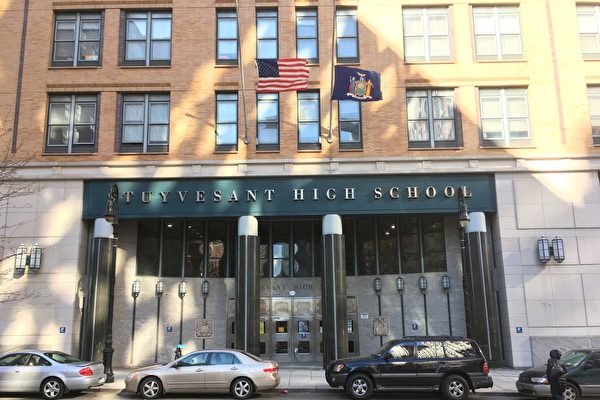
New York City Council members Lincoln Restler and Nantasha Williams recently proposed the “Special High Schools: Excellence and Integration Plan,” advocating for reforms to the admissions system of five specialized high schools, adjustments to the Discovery Program, and pushing for the abolition of state regulations that mandate the use of the Specialized High Schools Admissions Test (SHSAT) as the basis for admissions.
The New York City Parents Union (CACAGNY) issued a statement on September 14, criticizing the two council members for lacking the ability and intention to improve some of the “schools that even students are not willing to attend,” while seeking to weaken the specialized high schools and the selective admissions system. They pointed out that no other high school admissions standard has produced 15 Nobel Prize winners, emphasizing that the SHSAT is an objective exam that does not consider ethnicity or background, and should not attribute the issue of ethnic diversity in specialized high schools solely to the test itself.
The “Excellence and Integration Plan” proposed by the two council members includes eliminating the SHSAT as the sole admission criteria for certain specialized high schools, opting for a comprehensive evaluation that includes academic performance, teacher recommendations, essays, and applicant backgrounds. They also suggest increasing the number of seats in specialized high schools, improving access to advanced mathematics in middle school and exam preparation resources to provide more opportunities for students from low-income communities to apply.
“This is a shameless attack on New York City’s top schools,” said Wai Wah Chin, founder and president of the Parents Union, in a statement to the press. “When the entire education system is full of holes, they choose to divert attention by punishing those poor, hardworking, focused, and intelligent students. We must fight back against this behavior.”
The Parents Union pointed out that the most direct way to improve is to expand the capacity of specialized high schools and increase the number of seats within the framework permitted by the Hecht-Calandra Act, rather than altering admission standards.
The parent organization, PLACE NYC, also issued a statement on September 14, opposing three major measures in the reform plan, believing that the reforms could weaken merit-based admissions systems. However, they support increasing specialized high school seats, expanding advanced math courses, and improving free SHSAT preparation resources.
The plans of the two council members aim to change the admissions process of five specialized high schools, including Staten Island Technical High School, Manhattan Academy of Mathematics and Science, Queens School of Science, Bronx School of American Studies, and Brooklyn Latin School. These schools collectively account for about one-fourth of all specialized high school seats in the city.
The council members proposed incorporating middle school academic performance, teacher recommendations, applicant backgrounds, and essays into the admissions process. PLACE NYC argues that these criteria involve more subjectivity, whereas the standardized and anonymous SHSAT provides a more objective and clear basis for admissions.
The reform proposal by the council members also suggests adjusting the Discovery Program, concentrating eligibility within 15 of the city’s 32 community school districts. Currently, around 20% of admissions to specialized high schools are provided through the Discovery Program to students whose SHSAT scores are slightly below the cut-off and who qualify as low-income. PLACE NYC believes that restricting eligibility by location may exclude more low-income students.
Furthermore, the two council members have introduced a resolution to the city council, urging the state government to abolish the state laws that require some specialized high schools to use SHSAT for admissions. PLACE NYC believes that eliminating the SHSAT cannot solve the fundamental problem of differing levels of preparedness among students in different communities and that the focus should first be on expanding advanced middle school courses and exam preparation resources.
However, PLACE NYC supports some recommendations in the proposal, such as increasing the number of seats in five smaller specialized high schools, expanding advanced math courses from sixth grade, allowing more eighth-grade students to take Algebra I, and improving the free SHSAT preparation program, DREAM.
PLACE NYC also urges the Department of Education to introduce specialized high schools to students early, especially in middle schools where fewer students participate in the SHSAT, starting from sixth grade to introduce students and parents to specialized high schools and the admissions process.