
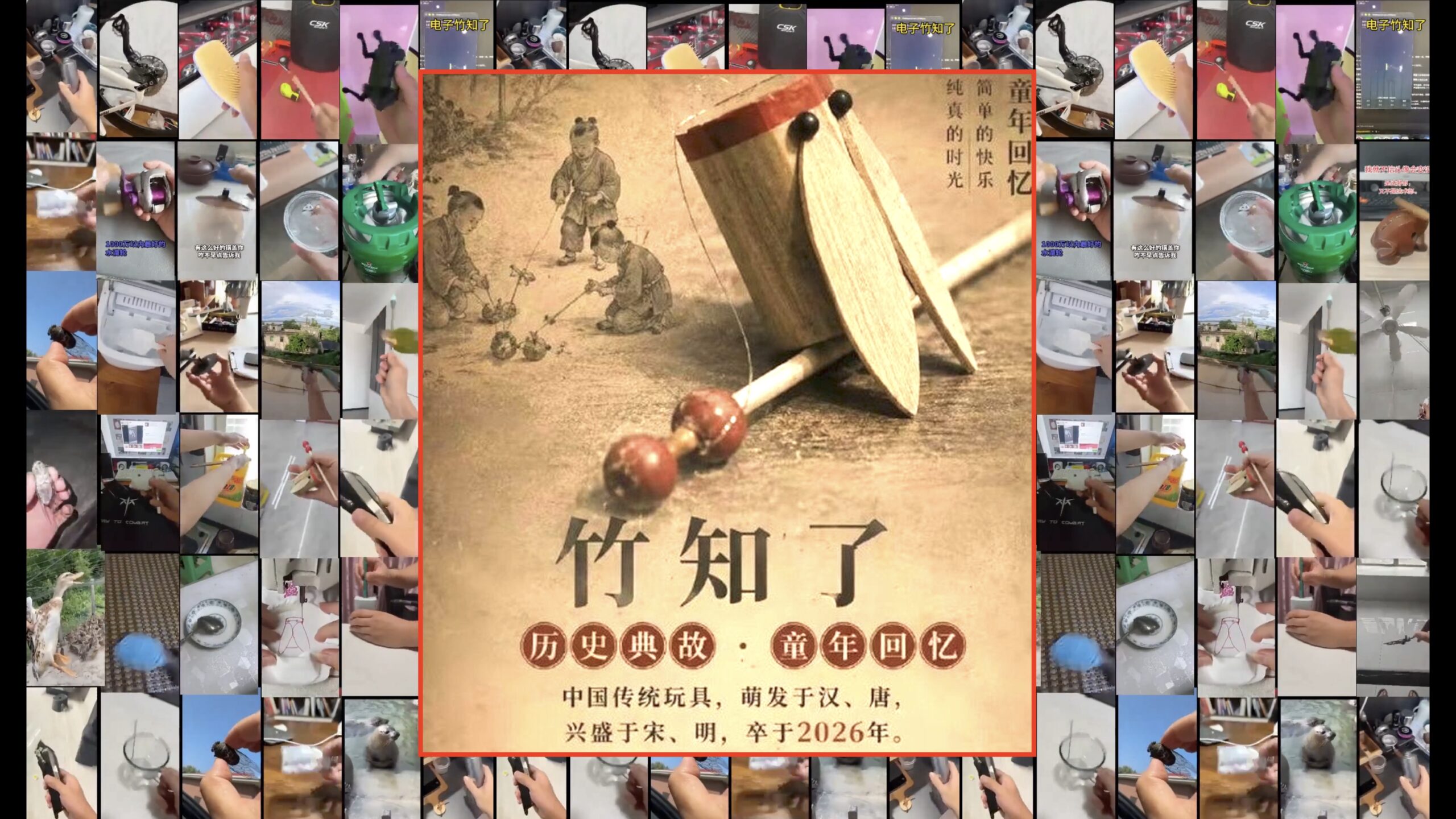
A small folk toy called “Bamboo Cicada” recently triggered an unexpected explosion of public opinion on the Chinese mainland.
The “Wow Wow” sound made by “Bamboo Cicada” was deemed highly similar to the exclamation sound at a Huawei product launch event, leading to a large number of netizens using this reference for parody and creative content.
Despite Huawei’s subsequent large-scale complaints about related content, the Cyberspace Administration of China recently announced plans to clean up the online environment and enhance scrutiny, sparking even greater backlash. This turned the “Bamboo Cicada” incident into a reflection of corporate PR, Chinese Communist Party’s media control, and social phenomena of public sentiment venting.
Analysis indicates that Chinese netizens found an excellent outlet for expressing dissatisfaction through the battle between the small “Bamboo Cicada” and Huawei, indirectly resisting the authoritarian rule of the CCP.
No one could have foreseen beforehand that a small toy like “Bamboo Cicada” would cause such significant social turbulence, evolving into a situation where netizens collectively mocked Huawei and indirectly countered CCP’s media censorship.
From the late July to early August of 2026, a small toy named “Bamboo Cicada” circulated on the mainland Chinese internet, emitting a chirping sound reminiscent of a cicada when shaken.
There had long been a saying on the Chinese mainland internet about Huawei product launches where the audience would exclaim “wow” in mockery of Huawei deliberately hyping the atmosphere at events.
Netizens discovered that the sound produced by “Bamboo Cicada” was highly similar to the astonished sounds heard at Huawei CEO Richard Yu’s 2023 HarmonyOS and Automotive Product Launch event.
This coincidence immediately sparked a wave of imitation and creative content production among Chinese netizens. For example, short videos such as “The Best Toy Under 10 Million” spread on platforms like Douyin, setting a record with over 3000 similar videos created in a single day.
In response to the rising tide of mockery online, Huawei launched a massive campaign to report such content to major social media platforms.
According to reports from Bloomberg and other media outlets, on August 4, a Huawei spokesperson for HarmonyOS announced complaints against 171 out of over 56,000 related comments, alleging various forms of derogatory references and parodies towards the company and its executives.
Jiang Pinchao, editor of “The Poems of June Fourth” and a writer at the Library of Congress, pointed out in an interview with Dajiyuan that large companies in China are essentially extensions of the state. He stated that their PR awareness is particularly poor, lacking humor and unable to take a joke.
He mentioned that Chinese officials, government agencies, and large state-owned enterprises have a mentality of “I am the world’s number one, how dare you joke with me?” They lack the ability to accept humor.
Lai Rongwei, CEO of the Taiwan Inspiration Association (TIA), also told Dajiyuan that “Huawei is a CCP-owned company, used by Xi Jinping to promote nationalism and maintain regime stability.” The methods used by Huawei in this matter are similar to those of the CCP, which will lead to public backlash.
Lai Rongwei stated that the concept of national security in the CCP is expanding continuously, with administrative jurisdiction growing infinitely. In this context, as long as the government wields the sword of national security, law enforcement can be ubiquitous and all-encompassing.
Explaining further, Lai Rongwei emphasized that Huawei’s resort to so-called legal measures against ordinary citizens is a sign of its lack of confidence in its products. This behavior would only alienate the public further, affecting sales and operating like a “self-defeating strategy”.
As of August 3, Weibo has classified terms related to “Bamboo Cicada” as sensitive, subjecting them to thorough monitoring. Platforms like Douyin, Kuaishou, and Xiaohongshu have issued numerous warnings to users. This approach has stirred up public opinion, with some viewing it as excessive protection and exaggerated response.
However, Huawei’s complaints and platform monitoring have not deterred netizens but rather intensified their resistance. The banning of “Bamboo Cicada” has only fueled its popularity, leading to a surge in demand with the toy becoming extremely sought after.
Many netizens continue to create videos expressing their opinions, using various means to vent their feelings. Some individuals have even gone to Huawei stores to spin the “Bamboo Cicada” in front of them, while others imitate its sound using bottle caps and pot lids.
Chinese netizens extensively mocked Huawei through the “Bamboo Cicada,” prompting Jiang Pinchao to believe that they are no longer afraid of the CCP authorities.
He noted that in the past, ordinary people had no way to voice their grievances, but with the internet, they can now express their opinions through comments and shares. Despite the CCP’s attempts to suppress them, these ordinary people are like ants, driving away a portion only to be replaced by more.
He stated, “Previously, they couldn’t speak out, but now they don’t care about life or death. If you try to suppress them, they will push forward more boldly. The more you suppress, the more resistances will arise, ultimately leading to a public relations failure.”
One simple toy like “Bamboo Cicada” managed to prick the fragile ego of Huawei. Chinese netizens, in their tenacity during the “Bamboo Cicada” incident, found an exceptional outlet for their pent-up grievances.
The reason behind Chinese netizens’ strong reactions in the “Bamboo Cicada” incident, according to Jiang Pinchao, is that ultimately “Huawei is not equivalent to Xi Jinping.” The restrained Chinese netizens located a perfect outlet for expression when dealing with Huawei.
In reality, “Chinese people are too kind-hearted, too afraid of evil forces. They have been holding back their grievances,” unable to resist the CCP government. However, “this time, it’s Huawei, not the CCP government. They found an outlet; they can confront the CCP.”
Jiang Pinchao emphasized, “When the people are not afraid to die, how can you intimidate them with death? Now, I am no longer afraid of you. This is why Huawei is at a loss on how to manage the situation.”
He further analyzed that Huawei cannot immediately arrest these individuals or progress to the point of incarceration and trials. Thus, Chinese netizens are leveraging their creativity to engage in a struggle with Huawei.
The root cause lies in the longstanding accumulation of grievances without an outlet for expression, which has now found a release through this episode, prompting an emboldened confrontation with Huawei.
The incident involving “Bamboo Cicada” is yet to receive any official stance from the CCP authorities. However, according to reports by mainland Chinese media on August 4, the Cyberspace Administration of China will carry out a specialized operation to “purify and optimize the business network environment, rectify malicious dissemination of enterprise-related information.”
On August 5, the WeChat public account of the Zhejiang Provincial Committee of the CCP published an article stating that although the “Wow Wow” sound was chaotic, tolerating the noise demonstrated a form of confidence.
Political commentator Tang Jingyuan believed that the purpose of this article was to maintain stability, affirm Huawei’s position and rights, dampen public opinion intensity, weaken responses, and depict the event as a minor emotional outburst, minimizing public sentiment.
Jiang Pinchao shared the same view, indicating that “Huawei is a business card for China, representing a fundamental tool of the CCP.” Whoever “harms the national treasure” challenges the CCP’s rule. Therefore, the CCP must “secure the position of Huawei to prevent it from being harmed by small ant-like individuals.”
Regarding Huawei’s rights-protection actions this time, Jiang Pinchao considered it as “essentially a form of maintenance for the CCP, a disguised form of stability maintenance.”
He emphasized that the public in China is extremely fed up with the CCP’s “monopoly on the market and the discourse.” This is why the “Bamboo Cicada” and “Wow Wow” uproar erupted on the Chinese internet.
Jiang Pinchao noted that over twenty elite families monopolize the Chinese economy under the CCP, and companies like Huawei serve as tools for these privileged families. The CCP must “uphold the image of Huawei, ensuring that this brand is not tarnished,” despite the suppression affecting the rights of ordinary people and their freedom of speech.”