
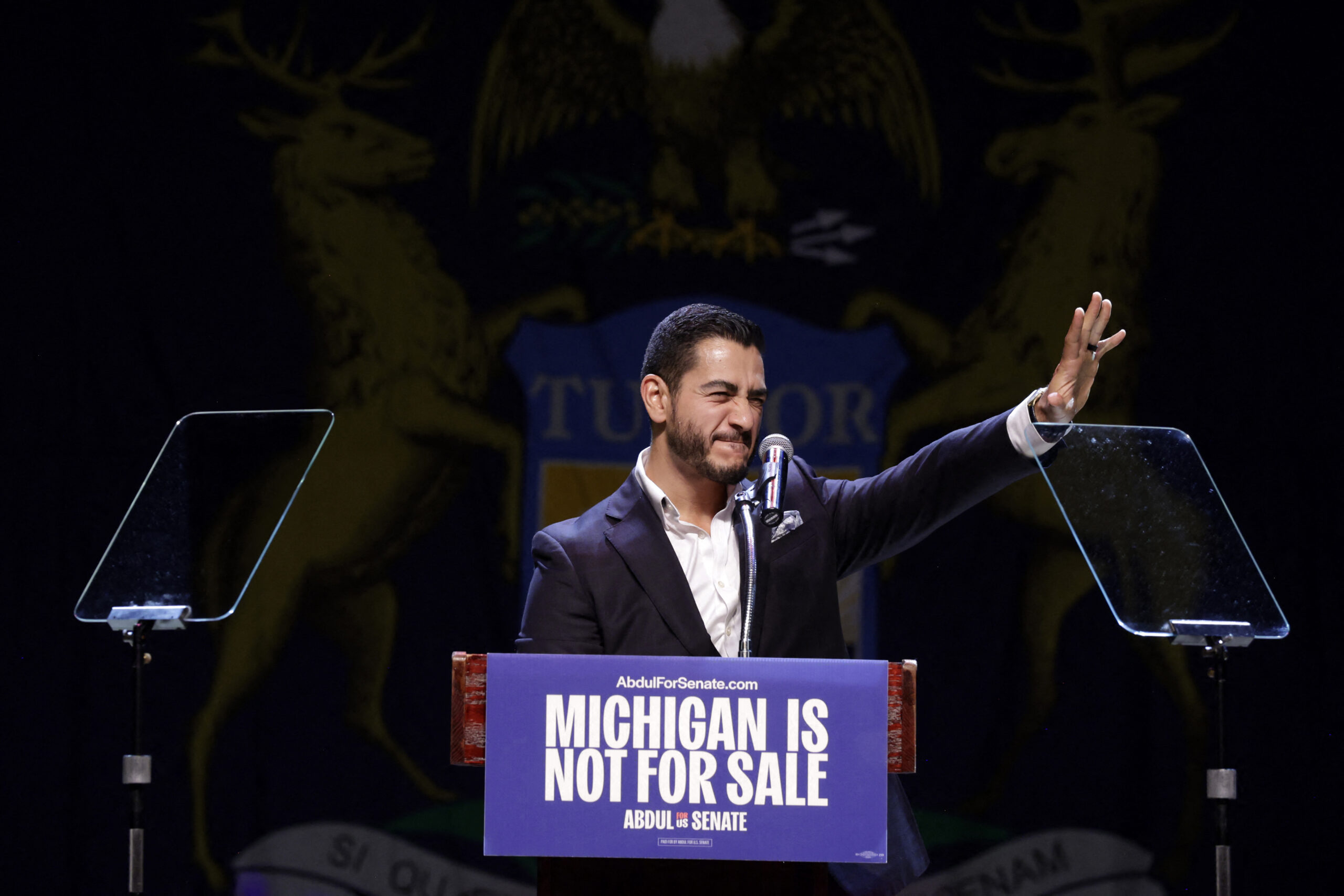
On August 5, 2026, according to NBC News, progressive candidate Abdul El-Sayed is predicted to defeat moderate federal congresswoman Haley Stevens and secure the Democratic nomination for the U.S. Senate from Michigan.
El-Sayed is expected to face off against Republican nominee and former federal congressman Mike Rogers in the upcoming midterm elections. This Senate seat, left vacant by the retirement of Democratic Senator Gary Peters, is considered a key battleground for both parties to gain control of the Senate.
As of the time of reporting, some ballots in Michigan are yet to be fully counted, and the official winner has not been confirmed. However, based on existing vote counts and the distribution of remaining votes, NBC News has forecasted El-Sayed to win the Democratic nomination.
According to Decision Desk HQ’s data, as of 4:37 am Eastern Time on Wednesday, with over 95% of the votes counted, El-Sayed has garnered 48.69% of the votes, slightly ahead of Stevens’ 47.28%.
CNN’s analysis around 4:45 am Eastern Time indicated that approximately 95% of the projected votes have been tallied. Although Stevens has slim chances of a reversal, the large number of mail-in ballots from Wayne County still unopened leaves room for a potential shift. Meanwhile, the Associated Press also mentioned that votes are still being counted, and El-Sayed himself has not declared victory.
Throughout the counting process, El-Sayed has maintained a slight lead, with the gap gradually narrowing as votes from Wayne County, where Detroit is located, are being tallied.
Both candidates have urged their supporters to prepare for the November elections while the outcome remains uncertain.
Stevens stated, “We knew this would be a close race from the start, and that’s exactly where we find ourselves now. I am fired up, and you should be too.”
El-Sayed expressed, “Regardless of what happens tonight, it is our responsibility to come together and ensure that Mike Rogers never sets foot in the U.S. Senate.”
This intense and high-cost primary not only impacts Senate control but is also seen as a crucial indicator of the future direction between the Democratic establishment and the progressive wing.
El-Sayed, a former director of the Wayne County Health Department, advocates for “Medicare for All,” campaign finance reform, and ending U.S. military aid to Israel. He has garnered support from progressive figures like Senator Bernie Sanders.
Stevens, a four-term incumbent federal congresswoman, has focused her campaign on manufacturing and the economy, highlighting her past victories in a competitive district. Senate Minority Leader Chuck Schumer and several Democratic establishment figures have backed her.
While progressive candidates have won multiple primaries in Democratic-leaning urban areas like New York and Denver this year, Michigan is a fiercely contested swing state for both parties. El-Sayed’s nomination will further test whether progressive policies can attract moderate Democrats and independent voters.
Joshua Koss, an assistant professor of political science at Eastern Michigan University, stated in an interview, “I think this is the ‘million-dollar question’ of this election, and perhaps even of the entire election cycle.”
The “million-dollar question” is an English idiom referring to the most crucial yet challenging question to answer.
Koss noted that El-Sayed is attempting to prove he has a better chance of winning than Stevens due to his grassroots support that could carry over to the general election. However, he will still need to unify Stevens’ supporters going forward.
This primary is one of the costliest battles in this election cycle. External groups supporting Stevens reportedly invested over $50 million, with organizations like AIPAC contributing over $30 million.
Despite campaign ads not directly mentioning Israel, the differing views of the candidates on the U.S.-Israel relationship and the Gaza conflict remain important focal points. Stevens advocates for continued support for the U.S.-Israel relationship, while El-Sayed calls for an end to military aid to Israel.
After a rally in Ypsilanti, Michigan, at the end of July, El-Sayed told the English Epoch Times, “If you can’t win without $60 million, then you don’t deserve to win.”
He also emphasized that having straightforward conversations with people becomes much easier when they are not bombarded with massive funds and false advertisements.
Following his nomination, El-Sayed will need to not only unite different factions within the Democratic Party but also appeal to independent voters in Michigan.
Retiring Democratic Senator Peters of Michigan stated in a mid-July interview with the English Epoch Times, “The makeup of the electorate in the general election is different from the primaries, with many independent voters…who play a very, very important role in determining the ultimate winner.”
Republican nominee Rogers narrowly lost the 2024 Michigan Senate election to Democrat Elissa Slotkin. The showdown between El-Sayed and Rogers in November will be a crucial battle affecting Senate control.
(This article includes referenced material from the English Epoch Times)