
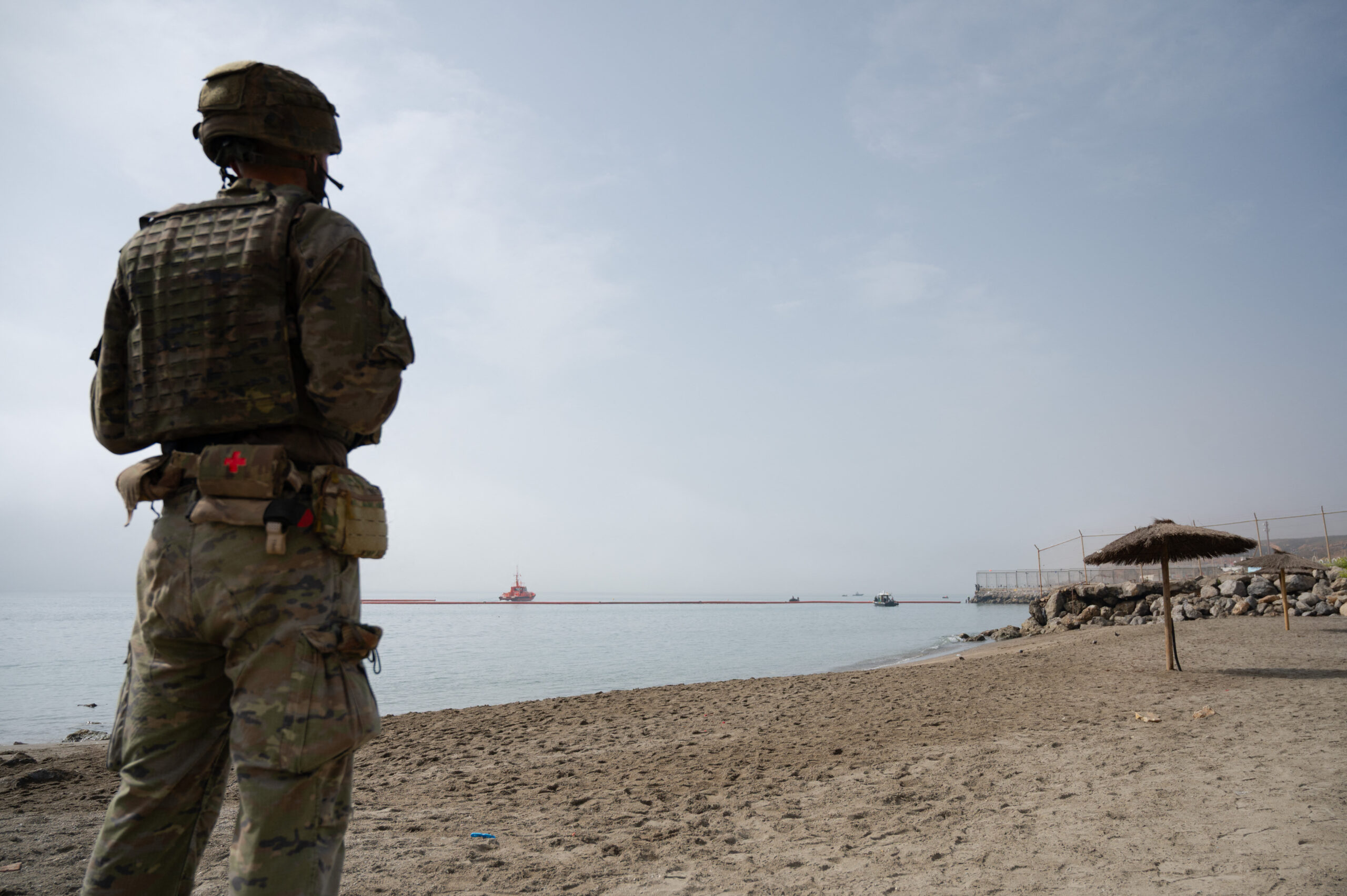
The Spanish government announced on Saturday (August 1) that a 500-meter-long maritime protection barrier has been officially installed at the maritime border between the Spanish enclave of Ceuta in North Africa and neighboring Morocco. Earlier this week, up to 50,000 to 60,000 illegal immigrants broke through the border defenses, resulting in a serious loss of life.
According to official sources in Spain, this border crossing incident has resulted in at least 67 deaths, primarily due to drowning while attempting to cross the sea and stampedes that occurred when rushing through narrow breakwaters.
To plug the border loopholes, the Spanish engineering corps has begun deploying a “border wall” in the Tarajal area. The 500-meter-long maritime protection barrier, known as the Containment Barrier, is designed to prevent immigrants from swimming along the coastline to bypass existing breakwaters.
On Saturday morning, a few exhausted immigrants who swam to the Tarajal beach were immediately escorted back to the other side of the border by waiting soldiers. The Spanish Ministry of the Interior stated that the vast majority of those who entered have already been returning to Morocco.
“We will not tolerate illegal activities,” affirmed Fernando Grande-Marlaska, the Spanish Minister of the Interior, during his inspection in Ceuta, emphasizing that security measures on both sides of the border are fully operational. He praised Morocco as a “reliable partner,” attributing the turnaround in the situation within 24 hours to close cooperation between the two countries.
This border crisis has quickly stirred up political turmoil within the European Union. Leaders of 22 EU member states, including Italy, Germany, and Poland, issued a joint letter urging the current EU Presidency, Ireland, to urgently convene a special meeting of interior ministers, warning against allowing the impression of “illegal entry turning into legal residence” to spread.
Italian Prime Minister Giorgia Meloni took a particularly hardline stance, threatening to suspend the Schengen open border agreement with Spain, and has already begun re-imposing border controls on sea and air arrivals from Spain. Some EU leaders even called for temporarily excluding Spain from the Schengen area.
In response, Spanish Prime Minister Pedro Sánchez strongly criticized the reactions of some EU leaders as being “driven by prejudice, fake news, ignorance, or political interests.”
Sánchez emphasized, “The security of external borders is a shared responsibility of all member states, not just the frontline countries. The EU cannot afford such selfish, divisive, and unlawful reactions.”
On the Ceuta side, many immigrants are seen returning to Morocco through gaps in the border fences along the breakwaters. Interviewees speaking to the Associated Press confessed to facing severe survival challenges in the area, struggling with food shortages.
However, there are still some immigrants determined to stay. Twenty-three-year-old Moroccan youth Mohamed Hatri told the Associated Press, “Even if they close everything, hungry or not, we plan to stay.”
Currently, authorities in Ceuta are expediting repatriation and cleanup efforts in order to swiftly restore order in the area.