
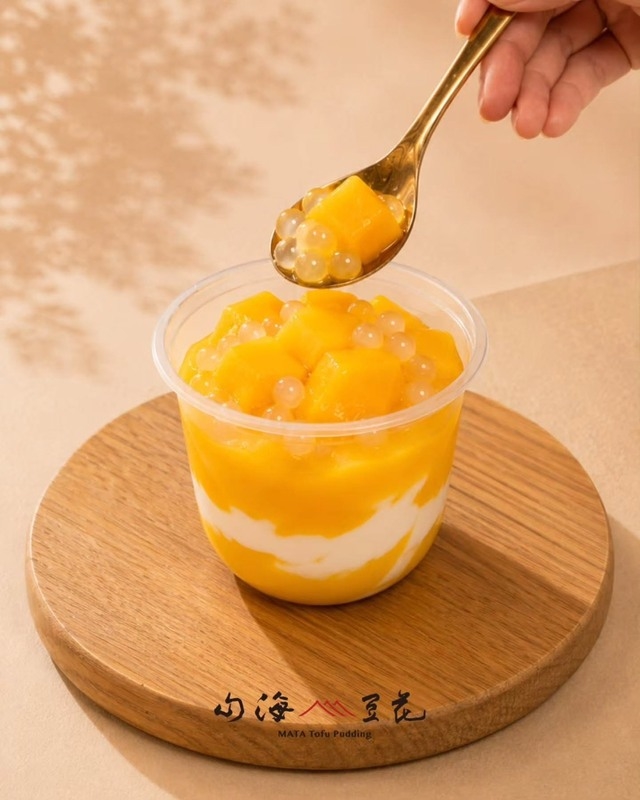
In Seoul’s Yoido Island, the underground second floor of Hyundai Department Store, even the department store manager had doubts about Taiwanese douhua (tofu pudding) at first, but after half a month of a flash opening, it achieved nearly 2.5 million New Taiwan dollars in sales, with the top seller surprisingly not being mango shaved ice as expected, but mango douhua. A bowl of mango douhua sold for about 200 NT dollars, a sales performance that even took Liu Yu-ting, the founder of Shanhai Douhua, by surprise.
Shanhai Douhua was established in September 2022 by Liu Yu-ting, a native of Taitung, Taiwan, and YoShi, a Japanese partner. The shop was opened on Yongkang Street in Taipei the same year. Liu Yu-ting noticed a potential business opportunity from the tastes of Korean tourists frequenting Yongkang Street in recent years. That inspired her bold move to enter the Korean market, which had almost no tradition of sweet douhua, not only to expand Shanhai Douhua overseas but also to introduce Taiwanese culinary culture to an international audience.
The story begins on Yongkang Street in Taipei. Liu Yu-ting mentioned in an interview with the Central News Agency that an increasing number of Korean tourists were visiting Yongkang Street since last year, not only for Taiwanese whisky and mango ice, but also stopping by Shanhai Douhua as a chance encounter during their travels.
However, she soon noticed that many Korean customers found Taiwanese douhua insufficiently sweet on their first try, often needing to add 3 extra spoons of sugar to suit their taste. This made her realize that Korean consumers were not unwilling to accept douhua, but rather needed a flavor more in line with their local eating habits.
Liu Yu-ting pointed out that unlike in Southeast Asia where there are similar desserts like doufu hua (tofu pudding) available, there is almost no tradition of sweet douhua in Korea, and Koreans do not have a habit of drinking unsweetened soy milk. The lack of an established impression in the market allowed her to see the potential of the Korean market.
After establishing a brand management mindset, Liu Yu-ting began considering how to extend the brand overseas. However, she admitted that she only knew how to open a store in the past and had almost no concept of trademark layout, international agency models, and store expansion plans. Therefore, she decided to participate in the overseas expansion plan organized by the Ministry of Economic Affairs, Bureau of Foreign Trade.
With the guidance of the government, the team started building brand recognition, inventorying trademark layout, learning how to evaluate international agency partnerships, participate in international trade shows and matchmaking events, gradually accumulating experience in expanding overseas markets.
With a direction for overseas layout in place, Liu Yu-ting did not rush to discuss agency partnerships with the Korean team. Instead, she took the Korean team to explore local night markets like Ningxia and Namjoongjang. From bingtanghuyuan (tangyuan in ice soup), yuyuan (yam balls) to red bean soup, she introduced Taiwanese dessert culture item by item, hoping that potential partners could understand Taiwanese dessert culture first rather than just representing a product.
“I’m not afraid they’ll find other partners,” Liu Yu-ting said, “because what I really want to promote is the taste of Taiwan.” She believed that only when partners truly understood Taiwan could they bring Taiwanese desserts overseas.
Investing efforts in researching recipes, ingredients, packaging, and deciding which items to “export,” Liu Yu-ting believed that the real challenge was just beginning for her.
Due to strict regulations on food imports in Korea, from preservatives and additive ratios to packaging labels, there were clear stipulations, and customs would inspect each box for samples. Liu Yu-ting admitted that the team had encountered obstacles multiple times due to formulation and regulatory issues, forcing them to repeatedly study Korean regulations and adjust ingredient ratios. The composition of peanut crisp could be categorized differently due to varying ingredient ratios, leading to differences in tariffs.
Originally concerned that changing ingredients might affect the taste, she later found that as long as suitable substitutes were found, not only did the chewiness of pearls and red bean fillings remain unchanged, but the team also gained more experience in food development.
Reflecting on their expansion into the Korean market, Liu Yu-ting believed that the real key was not the product itself but the trust established between partners.
She mentioned that with the language barrier, communication could only be achieved through translators and LINE translation tools, which often led to many funny situations. However, it was the willingness to continue communicating that allowed them to overcome challenges such as regulations and formulations. Both sides reached a consensus to not rush into opening fixed stores but to first accumulate visibility through flash stores in department stores, collect feedback from consumers on sweetness, ingredients, and items, and adjust product content based on this feedback.
“The market needs to be educated first, not just rushing to open stores,” Liu Yu-ting said.
This strategy quickly proved effective. Although the department store manager initially recommended focusing on mango shaved ice, which is more widely accepted by Koreans, the bestsellers after the opening turned out to be mango douhua followed by brown sugar douhua. The flash store had generated nearly 2.5 million NT dollars in revenue within half a month, exceeding the department store’s initial expectations.
Liu Yu-ting mentioned that currently, the main model would still be using flash stores for the next 3 months. Once the brand recognition gradually builds up, they will then plan to establish large-scale stores in Seoul, Busan, and other urban areas, gradually expanding their presence in the Korean market.
Having established a firm footing in the Korean market, Shanhai Douhua began planning for the next stage of development. Liu Yu-ting revealed that the team is collaborating with Korean partners to develop new items such as “soursop ice,” hoping to gradually introduce more Taiwanese-characteristic products centered around douhua.
As a native of Taitung, Taiwan, Liu Yu-ting expressed her delight in seeing the Korean team actively proposing the development of soursop ice. She hoped that through processed products like ice desserts, the added value of Taiwanese fruits could be elevated, allowing more international consumers to become acquainted with Taiwan’s unique agricultural products.
In addition to expanding their product line, Shanhai Douhua also plans to enter more international markets. In addition to existing locations in Japan, Hong Kong, and Korea, the team plans to open a store in London in March next year and adjust the product mix according to each market. Liu Yu-ting believed that there were no shortcuts for a brand to go international; only by continuously understanding the demands of different markets and adjusting products repeatedly could more people come to recognize Taiwan through a bowl of douhua.
Translated from Central News Agency.