
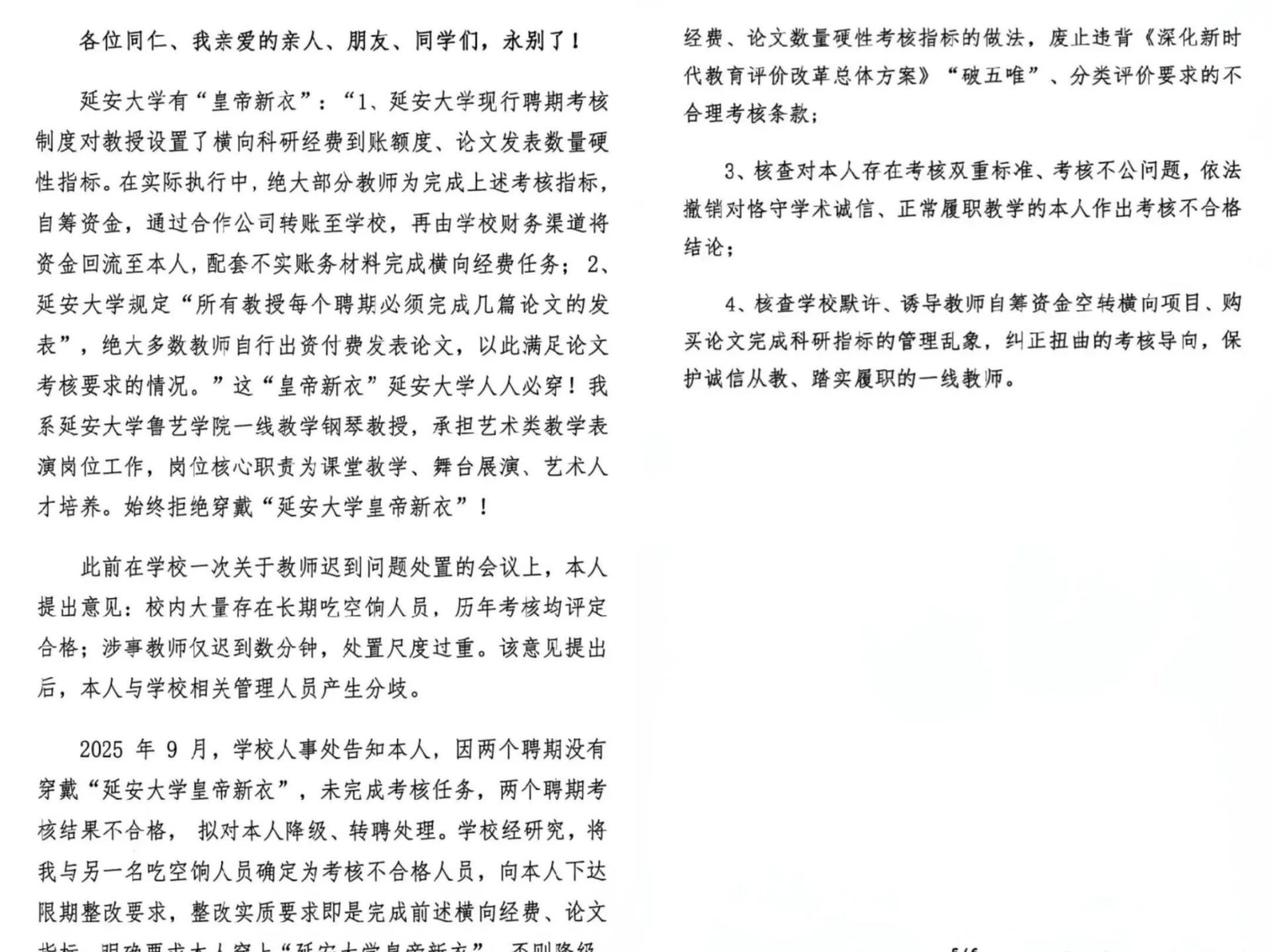
In October 2026, Bai Baoguo, an associate professor and master’s supervisor at the Lu Xun Art Institute of Yan’an University, tragically took his own life by jumping into a lake at the age of 54. Recently, a suicide note he left behind has gone viral online, drawing considerable attention and sparking discussions about the systemic issues within academia.
In his note, Bai revealed that Yan’an University incorporated the “amount of horizontal research funding” and the “number of published papers” into critical performance assessments for teachers across all disciplines. To meet these daunting targets, the majority of faculty engaged in a dubious practice referred to as “self-financed funding circulation.” This involved fabricating collaborative research projects with enterprises, sourcing their own funds to transfer money through a cooperative company to the university, and then having the school’s finance department return the funds to themselves with accompanying fictitious financial documentation to meet the horizontal funding requirements. Additionally, teachers were compelled to personally finance their publication costs to satisfy the paper assessment criteria.
Bai emphasized that these practices amounted to academic misconduct and corruption, and he expressed his unwillingness to compromise his integrity to be part of a system that normalizes such behavior. In September 2025, after failing to meet the aforementioned performance targets over two consecutive appointment periods, he received a notification from the university’s human resources department indicating that his assessment results were unsatisfactory. He was pressured to rectify the situation within a limited timeframe or face demotion or reassignment.
To maintain his position and fulfill his professional duties, Bai complied with the university’s demands, arranging to raise 150,000 yuan for the horizontal project funding and personally contributing another 50,000 yuan for paper publication costs. In his note, he articulated that, as a frontline piano teaching and performing instructor, his primary responsibilities revolved around delivering classroom instruction, showcasing talent, and nurturing students—not fabricating research funding or papers. Ultimately, it appeared that his only recourse to assert his integrity was through this tragic final act.
Furthermore, in his farewell note, Bai made pointed accusations about the pervasive issue of staff members at Yan’an University who were receiving salaries while being absent from their posts—described as “eating idle wages”—yet still managed to receive satisfactory performance evaluations. He called upon relevant authorities to investigate the school for tolerating such practices of idleness, fraudulent project claims, and the unethical sale and purchase of academic papers, demanding accountability for those in leadership positions responsible for these transgressions.
On November 4, a spokesperson from the Shaanxi Provincial Education Department responded, indicating that a specialized team was currently addressing the concerns related to Bai Baoguo. Meanwhile, representatives from Yan’an University confirmed Bai’s passing and stated that they were investigating the authenticity of the circulated letter content.
It is crucial to note that these illicit practices of “self-financed funding circulation” are not isolated to Yan’an University but reflect a broader issue within higher education institutions across the country. A previous survey conducted by the China Social Sciences Journal involving 117 university teachers revealed that nearly 90% of respondents perceived the existence of such gray practices in their surroundings, with a striking 17.95% admitting to having personally participated in fraudulent horizontal projects.
This tragic incident sheds light on the pressing need for reform in academic integrity and accountability in institutions of higher learning, as the systemic pressures to meet unrealistic expectations continue to impact the mental health and ethical conduct of educators.