
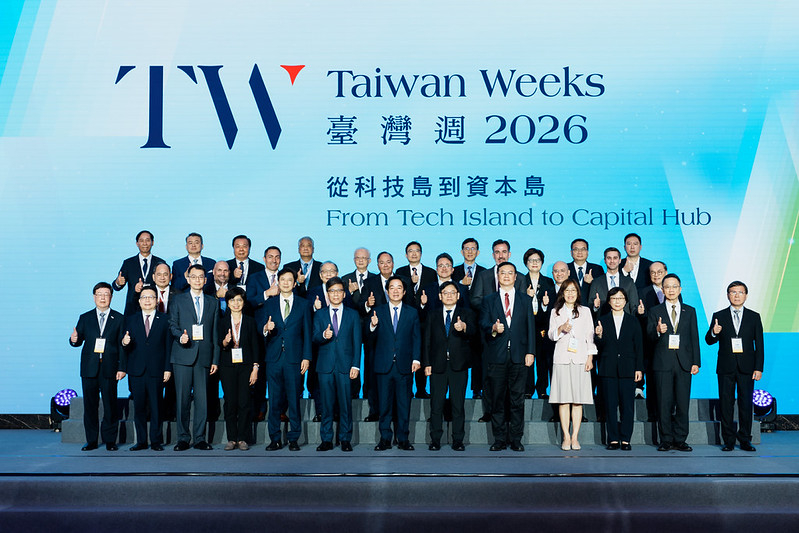
On November 3rd, the President of the Republic of China, Lai Ching-te, emphasized that the government will persist in leveraging Taiwan’s industrial strengths and enhancing financial development. His vision for Taiwan is to foster a more internationalized financial market, increase the innovative vitality of the capital market, and establish Taiwan as a highly trusted investment destination for the long term. He expressed the desire to connect global capital through financial strength, support innovation, and collaborate with international partners to achieve prosperous development and regional stability.
During his address at the opening ceremony of “Taiwan Week 2026,” President Lai conveyed his pleasure in participating in the event. He warmly welcomed the international guests who traveled from afar and expressed gratitude for their enduring trust and support for Taiwan’s financial market, as well as appreciation for all industry partners involved in this significant gathering.
The President highlighted the success of last year’s inaugural “Taiwan Week,” which brought together numerous domestic and international financial institutions and investors. This year’s theme, “From Tech Island to Capital Island,” expands the event to feature a series of international financial exchange activities, showcasing the achievements of Taiwan’s financial market while also sharing the vision for Taiwan’s next phase of financial development with the world.
Lai pointed out that in recent years, Taiwan has shown resilience amidst changing international circumstances and the challenges posed by the AI wave, resulting in robust economic growth. “Last year, our economic growth rate reached 8.76%, and we anticipate exceeding 11% for the full year. The Directorate-General of Budget, Accounting and Statistics reported last Friday that this year’s third quarter economic growth rate was 14.36%, a 2.94% increase from the August forecast, marking the highest growth for the same quarter in 48 years, with double-digit growth observed for four consecutive quarters.”
Additionally, Lai mentioned that according to Bloomberg statistics, Taiwan has risen to become the world’s fourth-largest stock market in terms of national market capital, indicating a continuous expansion of its capital market scale. He attributed these economic successes not to coincidence, but rather as a foundation established on Taiwan’s irreplaceable and robust industrial fundamentals. “Our companies boast excellent profitability, highly flexible supply chain connections, and a critical core position within the global supply chain, enabling Taiwan to maintain its footing in the face of change.”
Lai believes that the development of industries relies on financial services, and the global layout of industries further requires a financially competitive market as a backbone. The government will continue to advance in three key areas to leverage industrial advantages and strengthen financial development, ensuring that Taiwan becomes more formidable, capable of meeting various challenges, and achieving greater prosperity.
First, the plan is to further internationalize Taiwan’s financial market. “We are actively building an Asian asset management hub, aiming to make Taiwan a central point for global asset allocation. Over the past two years, the Financial Supervisory Commission has completed more than 60 regulatory adjustments. By the end of September this year, the asset management scale of Taiwan’s financial sector has reached NT$48.38 trillion, reflecting an increase of over NT$15 trillion compared to June 2024.”
The Kaohsiung Asset Management Zone has already attracted 62 financial institutions, gradually developing cross-border finance, family offices, and diverse asset management services. The next steps will involve promoting financial openness, deepening cross-border services, and fostering international market cooperation, with the goal of enticing more international asset management firms and professionals to make Taiwan a vital platform for global capital engaging in Asia’s growth opportunities.
Second, there is the objective of making Taiwan’s capital market more innovative and dynamic. Taiwan’s advantages extend beyond providing capital; it also integrates capital, technology, and a complete industrial supply chain. “Therefore, we will continue to promote the reform of Taiwan’s Innovation Board, relaxing listing and trading regulations, allowing businesses with innovation capabilities and growth potential, even those not yet in a mature profit stage, the opportunity to secure funding through the capital market.”
The government is also encouraging more top international companies to list in Taiwan, strengthening the connection between venture capital, financial institutions, and the capital market. “Our goal is to position Taiwan as an innovative fundraising platform in Asia, supporting more globally competitive innovative firms to grow into world-class enterprises.”
Thirdly, the intent is to establish Taiwan as a more trustworthy long-term investment market. “We believe that a financially competitive market must not only be large and efficient but also cultivate long-term trust. That is why Taiwan is continuously enhancing corporate governance and sustainability information disclosure, with phased implementation of IFRS sustainability disclosure standards starting this year, making corporate information more transparent and internationally comparable.”
Lai stated that the government also believes that the outcomes of financial development should be shared by a broader segment of the population. “We have launched the Taiwan Individual Investment Savings Account (TISA), with over 280,000 accounts opened so far. In the future, we will introduce tax incentives to encourage citizens to participate in investments in a small, long-term, and disciplined manner, accumulating retirement assets. The government hopes to enable capital to support innovation, let companies create growth, and ensure that the fruits of growth are shared by a wider audience. This is the core value driving Taiwan’s financial development.”
He noted that in the past, Taiwan engaged in the global economy through its technological prowess; moving forward, Taiwan aspires to link global capital through its financial strengths, support innovation, and grow together with the world. Through “Taiwan Week,” he welcomed more international friends to partner with Taiwan in promoting financial innovation, sustainable development, and cross-border cooperation, deepening mutual relationships. Finally, he wished for the success of the events and looked forward to collective efforts to leverage both technological and financial strengths to mutually promote prosperity and regional stability.