
The midterm elections of 2026 are set to take place on November 3, as voters across the country prepare to cast their ballots. Almost all states are allowing early in-person voting or mail-in ballots ahead of the election day, reflecting an impressive engagement from the electorate. This year’s early voting numbers in several states have already surpassed the total early voting counts from the 2022 midterms, indicating a growing enthusiasm among voters for the upcoming elections.
In an effort to gauge public opinion about the 2026 midterm elections, a survey was conducted on October 28 and 29, gathering insights from 5,264 respondents via email and social media platforms. The survey focused on various topics including voting methods, election integrity, polling, and the influence of media on the electoral process.
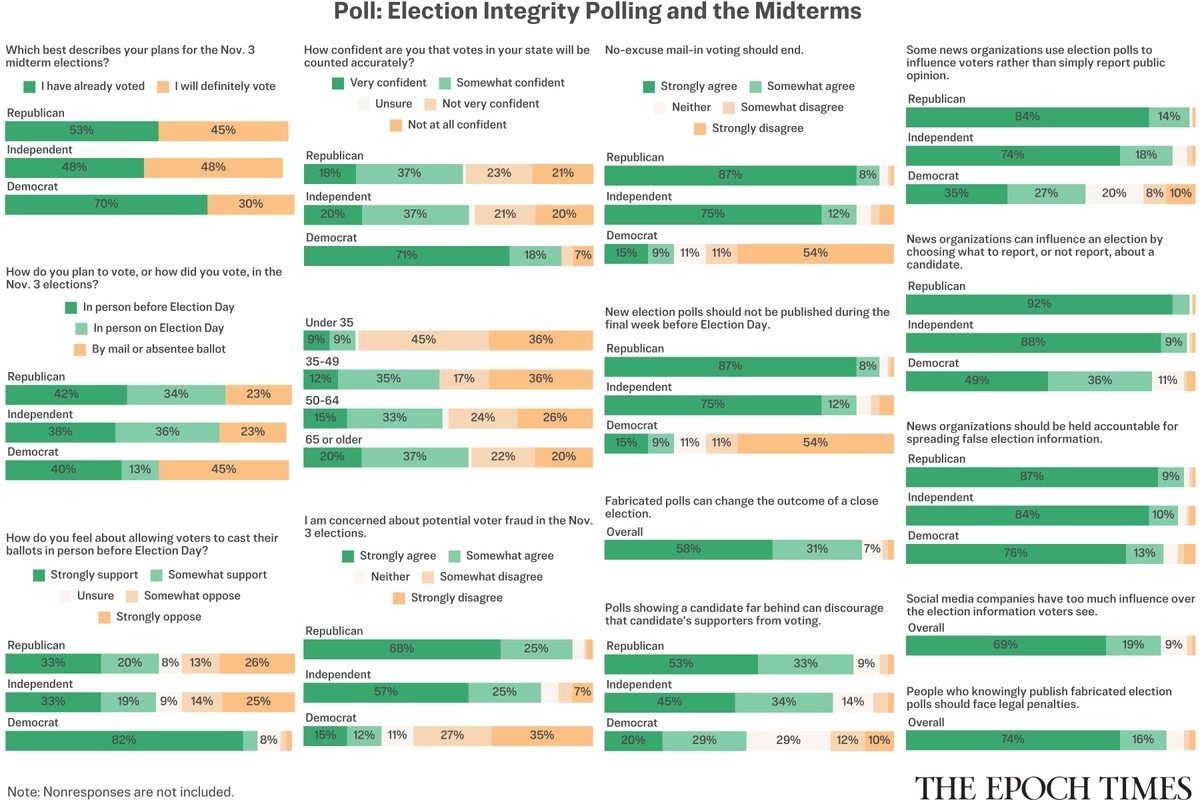
One notable finding from the survey is that a significant number of respondents had already completed their midterm voting at least five days before election day. Almost all participants expressed their intent to participate in this midterm election, showcasing a robust turnout forecast.
Interestingly, voting habits varied significantly across different political affiliations. Approximately 70% of Democratic respondents indicated they had voted early, compared to only 53% of Republican respondents.
While a larger proportion of Democrats opted for mail-in or absentee voting, Republicans and independent voters showed a higher tendency to vote in person on election day. About 40% of respondents, regardless of party affiliation, reported that they had voted in person before election day.
When it comes to early voting, slightly over half of Republicans and independents expressed their support, while 40% were opposed. In stark contrast, over 80% of Democrats were strong advocates for early voting, reflecting a pronounced difference in attitudes toward this voting method.
The survey also revealed that most respondents consistently cast their ballots for candidates from the same political party in elections. Less than one-fifth of independent voters reported that they voted for candidates from different parties, pointing to a level of party loyalty among the electorate.
Concerns regarding election fairness highlighted a stark divide among party lines. Nearly 90% of Democrats expressed confidence in the accuracy of vote counting, with more than 70% stating they felt very confident. However, this confidence was less prevalent among Republicans and independents, with only three-fifths expressing assurance in vote counting accuracy, while two-fifths admitted they had little to no confidence.
Furthermore, 82% of Democrats believed that local election officials were honest and competent in managing elections. This view was not shared by a majority of Republicans and independents, where fewer than half agreed with this assessment, and over 20% expressed disagreement, with a third remaining uncertain about the integrity of election officials.
An overwhelming 93% of Republicans voiced concerns about potential election fraud, while more than 60% of Democrats did not share these fears. The survey also highlighted that over 80% of younger respondents expressed significant worries about election fraud.
A striking 95% of Republicans supported the idea of requiring voters to provide identification, such as a passport or birth certificate, during registration, even if this may pose challenges for some eligible citizens. Conversely, 65% of Democrats opposed such requirements.
When it comes to mail-in voting without an explanation, 90% of Republicans believed it should be halted, while 82% of Democrats disagreed, with 75% of Democrats strongly opposing such a measure.
Notably, younger respondents demonstrated a lack of confidence in the fairness of elections, particularly regarding vote counting accuracy and the integrity of election officials. Among voters under 35, over 80% expressed little to no confidence in the accuracy of votes being counted in their state, while about 50% of older voters shared a similar lack of confidence.
Additionally, a higher percentage of younger voters (72%) disagreed that their county election officials could manage elections in an honest and competent manner. In contrast, older voters had a more nuanced perspective, with two-fifths agreeing, about a quarter disagreeing, and a third uncertain.
There was a general consensus among respondents regarding the influence of election polling on election outcomes. Over 70% of Republicans and 53% of Democrats believed that no new election polls should be published in the last week leading up to the election.
Close to 90% of respondents indicated that misleading polls in closely contested elections could potentially alter the election results. A significant 86% of Republicans noted that if a poll showed a candidate substantially trailing, it could dampen voter enthusiasm among that candidate’s supporters, a sentiment echoed by nearly 50% of Democrats.
Slightly more than half (56%) of Democrats believed that even if the results of most election polls were not accurate, these polls still made a good-faith effort to gauge public opinion. Conversely, two-thirds of Republicans disagreed with that notion.
Survey results also indicated that there is a widespread belief in the media’s political influence during elections. Nearly all Republicans (98%) contended that certain media outlets utilized election polling to sway voters rather than simply reporting on public opinion. This view was shared by a majority of Democrats (62%).
When asked about the media’s ability to influence elections through selective reporting of candidates’ news, a large majority of both Republicans (98%) and Democrats (85%) agreed.
Furthermore, 96% of Republicans and 89% of Democrats believed that media organizations should be held accountable for disseminating false information about elections.
An overwhelming majority (88%) of respondents asserted that social media companies have too much influence over the election information that voters encounter.
Finally, 90% of those surveyed maintained that individuals who deliberately disseminate false election polls should face legal repercussions.