
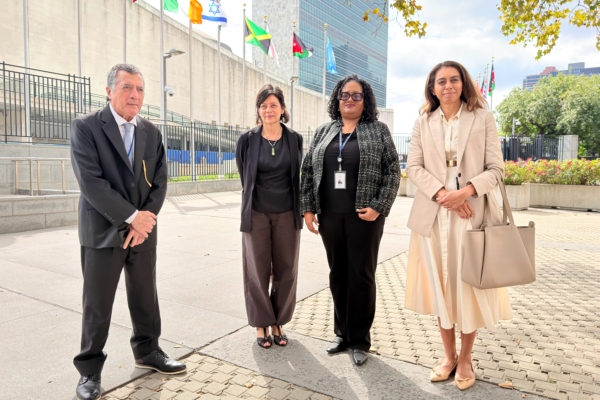
The 81st United Nations General Assembly debate is set to take place on September 22, with five of Taiwan’s diplomatic allies, Palau, Saint Lucia, the Marshall Islands, Belize, and Saint Vincent, jointly sending a letter to UN Secretary-General António Guterres on September 18, urging the UN to explore appropriate ways to involve Taiwan in the UN system and asserting that Resolution 2758 of the UN General Assembly should not be interpreted as excluding Taiwan from meaningful participation in the UN.
On Friday morning, representatives from Taiwan’s diplomatic allies personally delivered the joint letter to the UN Secretariat, which was accepted by Courtenay Rattray, the Chief of Staff to the UN Secretary-General.
In the joint letter, the diplomatic allies outlined three main demands, including emphasizing that Resolution 2758 does not exclude Taiwan from meaningful participation in the UN system, calling on the UN to seek ways to involve Taiwan, stressing that peace and stability in the Taiwan Strait are crucial for global security and prosperity, and urging the UN to adhere to the principles of the UN Charter, which prohibit the use of force and promote peaceful dispute resolution through collaboration among member states.
Palau’s Permanent Representative to the UN, Ilana Seid, stated in a media interview after delivering the letter, that the UN Charter’s spirit, centered around “the people,” signifies that the UN is an organization meant to serve all people worldwide, yet Taiwan’s 23 million people continue to be excluded, which she finds “quite regrettable.”
She noted the current high tensions in the Taiwan Strait, emphasizing the need for international organizations like the UN to bring different parties together to reduce the escalating pressures.
Regarding the contributions Taiwan could make to the UN, Seid cited semiconductor technology, environmental matters, and advancements in science and technology. She highlighted Taiwan’s significant role in global semiconductor production and how its technological capabilities can assist the international community in advancing development agendas that the UN is promoting, such as sustainability and poverty reduction.
Resolution 2758 of the UN General Assembly was a key issue in the joint letter. Seid stated that they believe this resolution has been misinterpreted.
“The resolution itself does not mention Taiwan anywhere,” Seid said, expressing that Resolution 2758 has been interpreted later on as a political tool to exclude Taiwan from participation, which is a matter the diplomatic allies hope the UN Secretary-General addresses.
When asked about China’s influence at the UN and whether Taiwan’s diplomatic allies feel pressured by Beijing, Seid acknowledged, “We indeed face pressure from China.”
She alleged that China has been trying to insert references to the “One China Policy” or “One China Principle” in many UN resolutions and related documents, even when the topics are unrelated to Taiwan. She mentioned that Taiwan’s diplomatic allies must clearly state in negotiations that they do not recognize such principles and should not include these terms in consensus documents.
Seid pointed to the recent Leaders’ Summit hosted by Palau in the Pacific Islands Forum as an example, where they faced pressure from China to exclude Taiwan, but Taiwan was ultimately able to participate. She believed this demonstrated the value of dialogue in bringing together individuals from various backgrounds and reducing political tensions that accumulate from exclusion.
John Silk, the Permanent Representative of the Marshall Islands to the UN, also emphasized the increasing importance of Taiwan’s participation in the UN amid concerns over the South China Sea situation and global conflicts and issues. He stated that the UN should strive for greater inclusivity.
Silk noted that in the past, Taiwan had observer status in World Health Organization activities, and Taiwan passports are accepted for visa-free entry in many countries, yet bearers of Taiwanese passports cannot enter the UN headquarters using these credentials. He questioned why the UN, an organization that emphasizes progress and collective cooperation, treats Taiwan differently.
“There are many areas where Taiwan can contribute,” Silk remarked.
He further expressed that he does not see Taiwan as seeking any special treatment from the UN, rather, “they just want to be a part of this international community.” Silk conveyed that the Marshall Islands government has long supported Taiwan, as these issues are not only important to the Taiwanese people but are also closely related to other regions globally.
Director-General of the Taipei Economic and Cultural Office in New York, Li Chih-chiang, thanked the diplomatic allies on behalf of the Taiwanese government for their continued practical support in Taiwan’s participation in the UN system and in maintaining peace and stability in the Taiwan Strait.
Taiwan expressed its hope for the UN to seek appropriate ways to involve Taiwan in order to contribute to global agendas like the UN Sustainable Development Goals (SDGs) and to uphold the concept of “leaving no one behind.”