
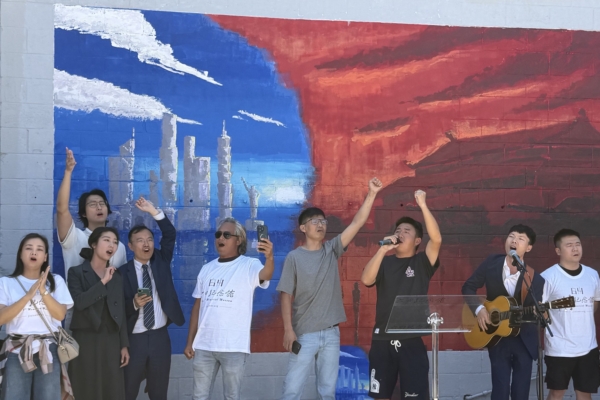
In late September, Washington welcomes you! People from all walks of life are rushing to Washington D.C. to participate in the protests against the visit of the leader of the Chinese Communist Party. Ni Shicheng, a new immigrant from mainland China, initiated a call on X platform for Chinese people to stand together, shout out when Xi Jinping appears, “Let the world hear the voices of the Chinese people: the CCP does not represent China.”
Ni Shicheng used to run a small business in China. After seeing the blocked historical and political truths while climbing the Great Firewall, he felt the urge to speak up. However, his posts on Weibo or WeChat were repeatedly censored or deleted. After coming to the United States, he found like-minded people and no longer felt suppressed and lonely. Although the journey to protest in Washington D.C. is long and costly, he didn’t want to miss the opportunity.
But participating in anti-CCP activities often came at a painful cost for Ni Shicheng: his family members in China were harassed and threatened by the CCP police; he himself was labeled with subverting state power and asked to “return to surrender” to authorities.
In Los Angeles, Ni Shicheng is just one of the victims of the CCP’s transnational repression.
The whereabouts of participants in the protest activities can quickly be transmitted to China.
“The police found my sister and threatened her; they also frequently harass my parents by phone, and now they dare not answer unknown calls,” Ni Shicheng said. Every time he video calls with his parents and sees their fearful expressions, he feels distressed. He also sees many Chinese people, even after obtaining green cards and living in the U.S. for many years, still cover their faces during protests, fearing repercussions on their family members in China.
Before leaving for the United States, Li Jinshan from Sichuan had his house forcibly demolished by the government. He was beaten during the resistance and threatened by the police when he reported on human rights abuses. He was taken to the police station, where the police forced him to write guarantees: no longer reporting abuses, not criticizing the government, and restricting his movements.
The long-term threats and pressures ultimately led Li Jinshan’s family to flee China.
In 2023, during the Asia-Pacific Economic Cooperation (APEC) meetings in San Francisco, Li Jinshan participated in protests. Shortly after, he joined the Chinese Democratic Party, often speaking out for oppressed individuals in China and criticizing the CCP on social media. Soon, his parents in Sichuan were taken away by the police for questioning.
Li Jinshan said that the police demanded his parents to contact him and discourage him from participating in overseas political activities, urging him to return to China to “surrender” for processing. Even his mother-in-law was implicated.
When the police summoned his father, they video called through his phone. The CCP police demanded him to “immediately confirm the exact time of returning to China, return to accept summons and investigation, and immediately cease all protest activities abroad”; if refused, the “charges” would become more severe.
Before coming to the U.S., Los Angeles resident Cao Wenbo was a guitarist and guitar teacher. Due to posting supportive messages for Taiwan’s democracy and freedom on WeChat, the police demanded him not to leave the area and be available for investigation. This experience scared him, and two weeks later, he fled China with his family.
After coming to the U.S., Cao Wenbo utilized his musical talent to compose and publicly perform songs like “Square of June 4th” and “Tiananmen Square,” which are considered “forbidden songs” by the CCP, often becoming the highlight of activities. However, these performances angered the CCP authorities.
The police threatened his parents, accusing Cao Wenbo of subverting state power and undermining national security, demanding his return to surrender. Cao Wenbo was extremely angry about this.
In response to the police’s home threats, the response from several young people was: raise their voices louder and participate in more activities.
Cao Wenbo recently recorded a music video, intending to play it as soon as possible and broadcast it at the protest site in Los Angeles.
Li Jinshan, on the other hand, said that while the police could pressure through his parents, he would continue to do what he believed was right. He hoped that one day, Chinese people would not be threatened for speaking the truth or putting forward political views, nor would their families be implicated, “No matter how the police threaten, I will stick to my political beliefs.”
Ni Shicheng posted on X, saying, “I am not without fear. I just cannot accept that while my body has left China, my mind is still trapped in fear there,” “Freedom is not just about where one goes, but more importantly, when someone orders you to shut up, will you dare to speak up?”
Compared to other protesters, Ni Shicheng went further: not only participating in protests himself but also encouraging others to join.
Ni Shicheng expressed that he understood some Chinese immigrants’ fear of the CCP, but he could not accept this fear anymore, “What I want to change is not just my own life, but also hope to participate in promoting political change in China.”