
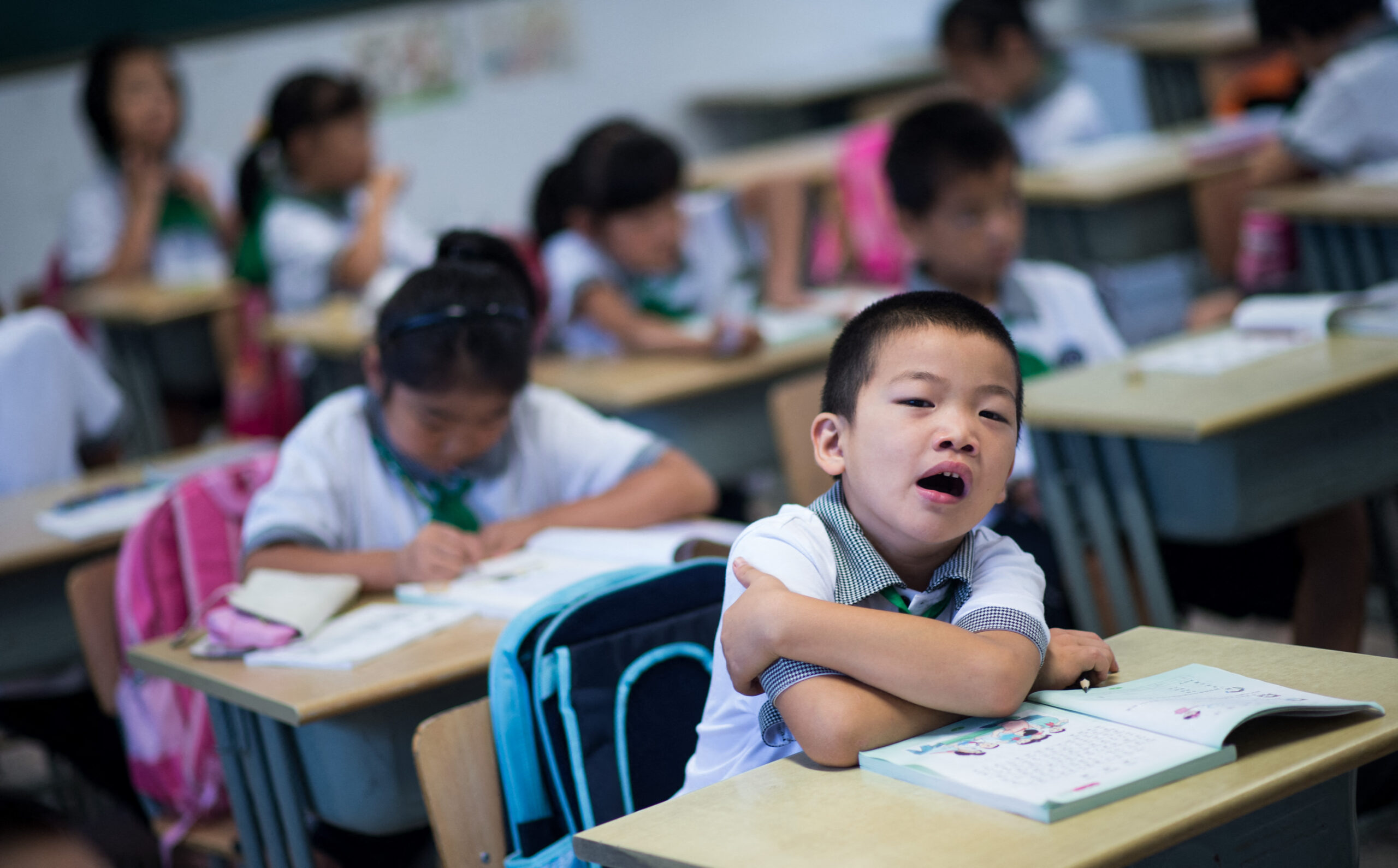
In a recent interview with a rural school administrator, it was noted that in 1997, the school had over 300 students, whereas now after consolidating six village primary schools, there are only 24 students. In another video segment, a previously bustling classroom now only showed a few scattered figures. There were even only 7 students attending physical education classes together from grades three to six. In urban areas, a parent mentioned that the nursery school her daughter attends was on the verge of closure as no new students were enrolled this year, making it the fourth nursery school in their neighborhood facing shutdown.
The declining population is gradually impacting families, teachers, and educational institutions from reduced student enrollment in rural primary schools to urban nursery schools facing closure due to lack of new students.
The phenomenon of declining student enrollment is not limited to areas with rapid population loss. In Shenzhen’s Luohu District, the Education Bureau announced the closure of five nursery schools, including the Edinburg Nursery School, citing operational reasons and a lack of actual enrollment activities.
According to reports from local media in Guangzhou, approximately 40 nursery schools have been closed since 2026, affecting 10 districts in the city. The Tianhe District had the highest number of closures, reaching 13 nursery schools.
In a report in August 2025, Shanghai’s Pudong New Area Sanqiao Primary School had five classes with 22 students and 23 full-time teachers. The “Fifteenth Five-Year Plan” for Education released in Shanghai in 2026 proposed adjusting educational resources in response to the gradual decline in the school-age population and population changes, including adjusting teacher resources and school facilities.
The decreasing student enrollment is also beginning to affect teachers’ employment and the operation of private nursery schools. In a video featured on “Today China,” a young female nursery teacher mentioned that despite obtaining her nursery teacher qualification, the nursery school she worked at closed within less than two months. She expressed concerns over unpaid wages, possibly resorting to selling toys from the school to cover her expenses.
Another female teacher with 13 years of experience displayed her teaching certificate, revealing her recent unemployment. She lamented investing her youth and best years in education but now struggles to find a job related to her profession. Similarly, a female entrepreneur who ran a nursery school for 15 years mentioned the facility that was once bustling with children is now quiet and on the verge of closure.
Statistics released by the Chinese Ministry of Education in 2025 indicated a decrease in the number of nursery schools nationwide to 231,900 and primary schools to 128,300. The number of children in preschool education reached 32.2552 million, and there were 101.78 million students in primary school.
In July 2026, the Ministry of Education issued the “Statistical Bulletin on National Educational Development in 2025,” revealing national reductions of approximately 8,000 primary schools and 21.4 thousand nursery schools, with an average daily closure of nearly 59 nursery schools. The cumulative reduction in the number of educational institutions totaled almost 30,000 for the year.
A report from “Finance and Economics” highlighted a primary school in Changsha, Hunan, that kept its 2026 enrollment notice until late July because it only filled five classes. Nearby schools had varying enrollment numbers, demonstrating how declining student enrollment is affecting school allocation and demand for teachers.
The diminishing student population primarily reflects the continuous decline in birth rates in China. Data from the National Bureau of Statistics of China showed a decrease in births from 95.4 million in 2024 to 79.2 million in 2025, resulting in a national population decrease of 3.39 million compared to the previous year.
A young woman interviewed on “Today China” expressed concerns over the high costs of housing, daily expenses, healthcare, and education, making it challenging for many to afford having and raising children due to long work hours and financial burdens.
Another interviewee pointed out the significant financial investments required for marriage, such as housing, cars, and wedding expenses, making it difficult for ordinary families to cope with these financial pressures.
The considerations around housing, education, healthcare, and marriage costs mentioned by interviewees have become critical factors influencing the decisions of young people regarding marriage and childbearing.
The impact of the declining birth rates on the education sector has a time lag, as children generally enter primary school around six years after birth. Thus, the recent low birth rates are expected to gradually impact the future enrollment in primary schools.
A team of experts led by Professor Qin Yuyou from the Education Department of Northeast Normal University predicted that the number of students entering primary school in China would continue to decline from 2026 to 2030, with an estimated 12.34 million students in 2026 possibly decreasing to 9.28 million by 2029.
Researcher Liu Houlian from the Population and Development Research Center of China stated that nursery schools and primary schools have peaked during the “Fourteenth Five-Year Plan” period, with junior high school expected to peak around 2026, senior high school around 2029, and higher education around 2032 before declining.
The Ministry of Education of the Communist Party of China has called for the establishment of a predictive warning mechanism for the school-age population and the adjustment of educational resources such as school facilities and teacher resources based on population changes as part of the “Fifteenth Five-Year” education development plan.
Shanghai’s planning also emphasizes the need to adjust teacher resources and school infrastructure to accommodate the gradual decline in the school-age population.
With the decrease in student enrollment, schools, teachers, and other educational resources configured according to past population sizes will require re-adjustment. For teachers, this could mean a reduction in job opportunities, while private nursery schools may face closure due to insufficient enrollment.
As the owner of a nursery school for 15 years expressed, the once lively environment with children has now quieted down. Caught in the “tides of the times,” she finds herself at a standstill.
On “Today China,” a citizen questioned the societal success of a country that pressurizes an entire generation to refrain from marriage, childbirth, property ownership, and even struggles to maintain the will to live due to the burden of escalating living costs and demanding work schedules.