
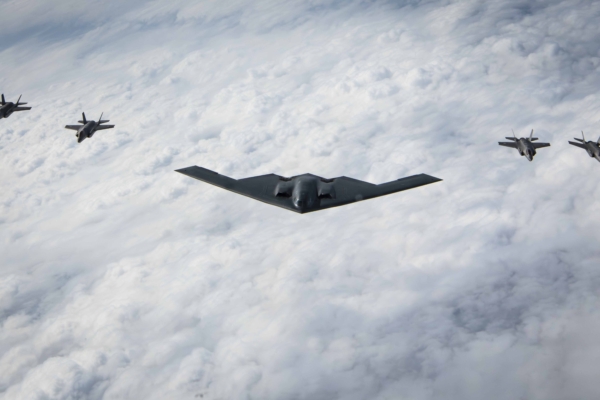
An illegal photographer of the US B-2 bomber, Chinese citizen Qilin Wu, is currently detained by the US Immigration and Customs Enforcement (ICE) awaiting deportation back to China. He was sentenced to six months in prison by the federal court in the Western District of Missouri in early July.
In December 2025, after being warned not to photograph important US Air Force military facilities and equipment, Wu returned to the base for illegal photography. The case involved the main base of the US B-2 “Spirit” stealth bomber and has garnered public attention due to the prosecution citing a Cold War-era regulation.
In early July 2026, the federal court in the Western District of Missouri made a judgment against Wu based on Title 18 of the US Code and Executive Order 10104. This law prohibits unauthorized photography, sketching/drawing, and other visual imaging of designated military facilities, aircraft, weapons, and equipment that require protection, with explicit prohibition on public dissemination of such content.
Due to Wu’s continuous detention after his arrest, it is equivalent to serving his sentence. Subsequently, he was handed over to the US Marshals Service by the court. Currently, he is detained by ICE, awaiting repatriation to China.
The Air Force Office of Special Investigations (AFOSI) in a statement released on August 13 once again referenced this case, emphasizing the significance of President Harry Truman’s historical executive order signed during the Cold War. The Wu case can be used to combat unauthorized photography around sensitive military facilities in the future and set a precedent for how law enforcement agencies will investigate similar cases to prevent further escalation.
“For our (law enforcement) agents, this is not just a case,” said Col. David Bethel, the commander of the AFOSI District Eight, “but a recognition that the operational environment has indeed changed.”
Bethel pointed out that the threats to the US military have shifted from clear threats in overseas environments to more ambiguous criminal activities around military facilities within the United States.
Regarding Wu’s case, investigators expressed concerns not only about his illegal photography but also his return after receiving a warning, as well as the objects he photographed not limited to aircraft but also encompassing the surrounding environment and infrastructure.
According to court documents, on December 2, 2025, the AFOSI received a report of a suspicious van outside the Whiteman Air Force Base in Missouri. The base is the primary residence of the US B-2 “Spirit” stealth bomber, considered highly sensitive strategic equipment by the US military due to its nuclear strike and stealth capabilities.
Patrol personnel encountered Wu when they investigated, and he claimed to be present to observe the B-2 aircraft. He was immediately warned not to take photos or videos of military facilities.
The next day, investigators found the same vehicle near the base fence. Upon contacting Wu, he admitted to photographing the B-2 bomber and voluntarily showed his phone.
Authorities discovered 18 video clips on Wu’s phone, including images of the B-2 bomber, base fences, entrances and exits, and various military equipment. Wu admitted to taking these images during questioning and disclosed that he had previously photographed Air Force bases and aircraft in Florida and Virginia.
Wu illegally entered the US from Nogales, Arizona in June 2023, and after being arrested by immigration authorities, he was released due to “lack of detention space.”