
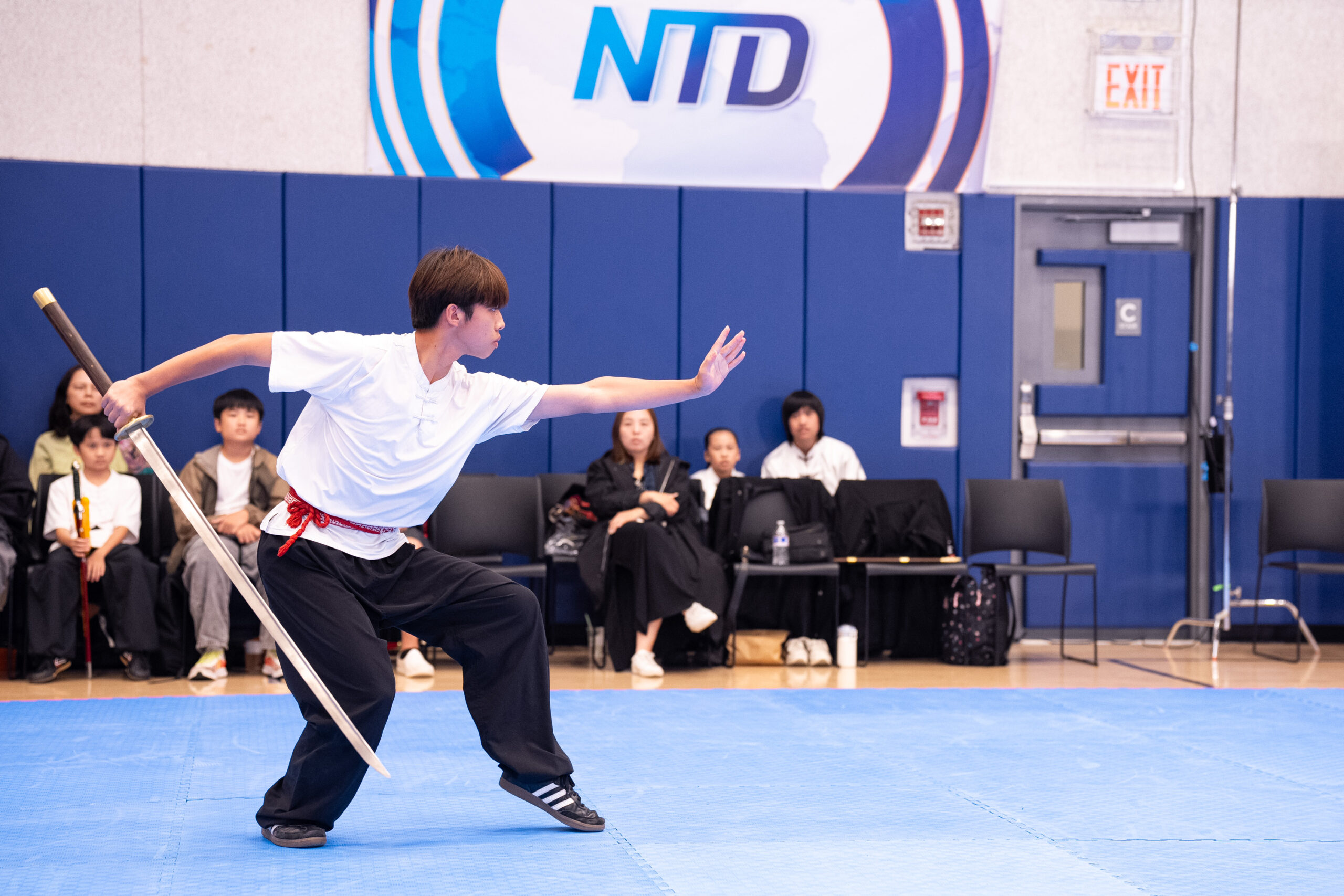
The 9th NTD World Chinese Traditional Martial Arts Competition finals were held on August 15th in Manhattan, New York. 16-year-old martial artist Liang Songqi from Taiwan won the silver medal in the youth division with a set using a Miao knife.
Liang, who has been practicing martial arts for seven years, initially started to learn self-defense, but gradually came to understand the traditional culture and martial virtue behind martial arts. He now emphasizes the importance of cultivating inner qualities through martial arts, realizing that martial arts offer more than just physical techniques and weapons.
Currently a high school sophomore at 16 years old, Liang has been practicing martial arts for seven years, although he has only been exposed to the Miao knife for less than a year. The first time he held the Miao knife, he felt its weight, around one kilogram. However, what truly captivated him was not just the elegant appearance of the Miao knife but also the historical stories his teacher shared.
He explained that during the Ming Dynasty when Japanese pirates invaded China’s coast, Chinese martial artists developed Miao knife techniques tailored to counter the features of the Japanese sword. The slender, slightly curved blade of the Miao knife resembled a sword or a samurai sword but remained fundamentally a knife. Liang described its unique feature as being able to bypass the opponent’s weapon to launch an attack, giving it distinctive characteristics.
After nearly a year of practice, he formed an emotional bond with the knife, noting how it felt lighter as he practiced, almost as natural as holding a brush.
He described the Miao knife as his reliable companion on the martial arts journey, acknowledging the deep emotional connection he has formed with it, despite not even a year of companionship. His initial intention of learning martial arts for self-defense evolved into a desire to preserve culture, realizing that the most crucial aspect is enhancing his inner cultivation.
Liang believes that martial virtue serves as a standard for behavior and conduct, shaping one’s approach to life. Martial virtue acts as a framework that guides one to continually strive for self-improvement, leading to greater spiritual refinement.
Reflecting on his personal growth, Liang observed increased maturity in his interpersonal relationships. He found himself more harmonious in interactions with friends and classmates, less prone to conflicts.
Even with his busy high school schedule, Liang prioritizes martial arts practice on weekends, utilizing spare moments to mentally rehearse routines. Although daily training may not always be feasible, he mentally goes through the routines to stay connected to his practice.
Preparing for the competition, he faced the challenge of time management rather than physical practice. Structuring his daily routine and adhering to a disciplined schedule were essential to maintaining order in his life.
Through his seven years of training, Liang has experienced noticeable improvements in his physical condition, breathing, and overall health. By learning to regulate his breathing through martial arts, his physical fitness improved, and he also noticed a positive impact on his mental well-being.
This trip to New York marked Liang’s first solo international competition. In the previous NTD competition, his younger brother represented Taiwan and won the bronze medal in the youth division due to financial constraints at home, the brothers could not travel together, and Liang elected to give his brother the opportunity.
Finally participating in an international stage he has long awaited, Liang emphasized the importance of setting personal benchmarks and overcoming them. Despite feeling nervous on the competition stage, he remained focused on the journey rather than the outcome, understanding that participation itself was a significant achievement.
Liang found New York to be a captivating and diverse metropolis, unlike any other city he had experienced. Surrounded by athletes from around the world, he gained a deeper appreciation for the diversity and skill across cultures.
Acknowledging the unique and invaluable heritage of Chinese traditional martial arts, Liang emphasized the importance of continuing this legacy for future generations. He believes that preserving and promoting this cultural treasure will contribute to global recognition and appreciation of Chinese martial arts as a significant cultural heritage.
Expressing gratitude to his parents for their support in enabling him to compete in New York, Liang feels a heightened sense of responsibility to meet their expectations. Post-competition, he understands that personal growth and the journey itself hold more significance than mere achievements.