
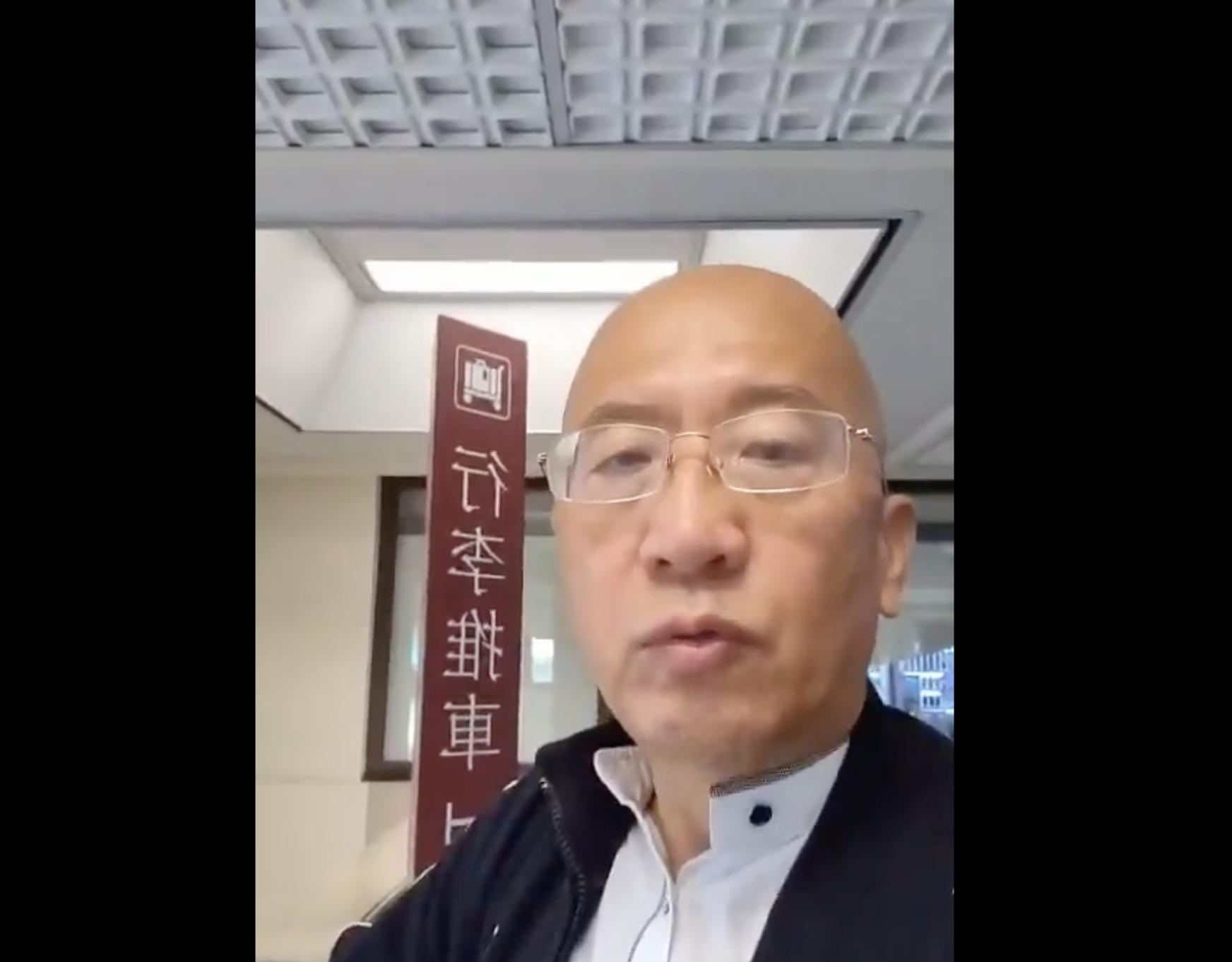
A prominent Chinese media figure, Cheng Wanjun, who has been living in exile, arrived at Taoyuan Airport in Taiwan on November 3, seeking temporary humanitarian protection from the Taiwanese government. Cheng was reportedly sentenced to six years in prison after being reported for describing Xi Jinping as a “king of destruction” in 2019.
The situation surrounding Cheng attracted the attention of the International Alliance of the Chinese Democratic Party, which is presided over by Jielijian, a Chinese expatriate living in the United States. He shared a video of Cheng’s plea for help on the social media platform X, noting that Taiwanese friends had contacted the local immigration office. However, there are concerns that if Cheng’s case does not receive sufficient attention, he may face deportation back to China.
Cheng Wanjun has held significant positions in the Chinese media, including serving as the editor of the magazine “Law and Life” and being the main speaker on the CCTV program “Legal Classroom.”
In the video he recorded at Taoyuan Airport, Cheng recounted his harrowing experiences of persecution in China. He explained, “In 2019, during a regular meeting at my workplace, I commented on Xi Jinping as a ‘king of destruction.’ I was secretly recorded and reported, which led to the Chinese Communist Party (CCP) leadership demanding a thorough investigation. My entire department faced an intense crackdown, and I personally endured six years of imprisonment.”
He continued, “After my release in 2025, I was forced into exile to publish my works from prison. I am currently recognized by the United Nations High Commissioner for Refugees (UNHCR) office in Thailand as being at the highest risk level. However, they also indicated that they cannot guarantee my personal safety while I await resettlement in Thailand.” Cheng expressed, “Due to my confessions being published in overseas media and to avoid potential secondary political persecution by the CCP, I must seek temporary humanitarian protection in Taiwan to assist with my resettlement process.”
On November 1, Cheng’s article titled “The Eternal Freedom Soul: A Political Prisoner’s Confession” was published in a journal, adding to the unfolding narrative of his ordeal.
In an interview with Radio Free Asia at Taoyuan Airport, Cheng mentioned that staff from the Taiwanese immigration office had already taken statements from him and forwarded them to the Mainland Affairs Council while awaiting a response. However, he could not rule out the possibility of being forcibly returned to Thailand at any moment.
He also disclosed that he was currently being held in the airport’s guard room and was restricted from moving freely. This restriction prompted him to urgently seek media attention to rally support for humanitarian assistance.
Cheng acknowledged that Taiwan currently lacks a formal refugee law, which complicates his ability to obtain long-term political asylum. His primary request is for the Taiwanese government to extend temporary protection based on humanitarian grounds and assist in his relocation to another country.
Zeng Jianyuan, a director at the Taiwan Chinese Democracy Academy, noted that Cheng Wanjun possesses a certain degree of influence in public opinion. His departure from China symbolizes the escalating tension in the political atmosphere there, as the CCP continues to tighten its grip on the intellectual and cultural spheres, making it increasingly difficult for outspoken individuals to exist within mainland China.
He urged the Taiwanese government to adhere to the principle of not deporting political prisoners on humanitarian grounds, allowing Cheng to live safely in Taiwan until he can be resettled in a third country.
As of the latest reports, the Mainland Affairs Council has not publicly responded to this situation.
In recent years, there has been a noticeable trend of Chinese exiles seeking help in Taiwan. In September, Chinese human rights lawyer Wang Xiaohong, who was persecuted by the CCP for defending the Zion Church, sought asylum in Taiwan with her family. The Taiwanese authorities granted her family humanitarian stay while they await resettlement in a third country.