
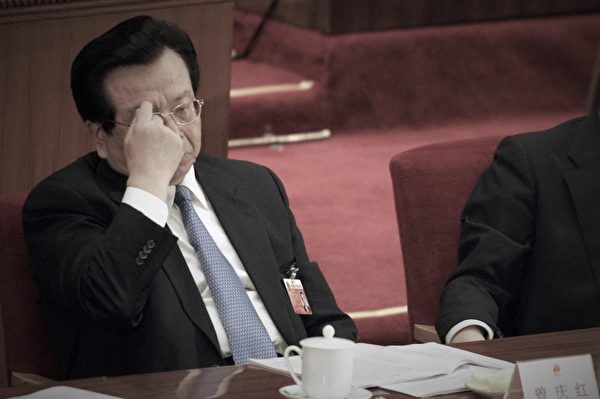
On October 29, 2026, the four-day Fifth Plenary Session of the 20th Central Committee of the Communist Party of China concluded. Just two days later, on October 31, Fu Chengyu, the former chairman of the China Petroleum and Chemical Corporation (Sinopec) and a key figure in the oil faction associated with former high-ranking official Zeng Qinghong, was placed under investigation at the age of 75, marking him as the first major figure caught in the aftermath of the Plenary Session.
In the lead-up to the Plenary, Huang Qifan, a prominent member of the Shanghai faction and a retired official, was also removed from his post, causing significant upheaval within the political and business circles of Shanghai. The power dynamics within Zeng Qinghong’s hometown of Ji’an in Jiangxi Province witnessed substantial purges, with reports surfacing that Zeng’s family is deeply entangled in various scandals, including those involving the China Evergrande Group and Evergrande’s founder Xu Jiayin. Moreover, claims from independent media have suggested that Zeng Qinghong may be under house arrest or semi-house arrest. These signs indicate that the Shanghai faction, particularly under the influence of Jiang Zemin’s old associates, might be the target of a broader political purge, placing Zeng in a precarious situation.
On October 31, the website of the Central Commission for Discipline Inspection (CCDI) of the Communist Party announced Fu Chengyu’s investigation. Fu previously served as a member of the CCDI during the 17th Central Committee and was a standing member of the 12th National Committee of the Chinese People’s Political Consultative Conference.
Born in 1951 in Heilongjiang, Fu graduated from the Geological Department of Northeast Petroleum University and has spent over 40 years in the oil industry, beginning his career in 1982 with China National Offshore Oil Corporation (CNOOC). Over the years, he held various prominent positions within many domestic and international cooperative oil field projects. He served as the general manager and chairman of CNOOC, eventually becoming the general manager of CNOOC in October 2003 and later the chairman and CEO of Sinopec in April 2011. He retired in 2015, and it has been eleven years since his retirement before he was subjected to scrutiny.
Fu Chengyu was closely associated with the oil faction led by Zeng Qinghong, a former member of the Standing Committee of the Politburo. Historically, companies like China National Petroleum Corporation (CNPC), Sinopec, and CNOOC have served as domains for Jiang’s powerful allies, Zeng Qinghong and Zhou Yongkang.
Zeng Qinghong began his career as a secretary to Yu Qiuli, the then director of the State Planning Commission in 1979. Yu, originally from Ji’an, Jiangxi, was a significant figure in the Ministry of Petroleum industry during the early days of the Communist Party. As the National Energy Commission was established in 1980, Zeng steadily climbed the ranks, holding several crucial positions which eventually positioned him as a key player in controlling China’s oil industry.
Following Jiang Zemin’s ascension to power, Zeng Qinghong was promoted significantly, cultivating a network of trusted individuals within the oil system and solidifying control over this critical sector, ultimately being seen as the leader of the “Oil Faction.”
In the weeks preceding the Fifth Plenary Session, four executives within the oil system were reportedly investigated. Notably, Qian Zhiye, the former general manager and deputy party secretary of the China National Petroleum Corporation’s Sales Division, was placed under scrutiny on October 23. Additionally, on the same day, Guo Shaoqiang, the general manager of Sinopec’s Jingmen branch, voluntarily turned himself in. Other high-profile investigations included Xiao Huaping, a deputy general manager of the Beijing pipeline branch of the National Petroleum and Natural Gas Pipeline Group, on October 19, and Shi Changchun, the party secretary of Sinopec’s Tibet branch, on October 13.
These investigations are indicative of a wider crackdown within the oil sector. Other notable removals include Wang Dasheng, the former deputy mayor of Ji’an, who was reported to be under investigation just days before the Plenary Session was convened. Wang, born in November 1969, held various positions within the Ji’an government throughout his career.
Reports and analyses indicate that the Ji’an region, which has been Zeng Qinghong’s political base, has seen a considerable number of officials under investigation since the 20th National Congress of the Communist Party. Over fifteen officials at the departmental level have been implicated over recent years, with many voluntarily coming forward for investigation.
On October 13, 2026, another key member of the Shanghai faction, Huang Qifan, was announced to be under investigation after having held various significant roles within Shanghai for over thirty years. His connections to previous Party leader Jiang Zemin and other prominent Shanghai figures are well documented.
Huang’s eventual fall from grace has raised concerns over the breadth and implications of corruption related to the Shanghai faction, as well as the complex web of relationships that connect these individuals back to Zeng Qinghong and the broader Jiang Zemin influence within the Party.
Notably, following the debt crisis at Evergrande and Xu Jiayin’s detention, links between Zeng Qinghong’s family and the corruption surrounding Xu have come under increasing scrutiny. As the pressure on Zeng’s faction mounts, the political landscape appears to be shifting towards a reevaluation and potential retribution against the very officials who once held considerable power.
The coming months will likely reveal whether Zeng Qinghong himself will face the same fate as others within his faction, suggesting a possible end to the era of entrenched circle politics that have persisted within the Communist Party for decades.
As the political dynamics in China evolve, the significance of these events highlights the ongoing internal struggles within the party as it grapples with issues of power, accountability, and the future direction of the nation. The fallout from the Fifth Plenary Session continues to unsettle the status quo, setting the stage for potential upheavals amongst the remaining leaders within the Communist Party hierarchy.