
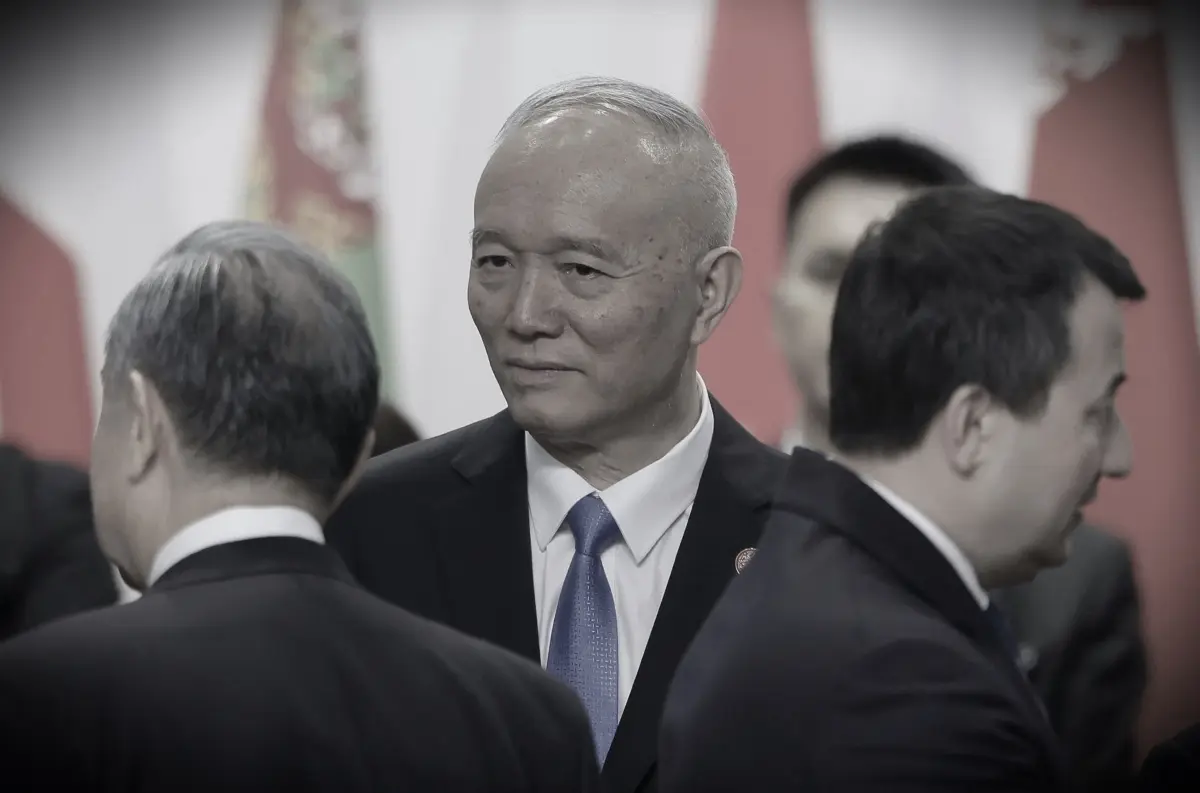
In the recently concluded Fifth Plenary Session of the 20th Central Committee of the Chinese Communist Party (CCP), a significant purge of high-ranking officials and military leaders took place. The authorities announced their commitment to continue anti-corruption measures and declared that there would be no tolerance for “iron-hat kings” or “Dan Book Iron Certificates,” which refer to powerful individuals who operate with impunity. Taiwanese scholars predict that Xi Jinping, the CCP’s leader, exhibits “narcissistic personality traits,” and that Cai Qi, the current member of the Politburo Standing Committee and head of the General Office, may soon find himself on the chopping block.
Dr. Cai Wen-hsuan, a scholar specializing in the CCP’s political system and a researcher at the Academia Sinica in Taiwan, spoke at a seminar titled “Observations Following the Fifth Plenary Session of the 20th CCP Central Committee.” During this event on October 31, he characterized Xi Jinping as a “typical example of a narcissistic personality.”
Dr. Cai expressed that Xi’s narcissistic traits manifest in his perception of being perpetually in the spotlight and believing that the country cannot function without him. At the same time, he harbors a deep-seated fear of the abilities and talents of others. This results in an intriguing pattern: “Many individuals who once assisted Xi Jinping, and significantly contributed to his efforts, have subsequently fallen from power,” he noted.
Addressing the recent purges of close allies of former Central Commission for Discipline Inspection Secretary Wang Qishan and the resignation of former Organization Department Minister Chen Xi from the Head of the Central Party School, Dr. Cai analyzed that Xi’s personality is such that while he may call upon individuals for assistance when needed, he will start to guard against them if their capabilities or prestige surpass his own.
Despite Cai Qi’s significant contributions to Xi in recent years, Dr. Cai posited that he might soon face backlash following the 21st National Congress of the Communist Party.
Describing Cai Qi’s current situation, Dr. Cai remarked, “He is too far from God, yet too close to Xi Jinping.”
Taiwanese fortune teller Jiang Boluo has previously indicated that Xi Jinping’s subtle facial features suggest he is ruthless in his dealings, whether with relatives or friends, creating an environment where those around him can be perceived as “serving a tiger.”
Currently, Cai Qi holds multiple core positions within the CCP, including being a member of the Politburo Standing Committee. He also serves as the Director of the General Office, First Secretary of the Central Secretariat, Vice Chairman of the National Security Council, President of the Central Party School (National Administrative School), Secretary of the Party Working Committee for Central and State Institutions, and leads over twenty specialized roles related to security, propaganda, party affairs, key communications, personnel, and internet monitoring within various critical departments of the CCP.
China expert Heng He has pointed out that Cai Qi, ranked fifth among the members of the Politburo Standing Committee, has effectively become the second most powerful figure within the party. His dual role as Director of the General Office is notably irregular. However, during times predominantly characterized by internal party struggles, being deemed second in command can be perilous.
Historically, Liu Shaoqi, who aided Mao Zedong during the Yan’an Rectification Movement in reshaping Party history, established Mao’s leadership position and fervently promoted a cult of personality around him. After the establishment of the People’s Republic of China, Liu became the second-most powerful figure in the CCP, just after Mao. Yet, he sowed the seeds of his own demise, ultimately becoming Mao’s most formidable enemy and suffering a tragic end.
Similarly, Lin Biao, another second-in-command during the Cultural Revolution, also promoted a cult of personality around Mao while trying to establish his authority within the military. Despite his successor’s position being enshrined in the party charter, he too could not escape the traps laid by Mao.
Heng He believes that Xi Jinping’s suspicions are no less than Mao’s; he has already eliminated all potential successors. However, this does not mean Xi will refrain from creating new targets for purges, as the alliance between targets and opposition to him is minimal. Notably, both Liu Shaoqi and Lin Biao never directly opposed Mao, but that did not spare them from his wrath.
After the fall of Beijing Municipal Political Consultative Conference Chairman Wei Xiaodong on June 6 this year, another high-ranking Beijing official, Executive Vice Mayor Xia Linmao, was investigated on October 22. Both were considered associates of Cai Qi from his tenure overseeing Beijing. Information sources previously indicated that Xia Linmao was implicated in connections involving Cai Qi’s son, Cai Erjin.
On October 23, the Politburo convened a meeting during which they explicitly addressed concerns regarding issues within central and state organs, applying pressure for reforms. Chinese affairs analyst Li Linyi interpreted Xi Jinping’s stern approach within the Politburo as not solely reflecting concerns over personnel decisions but also pointing to existing problems tied to Cai Qi himself.
While Cai Qi is unlikely to be easily removed, he is certainly under immense pressure. His earlier tactics to consolidate power might require more caution moving forward, especially with the probability of his retirement growing as the 21st National Congress approaches in 2027.