
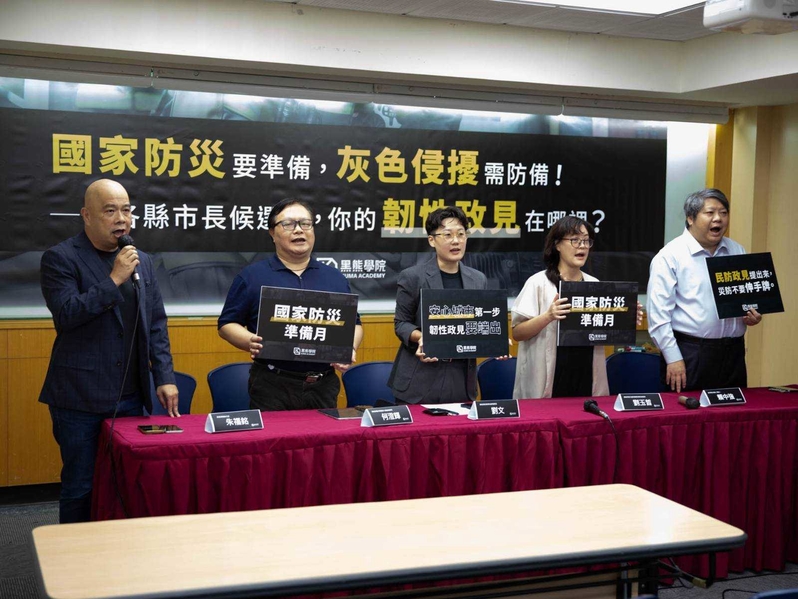
The Black Bear Academy held a press conference today (September 17th) at the National Taiwan University Alumni Association to address Taiwan’s facing of new forms of gray zone threats and compound threats. They emphasized the need for local governments to break away from traditional disaster preparedness thinking in light of National Disaster Preparedness Month in September.
At the event, the Black Bear Academy, in collaboration with experts and scholars, called on mayoral candidates from various counties and cities to incorporate “war disaster” into local disaster preparedness and to present specific “resilience policy proposals” during the election period.
According to the co-founder and chief consultant of the Black Bear Academy, He Chenghui, Taiwan’s vulnerability lies in the concentration of 14 international submarine cables at 8 landing stations, making it a critical infrastructure easily prone to physical destruction and cyberattacks in times of conflict, with the potential to cause social chaos through the dissemination of false information.
He emphasized the need for local governments to establish non-commercial communication backup means to stabilize public sentiment in extreme situations, as well as promote community microgrid and backup power systems for energy and supply contingencies, along with developing plans for emergency power allocation.
He called for the planning of a “Civil Defense Fund” to guide convenience stores and logistics operators to increase their inventory by 20-30%. He also highlighted the importance of considering the coordination of medical and social welfare resources for nursing facilities and vulnerable groups during war disasters, stressing the necessity for governance capability of county and city leaders.
Regarding grassroots defense capacity, the Chairman of the Black Bear Civil Defense Education Association, Liu Wen, emphasized the importance of public participation in civil defense. He proposed establishing a “Model Resilient Community” assessment and reward mechanism, encouraging neighborhoods to inventory air raid shelters and set up emergency lighting, sanitary facilities, power backups, and communication devices like Meshtastic networks.
Liu pointed out that while Taiwan has constructed and renovated numerous shelters, the accessibility features of nearly 90% of these facilities in Taipei have not been properly surveyed or improved, with misinformation posing a greater problem during disasters. Therefore, relying solely on government websites for communication during emergencies may not be effective as people are less likely to actively check official sites in critical situations.
Furthermore, Liu highlighted the strong grassroots capabilities of civic organizations in Taiwan and urged local governments to establish reliable communication networks, integrate long-term NGO participants in disaster preparedness and civil defense exercises, and enhance collaboration between local governments and grassroots NGOs.
Member of the Presidential Office’s National Defense Resilience Committee, Liu Yuxi, focused on the survival challenges faced by small and medium-sized enterprises during war disasters. She stressed the importance of providing adequate information in advance rather than post-disaster financial subsidies, advocating for labor relations guidance, uninterrupted energy supply for precision processing and fresh produce industries, and efficient traffic management in risky situations.
From a financial perspective, convenor of the Economic Democratic Union Think Tank, Lai Zhongqiang, proposed a significant increase in civil defense budgets by local governments, given the substantial increase in central government tax revenue allocation to localities following the amendment of the Fiscal Intermediation Act. As financial resources for local governments have markedly increased, resources should be allocated towards enhancing social resilience.
Lai urged the newly elected county and city leaders to promptly submit a three-year civil defense budget analysis report from 2025 to 2027, addressing the allocation of funds for supporting civilian forces, responding to gray zone and war disaster risks, and covering areas like organizational training, information and intelligence systems, exercise promotions, stockpiling supplies, and disaster relief equipment facilities.
Emphasizing the differing proportional increases in central allocation percentages among counties and cities, Lai stressed the vital need for new county and city leaders to propose additional budgets if the growth rate of civil defense budgets does not match that of central tax revenue allocation increases to ensure a tangible enhancement of civil defense capabilities.
Lastly, the Executive Director of the Black Bear Academy, Zhu Fuming, underscored the importance of national disaster preparedness focusing not only on natural disasters but also on being prepared for “war disasters” and “gray zone operations”, with local governments playing a vital role in the overall national resilience. The academy and attending experts collectively urged all mayoral candidates not to overlook issues of “war disasters” and gray zone threats and to present clear disaster response and resilience policy proposals for scrutiny by voters.