
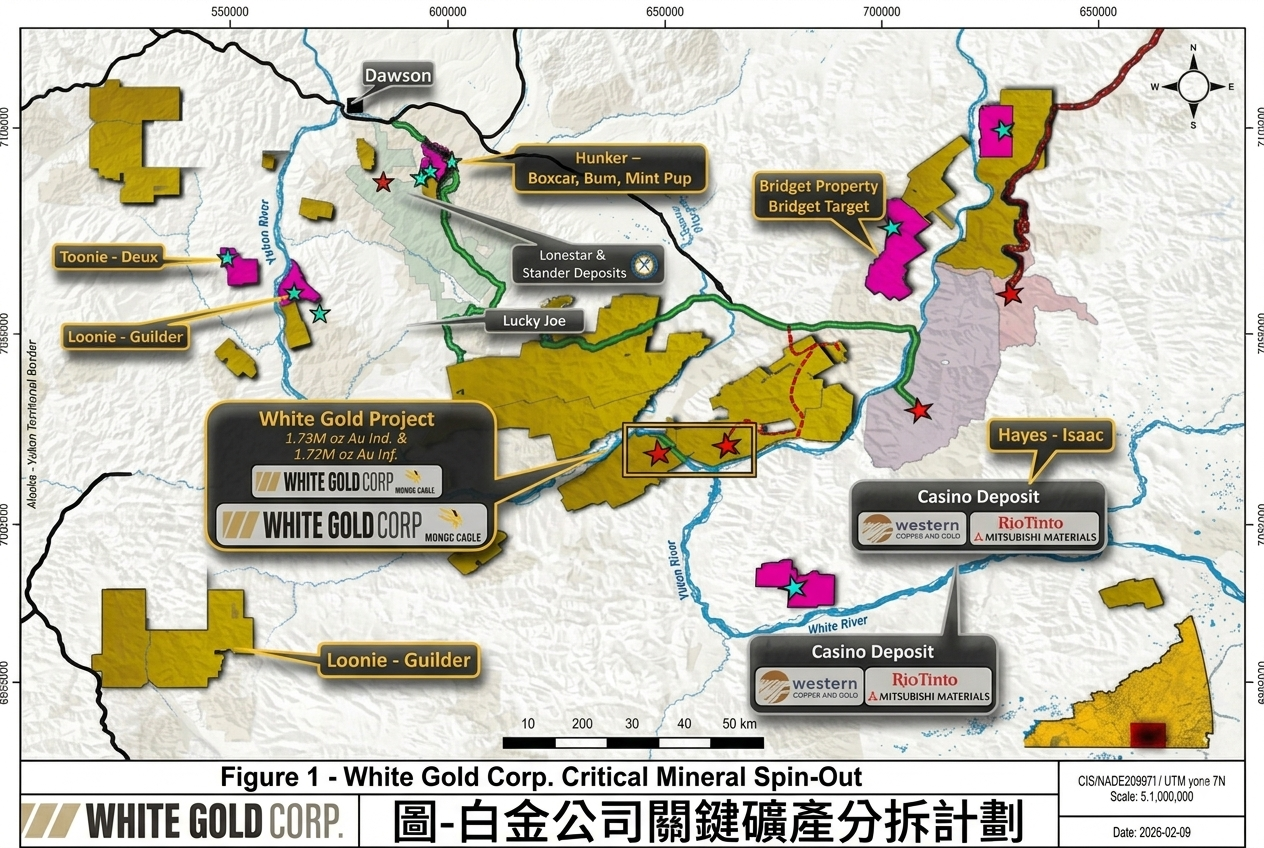
White Gold Corp., a Canadian mining company, is planning to spin off some of its key mineral assets in the Yukon region into a new company named W2 Critical Minerals Corp. (W2). These assets include several projects with exploration potential for metals such as copper, molybdenum, tungsten, as well as antimony, zinc, and bismuth. In essence, White Gold Corp. is preparing to separate its “non-gold” critical mineral projects.
The spin-off has received approval from shareholders, and a hearing was held at an Ontario court on August 13 to review whether to approve the transaction. Following the completion of the deal, W2 also plans to apply for listing on the TSX Venture Exchange in Toronto, making these critical mineral assets part of a standalone company.
Whether W2 will ultimately be listed depends on court approval of the spin-off and the listing approval from regulatory authorities and TSXV.
For ordinary shareholders, the most direct change would be that if the spin-off is successfully completed, shareholders holding White Gold Corp. stocks will not need to purchase W2 stocks separately to receive W2 shares proportionally. For every 5 shares of White Gold Corp. held, shareholders will receive 1 share of W2. At the same time, the number of shares held by the shareholders in White Gold Corp. will not decrease.
Following the spin-off, White Gold Corp. is expected to retain approximately 19.9% ownership in W2. W2 will possess six key mineral projects in the Yukon, ranging from early-stage exploration to more advanced projects. Among them, the Bridget project is one of the most anticipated exploration targets for W2. This 3 km x 3.5 km copper-molybdenum porphyry anomaly area shows clear copper and molybdenum mineralization signals and has further narrowed down underground targets through geophysical exploration. However, the discovery of economically valuable deposits through diamond drilling at this project remains uncertain.
White Gold Corp. stated that the purpose of the spin-off is to separate the gold business from the critical mineral business, allowing W2 to focus on exploring and developing resources such as copper, molybdenum, and tungsten while building its financing and development platform. White Gold Corp. can continue to concentrate on developing its primary gold projects.
For the average investor, this spin-off can be viewed as a company splitting its “gold” and “critical mineral” business lines into two separate entities; eligible existing shareholders will be able to hold shares in both companies simultaneously in the future.