
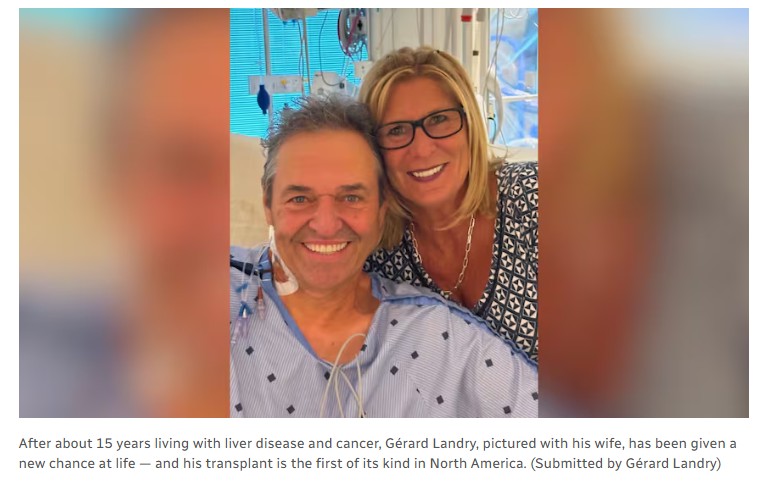
A 64-year-old man from Quebec, Canada has become the first patient in North America to undergo a liver transplant using regenerated liver tissue. This groundbreaking achievement was made possible by a new technology that could make dozens of previously unusable livers suitable for transplantation within the first year.
According to reports from the Canadian Broadcasting Corporation (CBC), Gérard Landry, a resident of Nouvelle in Quebec, has been battling liver disease for about 15 years, ultimately leading to cirrhosis and liver cancer.
Before being taken into the operating room for the liver transplant surgery, doctors gave him unexpected news about the organ: it had been regenerated by a new machine that was first used at the Montreal University Hospital Centre (CHUM).
Landry said, “The doctor told me about this new machine he had been researching for years. It was like a Christmas gift.”
The technology, called “liver assistance,” allows doctors to process and evaluate donated livers outside of the body before transplantation. For Landry, this meant receiving an organ that would have been deemed too risky for use without this innovative technique.
Dr. David Hénault, a liver and pancreas surgeon and transplant specialist, led the development of this project and personally performed the transplantation surgery on Landry.
He mentioned that the research team spent three years preparing for this technology.
The liver assistance system works by connecting the donated liver to a machine that circulates oxygen-rich fluid within the organ, helping reverse some of the damage caused by lack of oxygen outside the body.
This technique also allows doctors to employ blood-based solutions and assess the liver’s function under simulated human conditions.
“If it works on the machine, it will work in the body,” says Hénault.
He explained that Landry’s received liver was particularly suitable for this technology because it had already been damaged due to lack of oxygen.
CHUM performs approximately 70 liver transplant surgeries each year. Hénault stated that a research collaboration with the Quebec transplant center analyzed livers previously rejected for various reasons and evaluated which ones could regain health through the new technology.
The development team estimates that within the first year of using this machine, an additional 20 to 24 livers could be made available for transplantation. As this technology becomes more widely used, this number is expected to increase.
“We will be able to help more patients waiting for liver transplants,” Hénault said, noting that the research shows this technology can help reduce complications, reoperations, and hospital stays for suitable patients.
In Landry’s case, doctors almost immediately saw signs of transplantation success.
Hénault mentioned that Landry’s blood tests conducted the day after surgery showed better results than expected for similar transplants.
“I do believe that this machine has made a significant impact on this case,” Hénault said.
Landry’s recovery process also appears to be unusually smooth.
“His recovery is much better than the average liver transplant patient,” Hénault said. “He is doing very well.”
Landry is currently still in recovery. He resides in Montreal and visits the hospital for blood tests one to two times a week for medication adjustments by his doctors.
He hopes to return home soon and continue his recovery in the comfort of his own surroundings.
“I am eager to see my family, my grandchildren, my friends, and my horse,” he told CBC.