
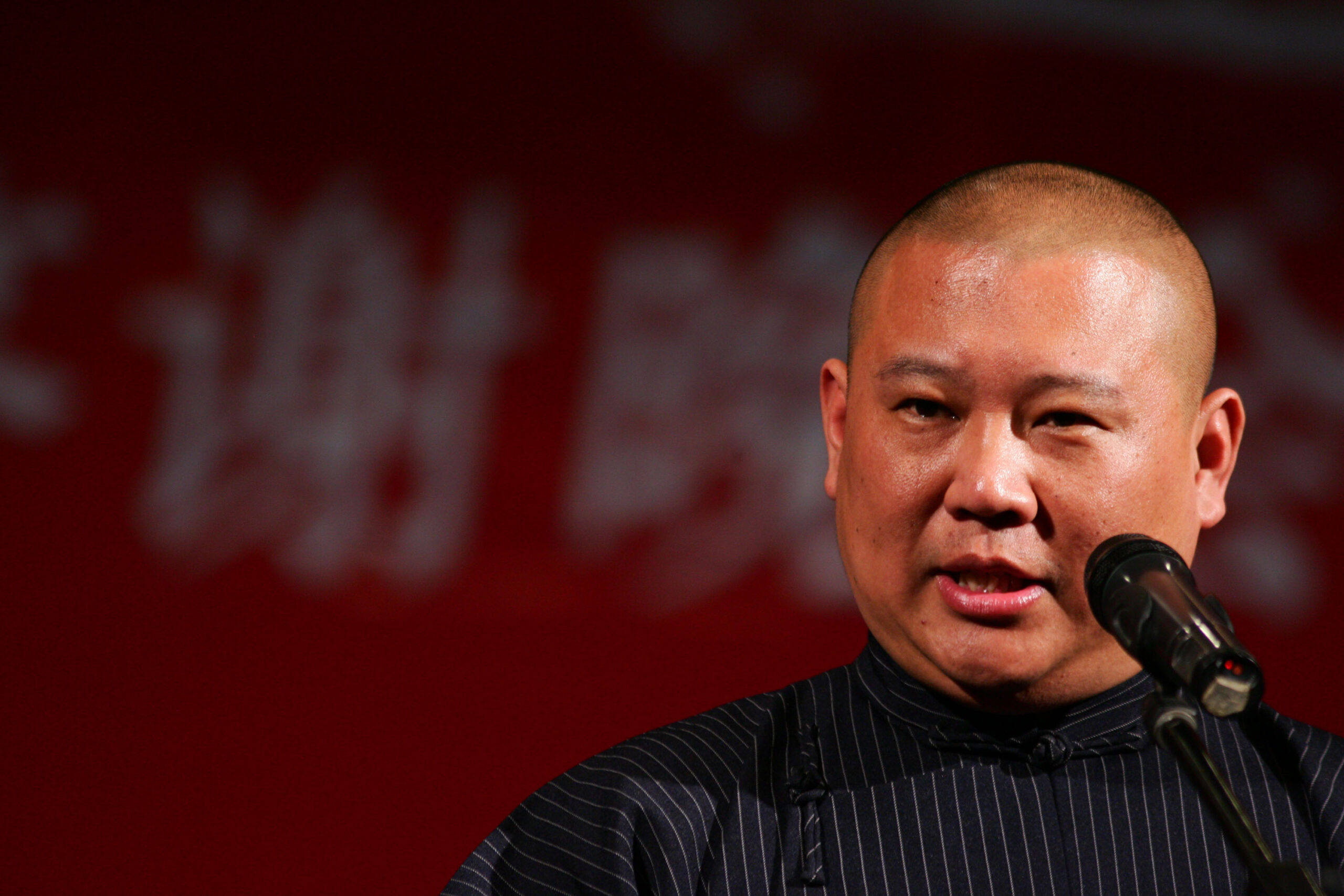
In late July, Chinese renowned crosstalk performer and co-founder of De Yun She, Guo Degang, during a performance in Wuhan, spontaneously adapted the lyrics of a popular revolutionary song, leading to a report filed against him. Recently, the Wuhan Municipal Bureau of Culture and Tourism has initiated an investigation into the matter.
According to reports from mainland media on August 12th, on July 24th, Guo Degang altered the original lyrics of the revolutionary song “Playing My Beloved Pipa on the Weishan Lake” to “Playing My Beloved Pipa in the Forbidden City” during his performance in the Peking Opera “Jigong Living Buddha” at the Kirin Drama Society in Wuhan. He also added playful lines like “Amitabha Buddha, Mama Mama Hold Me”, delivering them in a comedic manner, which prompted someone to file a report against him.
“Playing My Beloved Pipa on the Weishan Lake” is an insert song from the Communist revolutionary film “Railway Guerrillas.”
On August 11th, the Wuhan Municipal Bureau of Culture and Tourism stated that while the performance had legal approval, Guo Degang’s adapted segment was not reflected in the submitted materials, possibly violating the “Regulations on Commercial Performance Management.” Consequently, they have started a legal investigation process.
Following the escalation of the incident, the Kirin Drama Society has removed the controversial segment from their subsequent touring performances, and all related promotional materials have been cleared as of August 12th. Guo Degang and his team have yet to publicly respond to the incident.
This incident has triggered heated discussions among netizens.
Some netizens cautiously commented on Weibo, saying, “After watching the full version, the revolutionary song was only slightly adapted, it shouldn’t be that serious.” “Are they engaging in thought policing again?” “Maybe they are afraid that if this song becomes popular, everyone will follow suit (and then it’s back to being censored, back to Forbidden City).”
“Writer Cui Chenghao” expressed on the social platform X, “Recently, mainland renowned crosstalk performer Guo Degang, in his performance of Jigong Living Buddha, utilized a song from the movie ‘Railway Guerrillas,’ which should not be a big deal. However, some revolutionary masses did not accept it, insisting on reporting it. Even a movie insert song has become untouchable, indicating the current political and economic environment on the mainland is turbulent, and everyone is on edge.”
“Gao Zhifei @Gfreedman9,” who has long been following issues related to Chinese politics, society, and international relations, commented on X, “Reporting is the easiest weed to thrive in a cultural desert… A country that institutionalizes and normalizes the ‘reporting’ system is itself employing an anti-human governance logic. Normal social governance relies on clear rules, independent judiciary, and the most basic trust and cooperation between people. Using reporting as a core governance tool essentially encourages people to monitor and denounce each other. It brings suspicion, resentment, and jealousy, which should exist in the private sphere, directly into the channels of public authority, making ‘informing’ a behavior affirmed and even rewarded by the authorities. It systematically destroys trust. As a result, society is fragmented into countless suspicious atoms. When people distrust each other, a true community is hard to form. The rulers do not have to fear being done in by a unified populace.”