
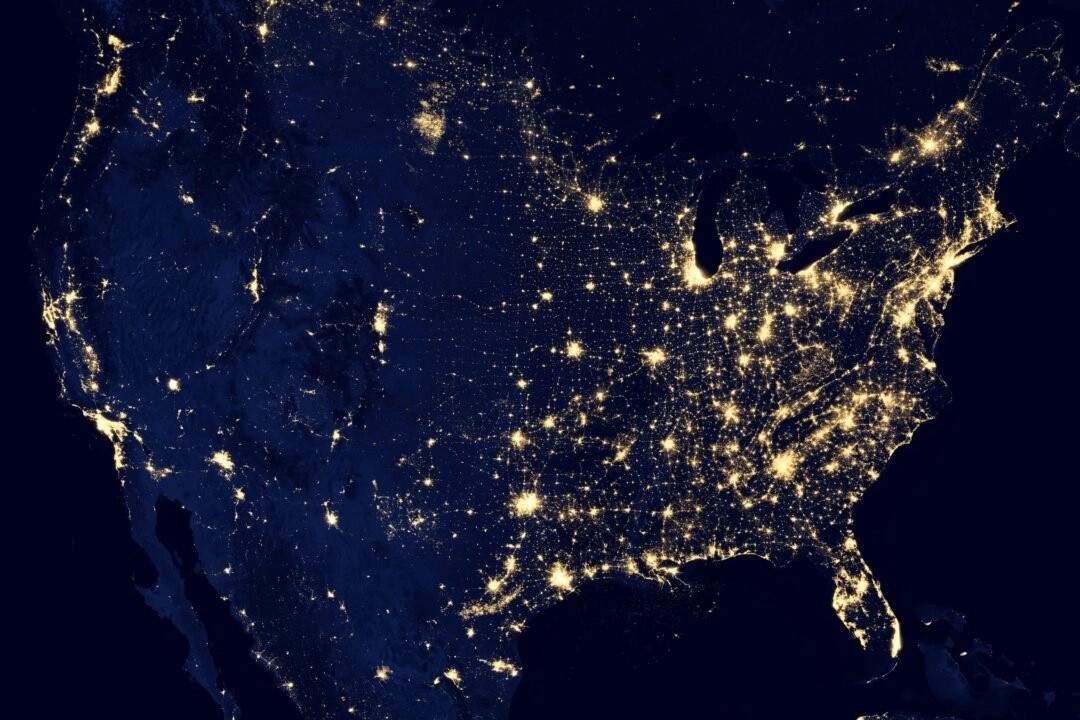
The United States Federal Communications Commission (FCC) recently approved a technology company to conduct an experiment deploying giant reflective mirrors in space, sparking controversy over the related “sunlight on demand” project. Some experts warn that the service may worsen light pollution, affecting astronomical observations and the nocturnal habits of wildlife.
Reflect Orbital, a California-based space technology company, has obtained FCC approval to test their satellite “Eärendil-1” with a giant space mirror. The satellite will reflect sunlight from low Earth orbit to provide illumination for the dark side of the Earth.
According to a spokesperson for Reflect Orbital, after obtaining approval, the company will launch and test their demonstration satellite “Eärendil-1.” The satellite will carry a giant space mirror and adjust its angle to precisely reflect sunlight into designated areas, illuminating an approximately 3-mile diameter.
In the future, this technology could be used for lighting in off-grid communities, nighttime solar power generation, agriculture, and disaster relief efforts.
The spokesperson said that the first test mission of “Eärendil-1” is expected to launch later this year, with a goal of deploying 36 satellites with giant space mirrors into orbit by 2027.
The long-term plan of the company is even more ambitious, aiming to deploy as many as 50,000 satellites by 2035.
Despite the seemingly positive outlook of the “sunlight on demand” project, it has faced significant opposition. Experts have raised concerns about increased light pollution and alterations to the night sky.
Stacy McGaugh, head of the Department of Astronomy at Case Western Reserve University in Ohio, stated that artificial light like this could disrupt astronomical observations significantly.
The American Astronomical Society also pointed out that reflective light may interfere with sensitive research telescopes, posing risks such as glare and eye damage.
The International Astronomical Union (IAU) and its Center for the Protection of the Dark and Quiet Skies (CPS) have begun researching the actual impacts of the first satellite that Reflect Orbital plans to launch.
Piero Benvenuti, director of the CPS, warned that deploying 50,000 reflective mirror satellites could have disastrous consequences for astronomy.
Some experts are also concerned that changes in nighttime lighting may disrupt the lives of wildlife, especially nocturnal species that rely on natural dark-light cycles for their activities.
Gregory Radisic, a senior teaching researcher at the Space, Cyber, and Data Law Center at Bond University in Australia, suggested that while this technology may have value in strict situations like disaster relief, further research is needed on its long-term effects on ecosystems, human circadian rhythms, and light pollution before widespread commercial application.
The United Nations Office for Outer Space Affairs (UNOOSA) pointed out that the existing Outer Space Treaty does not explicitly prohibit placing reflective objects in orbit, but such activities must consider the interests of other treaty nations, and affected countries have the right to raise objections.
In response to these concerns, Reflect Orbital stated that they have communicated with scientists, astronomers, and environmental researchers, and pledged to establish no-shine zones for observatories, ecologically sensitive areas, and bird migration pathways, while also undergoing environmental impact assessments and relevant regulation.