
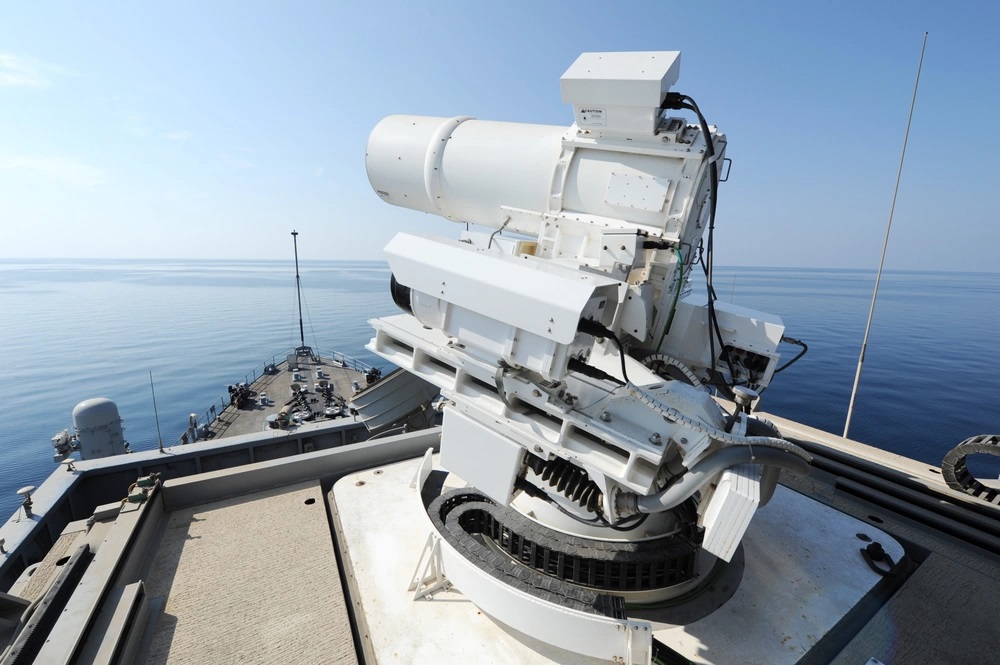
Laser weapons are stepping out of the laboratory and into the battlefield, according to missile defense expert Tom Karako from the Center for Strategic and International Studies (CSIS). He detailed the changing landscape, the actual effectiveness of laser weapons, and why they cannot replace missiles.
For decades, laser weapons have been one of the most ambitious technological goals for the Pentagon, envisioning a future where enemy drones and missiles can be shot down at the speed of light without the need for expensive interceptors.
Now, after years of testing and setbacks, the U.S. Army is preparing to take a crucial step towards turning this vision into reality.
The Army is on the brink of finalizing a contract for the “Extended-Range High Energy Laser” (E-HEL), which once deployed as planned, will become the Army’s first laser weapon with persistent combat capability.
Modern warfare is facing a new era where low-cost drones can overwhelm traditional air defense systems, forcing military forces to expend expensive intercept missiles costing hundreds of thousands or even millions of dollars. If successfully deployed, the E-HEL will mark a significant advancement for the U.S. military in countering such drone threats, providing a new means that does not solely rely on expensive traditional kinetic weapons.
In July of this year, Lieutenant General Frank Lozano, who oversees Army equipment procurement, stated that the Army is in discussions with AeroVironment for the E-HEL project and described it as the Army’s first official project for a high-energy laser weapon system. He noted that the technology showcased “enormous potential and capabilities” during testing at the White Sands Missile Range in New Mexico.
An insider informed Fox News Digital that the Army is nearing finalization of the contract, although negotiations are still ongoing and a final decision has not been made.
The Army’s efforts are not isolated actions. In July of this year, the Air Force revealed that compact laser weapon systems are being used at multiple overseas locations to defend against drones. Meanwhile, the Navy has been testing its “High-Energy Laser with Integrated Optical-dazzler and Surveillance” (HELIOS) on destroyers and gradually integrating directed energy laser weapons into fleet operations.
Taken together, these advancements indicate that after decades of research and billions of dollars invested, the Pentagon is entering a new phase in the field of directed-energy laser weapons.
The focus is not only on the laser technology itself. Tom Karako from CSIS Missile Defense Program told Fox News Digital that “what really makes it an effective weapon system are a host of other factors,” from ensuring equipment can withstand dust, high temperatures, and harsh weather conditions to drafting operational doctrines, training personnel, and maintaining the system in the field, all of which are crucial.
Additionally, as laser beams continue to propagate after hitting the intended target, the military must ensure that the laser does not accidentally irradiate satellites or other aircraft. This is one of the reasons why integrating this technology into combat is much more complex than simply producing high-powered lasers.
Although laser weapons are increasingly closer to deployment in actual combat, they are unlikely to replace traditional missile defense systems.
Unlike missiles capable of striking distant targets beyond the horizon, laser weapons are primarily short-range weapons, meaning they can only engage targets within direct line of sight.
“When a drone approaches overhead, it’s highly effective,” said Karako, “but achieving beyond-visual-range engagement is challenging.”
Therefore, lasers are likely to become another layer in the Pentagon’s air defense system, rather than a substitute for kinetic intercept missiles. When dealing with long-range threats or threats in harsh environments, reliance on missiles is still necessary, while lasers may be most effective against drones and other aerial threats within the defense area.
The Army is also developing a next-generation anti-drone missile expected to cost less than $150,000 per interceptor, as part of broader efforts to expand low-cost anti-drone capabilities.
Laser technology is just one facet of the Pentagon’s push for directed-energy technologies. The military is also testing high-powered microwave systems, such as Epirus’ Leonidas system, to counter one of the fastest-growing threats on the battlefield: swarms of low-cost drones.
Unlike kinetic intercept missiles, high-powered microwave systems utilize pulsed electromagnetic energy to simultaneously disrupt the electronic systems of multiple nearby drones.
The Pentagon is also investing in radio frequency technologies that can disrupt communications between drones and operators or interfere with satellite navigation signals, potentially causing drones to lose control.