
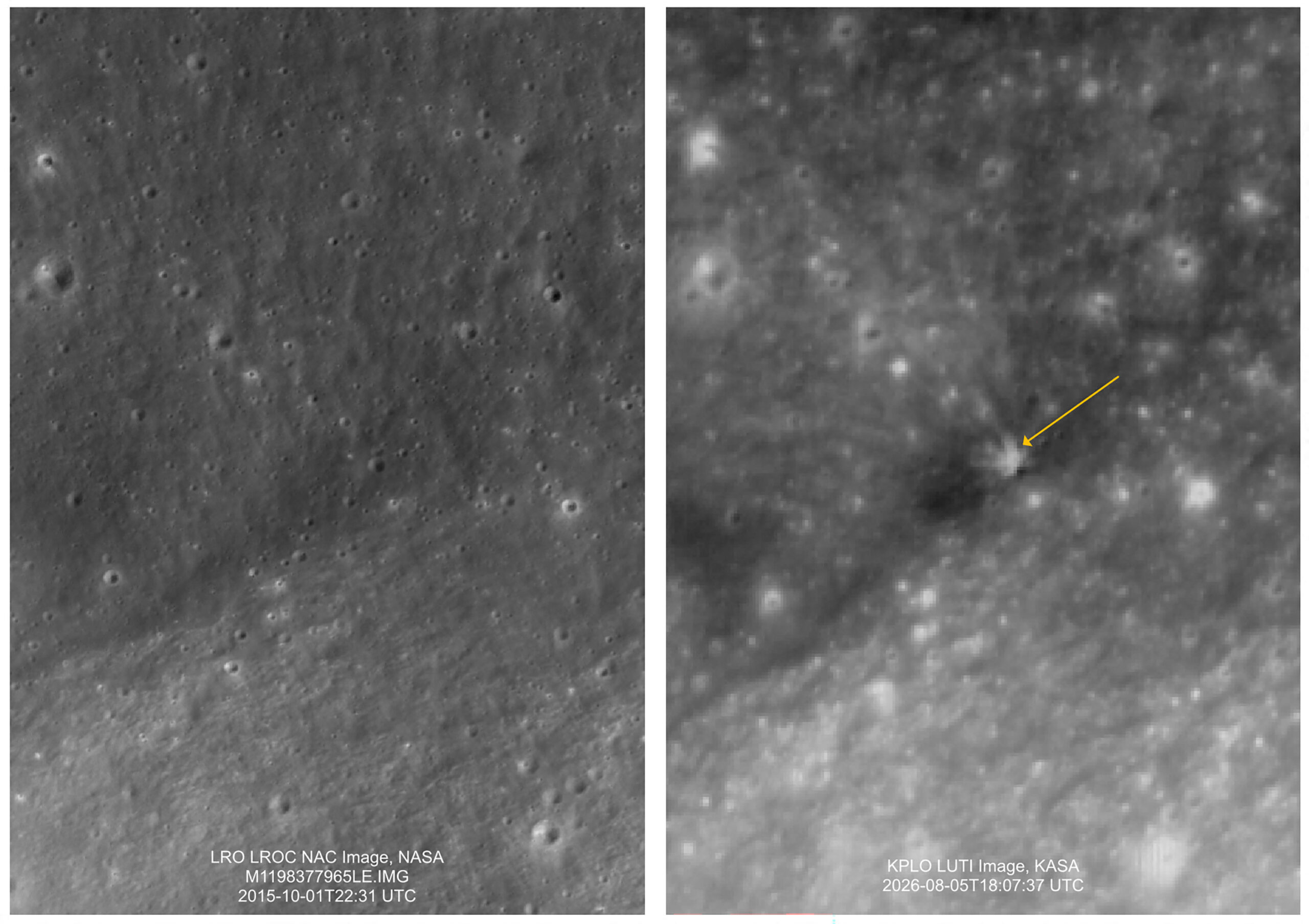
On Wednesday (August 5th), a SpaceX discarded rocket, traveling at a speed of 5400 miles per hour, successfully crashed into the moon as scheduled, leaving the rocket permanently on the lunar surface. South Korea’s lunar orbital spacecraft was the first to transmit images of the moment of impact and the giant new crater left on the lunar surface.
This impact event had been predicted as early as April and has been eagerly anticipated by astronomers and the public for months, with everyone eager to see how the impact unfolds. Although it was challenging to observe directly from Earth, the lunar orbital spacecraft was expected to at least record the aftermath of the impact.
The 8800-pound (approximately 4000 kg) rocket debris crashed at a velocity estimated at around 5400 miles per hour (about 8700 km per hour), near the “Einstein crater.”
According to astronomers and SpaceX, this discarded rocket, which used to orbit the Earth’s upper atmosphere every 26 days, lost control after running out of fuel and was pulled towards the moon by a combination of solar activity and gravitational forces.
Scientists predicted that this impact would create a crater approximately 60 feet wide (about 18 meters) and 12 feet deep (about 3.6 meters), ejecting a plume of dust and rock debris into the air. Currently, South Korea’s lunar orbit probe has become one of the first spacecraft to capture images of the impact aftermath near the moon.
The Korea Aerospace Research Institute (KARI) stated on the social media platform X that their probe, named “KPLO, also known as Danuri” (Korean Pathfinder Lunar Orbiter), began observing approximately 30 minutes before the impact and continued to monitor the site after the collision, conducting a total of 8 imaging shots.
KARI further mentioned in the post, “Through this observation, changes in the terrain surrounding the impact point and traces of ejecta diffusion have been confirmed.” The post also included several before-and-after comparison photos of the impact site.
NASA is also using the Lunar Reconnaissance Orbiter to search for the impact site, a spacecraft that has been orbiting the moon since 2009.
NASA stated in a press release before the impact that determining the exact impact location is not easy and depends on lighting conditions, orbital timing, and spacecraft positioning. NASA added that even if images are captured, it may take “several days to receive them.”
In a statement, NASA said, “Any data collected will help scientists better understand the impact of artificial objects on space exploration.”
The Falcon 9 rocket that impacted the moon had its upper stage originally intended for a launch mission, which took place in January 2025 from Florida, sending Firefly Aerospace’s unmanned commercial lunar lander to the moon.
Usually, after delivering the payload to its designated orbit, the rocket’s upper stage would re-enter Earth’s atmosphere, burning up or crashing into the ocean. However, due to the need for additional thrust to place the lander on a trajectory to reach the moon, the rocket’s upper stage entered a state of “orbital deadlock.”
SpaceX, on the X platform, emphasized their commitment to responsibly handling hardware left in space to ensure space safety, even for more complex missions. While such impact events are rare, they remain a possibility for objects in such orbits; hence, they have collaborated with NASA to develop optimal disposal plans.
SpaceX concluded their post by mentioning the “Starship,” a giant rocket still under development at 400 feet (approximately 122 meters) tall. Unlike the Falcon 9 with its disposable upper stage, the second stage of the “Starship” is designed for reusability, aiming to reduce the number of artificial hardware pieces left in orbit in the future.