
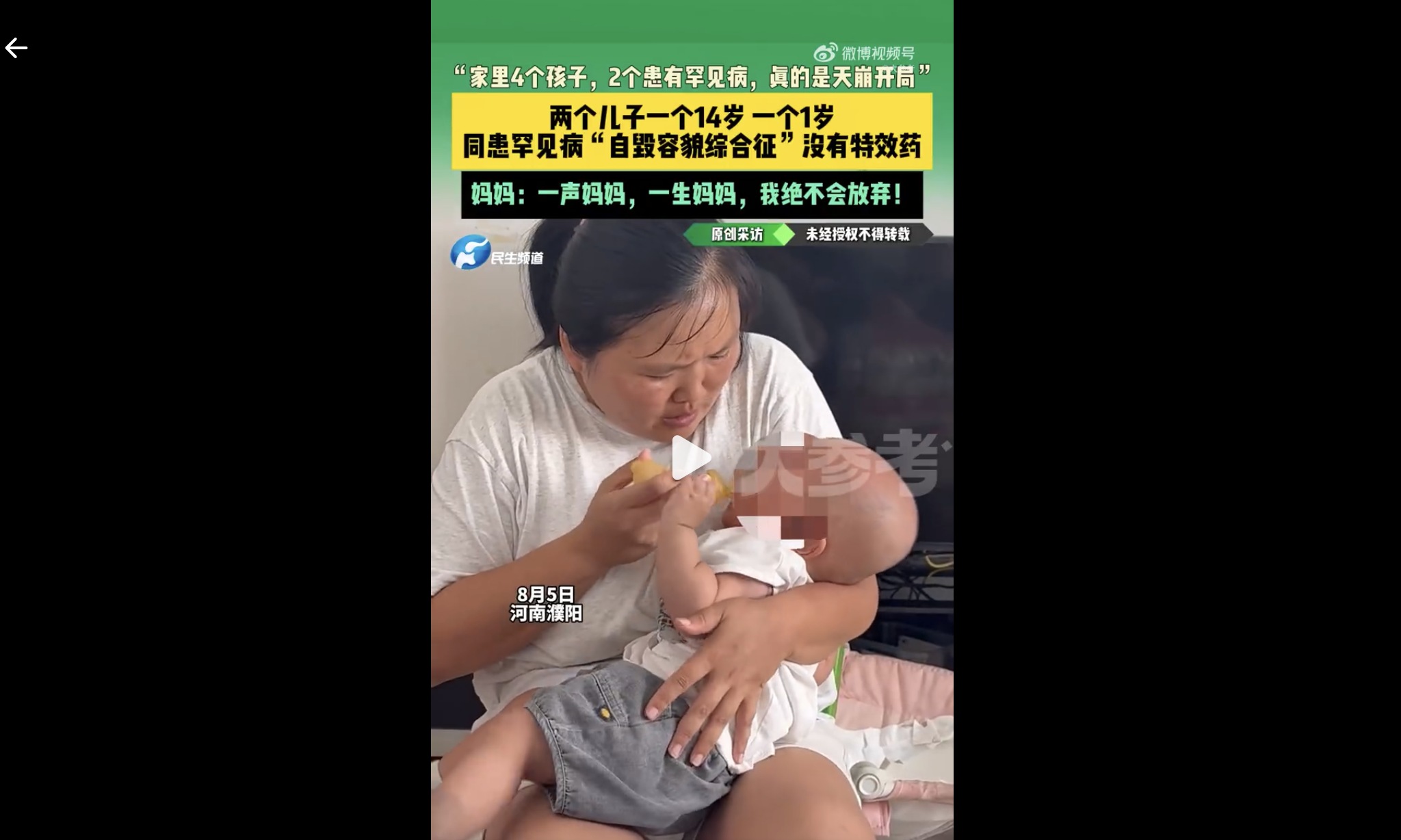
In a recent incident that has sparked widespread discussions among netizens, Ms. Bai, a resident of Puyang City in Henan Province, revealed that two of her four children have unfortunately been diagnosed with the rare genetic disorder known as Lesch-Nyhan syndrome. The two affected sons are 14 years old and just 1 year old, showing uncontrollable self-destructive behaviors such as nail-biting, lip-biting, and head-banging.
Initially, when her elder son began showing symptoms, the family mistook it for cerebral palsy. However, it was only when the younger son, whose prenatal tests indicated normal development, failed to lift his head at 3 months old that both children were diagnosed with the same condition.
Witnessing her children in such distress has been incredibly difficult for Ms. Bai, who expresses deep remorse as a mother. She hopes that more attention can be brought to this disease, offering her children hope for even a single medication to alleviate their suffering. Despite the lack of a cure for the syndrome, she remains steadfast in her determination to care for her sons.
Following the exposure of this event, reactions from netizens have been mixed. While some express sympathy towards the afflicted children, others have raised questions about Ms. Bai’s decision to continue having children after the firstborn showed abnormalities.
Lesch-Nyhan syndrome is a rare genetic disorder with an incidence rate of 1 in 380,000. It is caused by a deficiency of a crucial enzyme in the body, leading to metabolic abnormalities and elevated uric acid levels. In addition to growth and developmental delays, lack of coordination in limbs, intellectual impairment, and difficulties in walking and speaking, individuals with this syndrome may exhibit uncontrollable behaviors such as lip and finger mutilation to the point of bleeding, as well as head-banging. As the pathogenic gene is located on the X chromosome and is recessive, the disorder primarily affects males. Currently, there is no specific treatment available, only symptomatic relief measures can be provided.