
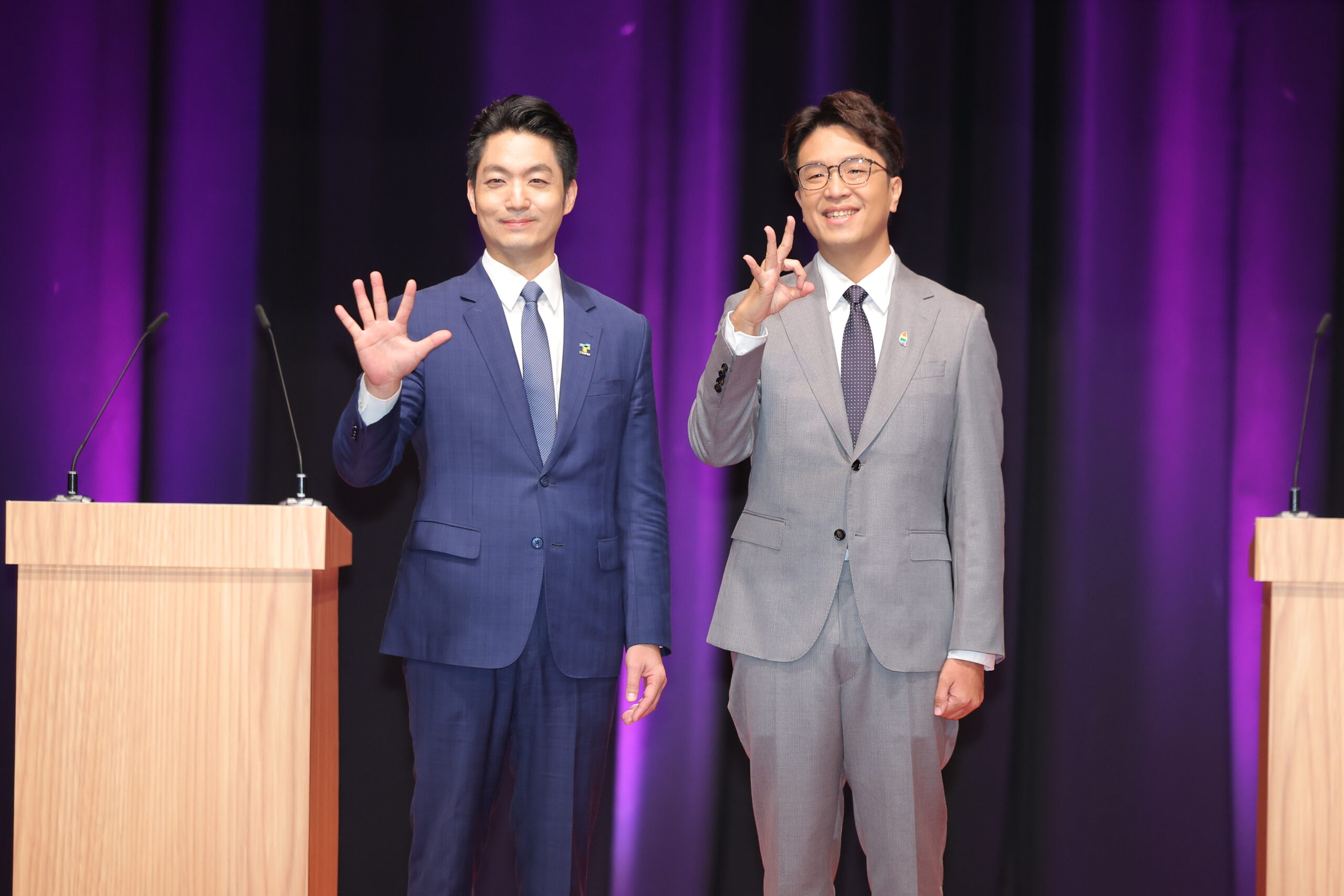
The first televised debate for the Taipei mayoral election took place on October 31, 2026, from noon until 2 PM, at the TVBS studio, jointly organized by TVBS and Sanlih E-Television. This marked the first public confrontation between the Democratic Progressive Party’s candidate Shen Boyang and the incumbent mayor Jiang Wan’an. The two candidates engaged in spirited exchanges, addressing their political views and current events.
As the debate unfolded, observers were keen to determine which candidate mastered the rhythm of offense and defense and whose policies were more feasible. To analyze the performances of both candidates, an in-depth interview was conducted with three political experts, focusing on their policy visions and execution capabilities.
When questioned about who performed better, Luo Zhijiang, the head of Jiang Wan’an’s campaign headquarters and a legislator, took to Facebook on the day of the debate to express his admiration, claiming that Jiang’s performance was a clear victory.
In response, Shen Boyang emphasized during an interview at the Legislative Yuan on November 2 that the crux of the debate was to engage in dialogue with the public rather than to simply win or lose. He expressed the belief that Jiang’s continuous attacks might provide short-term satisfaction to his supporters but could cause lasting damage to Taiwan’s democracy. Shen indicated that he did not wish to engage in such aggressive tactics.
Jiang Wan’an opened the debate by criticizing Shen Boyang for relying on vague slogans, stating that while Shen’s rhetoric was abundant, his actions did not match his words. He accused Shen of being unfamiliar with municipal governance and of often responding improperly to inquiries about city government issues, likening a potential Shen administration to a city adrift.
In an analysis of the debate’s techniques, Yu Zongji, a former dean at the National Defense Medical College, pointed out that Jiang indeed gained an upper hand by strategically using specific examples to frame topics. He continuously posed questions that forced Shen to spend time answering, thus limiting Shen’s ability to delve into administrative shortcomings and the execution of policies.
Yu characterized this tactic as “using attack instead of answers,” effectively sidestepping parts of the administration where explanations were necessary.
Former Kuomintang representative Huang Pengxiao remarked that both candidates performed decently, with Shen meeting expectations while Jiang surpassed them. However, he took issue with the prior provision of questions to both candidates, feeling it diminished the debate’s value and undermined the test of immediate responses, making the event feel more like a pre-arranged speech.
On social media, well-known lawyer Yang, also referred to as the “Heartless Lawyer,” noted Shen’s quick reactions but cautioned that his rapid speech sometimes hindered clarity. He suggested that Shen slow down to enhance audience comprehension. Yang offered three recommendations for Shen: to put down his notes while speaking to prevent distractions, to reduce opening statements and get directly to the point, and to incorporate a bit more humor and teasing to heighten the intensity of their exchanges.
Yang further observed that Jiang’s team had likely benefited from assistance from key advisors, which alleviated some pre-existing flaws in their messaging. He also advised Shen to consider engaging professional speech and debate consultants should he pursue further political ambitions. However, he noted that his suggestion was merely speculation regarding Shen’s preparation.
One of Jiang Wan’an’s prominent proposals, named “Relocating Songshan Airport to Boost AI Development,” was introduced in October 2026. This initiative suggests relocating Songshan Airport and integrating around 300 hectares of surrounding land, promoting the establishment of an AI industry cluster covering 100 hectares, alongside 90 hectares dedicated to residential and public facilities, and an additional 110 hectares for parks and green spaces. The proposal aims to connect technological hubs in Beitou and Neihu with the Nangang Industrial Corridor, while also advancing urban renewal efforts by lifting height restrictions related to aviation.
However, Jiang’s plan was met with criticism from Executive Yuan Premier Cho Jung-tai, who dismissed the airport relocation as opportunistic and lacking substantive cooperation from both central and local governments.
Regarding the supporting policies for the airport relocation, Yu Zongji pointed out that such a proposed move involves central authority as well as national security and healthcare responsibilities concerning offshore islands, which the Taipei City Government cannot unilaterally decide. He asserted that this vision could attract residents hoping for eased height restrictions and urban renewal, but the struggles to fulfill such commitments might pose challenges.
In contrast, Yu suggested that Shen Boyang’s advocacy for using AI in urban governance and the development of smart cities would more directly improve citizens’ lives. He recommended considering the development of areas with lower population density while preserving the existing aviation and healthcare functionalities of the airport, deeming this approach more pragmatic.
Huang Pengxiao echoed similar concerns, noting that relocating the airport exceeds the decision-making authority of the Taipei City Government, while multinational companies like Nvidia also enjoy a high degree of autonomy, making it impractical for local governments to dictate corporate layouts. He believed that Shen’s focus on cross-city cooperation for industrial planning was more mature and feasible.
Throughout the debate, Shen pressed Jiang on meeting attendance and administrative procedures, while Jiang emphasized the existence of special project meetings and government follow-ups. Unfortunately, the exchange often strayed from direct focus, prompting differing interpretations from the experts.
Yu Zongji assessed that Shen was attempting to win over moderate voters, while Jiang aimed to solidify his base and attract supporters from the Taiwan People’s Party. Jiang’s strategy involved attacking Shen’s call for major recalls and underscoring his own executive pragmatism, illustrating that while he had only made minor mistakes, such as cutting one tree, he had planted over 40,000 others—a metaphor for Shen’s more critical observations.
Three days prior to the debate, Jiang’s campaign announced the cancellation of all scheduled activities due to his illness.
Huang speculated that Jiang took a three-day sick leave to prepare and recite his notes, suggesting that his heavy reliance on prepared speeches made him less responsive during the debate. He noted that regardless of the questions posed, Jiang consistently reverted to pre-scripted answers.
Chen Wen-jia, the vice president of Kainan University and director of the National and Regional Development Research Center, commented that a mayor’s performance shouldn’t only be measured by attendance rates but should also account for authorization, coordination, and follow-up effectiveness. He concluded that while necessary procedures and accountability must be clearly articulated, Jiang’s repeated shifting of focus resulted in “answering B to question A,” which might reduce public trust.
Following the debate, numerous polling organizations conducted surveys revealing varying support levels for Jiang Wan’an and Shen Boyang. Poll results from ETtoday and TVBS both indicated that Jiang led Shen by a margin of around 11 percentage points among respondents, with many endorsing Jiang’s chances for election and labeling his viewpoints as more credible.
However, the TVBS poll, released on October 31, showed a narrower margin of only 4 percentage points in Jiang’s favor. Interestingly, participants rated Shen’s performance more favorably, suggesting a disconnect between perceived debating prowess and actual supporting choices.
Conversely, the Taiwan Strategic Analysis Association reported on November 2 that Shen received over half of the support, leading Jiang by approximately 17 percentage points, with favorable views on both his debate performance and electoral prospects. Despite this, more than 60% of respondents indicated that the debate would not affect their voting intentions.
Online polls and local street interviews presented differing outcomes: approximately 70% of respondents in a Yahoo survey favored Jiang, while street interviews in Wanhua showed stronger support for Shen.
Beyond the polling data, veteran political and economic commentator Wu Jialong provided observations on the candidates’ stances during the debate, underscoring the significance of their offensive and defensive tactics. Drawing on experience from U.S. elections, he highlighted that frontrunners typically adopt strategies to cool tensions and avoid giving opponents opportunities for a comeback, while the underdogs engage more aggressively to gain exposure and overturn disadvantages.
Thus, Wu advised the public to focus less on the specific issues discussed and more on who dominated the debate with fervor and conviction.
He suggested that by analyzing the debate footage through this perspective and observing the candidates’ body language, one could effectively discern the victor in this electoral showdown.