
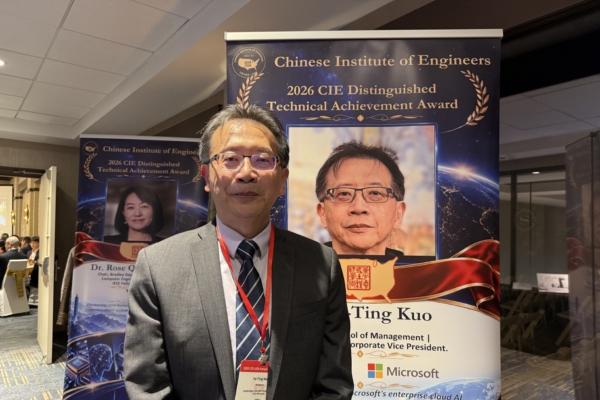
In a world where artificial intelligence (AI) is advancing rapidly and businesses are competing to drive automation, former Microsoft Vice President Yu-Ting Kuo delivered a keynote speech titled “Choice, Not Prediction: Co-Shaping the Age of AI” at the annual dinner of the Greater New York chapter of the Chinese Institute of Engineers on October 25. In an interview that followed with Epoch Times, Kuo emphasized that the purpose of AI should be to enhance human capabilities rather than replace humans. He stressed the importance of maintaining independent thinking, judgment, and decision-making abilities within humanity.
Yu-Ting Kuo, an alumnus of National Tsing Hua University in Taiwan, has been living in the United States for over 30 years. He spent 27 years at Microsoft and retired this past summer. Currently, he is a faculty member at the Massachusetts Institute of Technology and National Tsing Hua University, and serves as an honorary fellow at Hughes Hall, Cambridge University in the United Kingdom.
In his speech, Kuo pointed out that while AI generates answers at an increasingly rapid pace, human ability to comprehend and validate these answers may not keep up. He remarked, “Our capacity to produce answers is evolving at a pace faster than our ability to validate and fully understand these answers.”
He highlighted that AI is already capable of writing software autonomously, allowing an individual to accomplish tasks that previously required an entire team. However, he cautioned that human capabilities to verify AI’s answers and understand its mechanisms and consequences may lag behind.
Kuo particularly noted that when students encounter difficulties and engage in thoughtful reflection during their learning process, this struggle is, in itself, an essential part of learning. Unfortunately, he observed, students today are increasingly “turning over the thinking process to AI.”
In the subsequent interview, Kuo commented that the current trajectory of AI technology development is primarily focused on replacing jobs traditionally performed by humans. He argued that AI should be employed instead to augment human abilities. He cited the example of AI potentially scoring top marks on the bar exam; however, this does not imply that it can become a successful lawyer, as professional roles encompass not just knowledge but also numerous human values and judgments that AI cannot replicate.
Kuo expressed particular concern about the younger generation’s over-reliance on AI, which he believes could result in a gradual loss of independent thinking skills. “AI may provide answers, but we cannot accept them blindly for the sake of convenience; we should continue to question and think critically,” he remarked. He warned that without opportunities to practice critical thinking and inquiry, young people’s critical thinking skills and judgment could deteriorate over time.
Referencing the famous philosophical statement “I think, therefore I am,” Kuo emphasized that the act of thinking is a vital value of human existence. While AI can assist in completing various tasks, surrendering the processes of reasoning and judgment to AI could lead to an unconscious loss of autonomy for humanity.
He underscored the importance of “Cognitive Sovereignty,” pointing out that technology is not entirely neutral; it often reflects the interests and choices of its developers and corporations. If humans lose their ability for independent judgment, they could unwittingly become dominated by the very technologies they created.
Moreover, he affirmed that amidst the increasing automation of AI systems, human oversight remains indispensable. “We are in charge,” he stated emphatically, implying that it is crucial for society to take leadership in managing the implications of AI.
Kuo concluded by noting that while AI can indeed enhance efficiency and productivity, humanity must not relinquish its capacity for thought, values, and judgment. The fundamental challenge remains for society as a whole to decide how best to leverage this technology to maximize its positive benefits while minimizing negative impacts.