
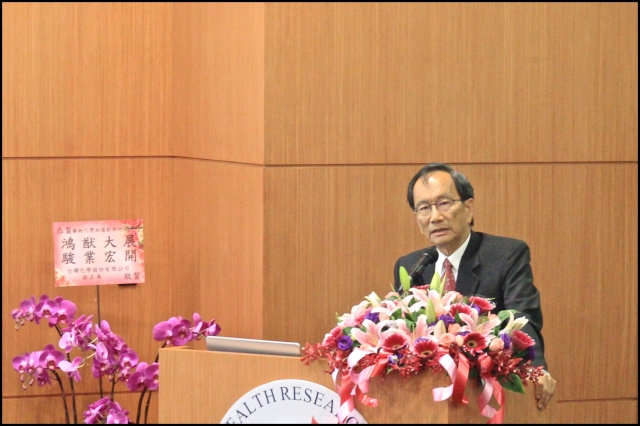
Taiwan’s Academia Sinica announced today that former Vice President Academician Wang Hui-jun has recently been named a Founding Honorary Member of the Federation of European Biochemical Societies (FEBS) Research Academy. He is among the 96 founding members globally, which includes 27 Nobel laureates, showcasing Taiwan’s research strength and gaining international recognition.
According to the press release by Academia Sinica, former Vice President and former Distinguished Research Fellow of the Institute of Biochemistry, Academician Wang Hui-jun was honored as a Founding Honorary Member of the FEBS Research Academy.
The FEBS Research Academy is a new international academic platform established by the federation, aiming to bring together outstanding scientists in molecular life sciences and related fields from around the world to promote excellent research, nurture research talents, and address challenges in human society.
Academia Sinica stated that Academician Wang Hui-jun is a globally recognized structural biologist. He obtained his Ph.D. in Chemistry from the University of Illinois at Urbana-Champaign in 1974 and subsequently conducted research at the Massachusetts Institute of Technology (MIT) for over 10 years before returning to his alma mater in 1988.
Throughout his rich experience in research, teaching, and administration in the United States, Wang Hui-jun returned to Taiwan in 2000 to serve as the director of the Institute of Biochemistry at Academia Sinica. He was elected as an academician of Academia Sinica in the same year and has also served as Vice President of Academia Sinica and President of the Asia-Pacific Biochemical and Molecular Biology Union. He has received numerous international academic honors, including being an Honorary Member of the American Association for the Advancement of Science (1998), a Fellow of the World Academy of Sciences (2005), and the Presidential Science Prize of Taiwan (2017).
Academician Wang Hui-jun has long been committed to research on nucleic acids and protein structures. During his tenure at MIT, he first discovered the Z-DNA conformation of the left-handed double helix, opening up new research fields. He also elucidated the molecular structure of the world’s first anti-cancer drug and DNA complex, providing a vital scientific basis for the design of next-generation anti-cancer drugs.
Subsequently, Wang Hui-jun has revealed the pathogenic and antibiotic resistance mechanisms of Staphylococcus aureus and Staphylococcus epidermidis, providing important clues for combating superbugs. He has also developed methods to assist in the regular arrangement of proteins, overcoming the bottleneck of proteins being difficult to crystallize and challenging to analyze structurally.
In recent years, Wang Hui-jun has actively applied the results of structural biology to new drug development, including enhancing the efficacy of antibody drugs and designing small molecule drugs targeting key enzymes related to Alzheimer’s disease, continuously promoting the development of basic research results towards biomedical applications.
FEBS, founded in 1964, has a history of over 60 years and is one of Europe’s most representative international academic organizations in molecular life sciences. Through publishing international journals, organizing annual conferences, and providing research funding, FEBS promotes academic exchanges and research development. The inauguration ceremony of the Research Academy is scheduled to take place during the 51st FEBS Congress in Latvia in July 2027.