
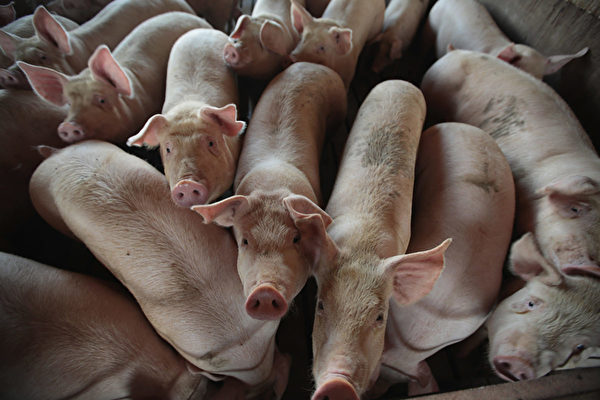
China’s pig prices continue to remain low, causing leading pork companies to suffer significant losses. Wens Food Group Co., Ltd. (Wenshi Shareholding), disclosed its third-quarter report for 2026 on October 21st, revealing a net loss of 4.961 billion yuan (RMB) to the public company’s shareholders from the beginning of the year until the end of September, whereas it recorded a profit of 5.256 billion yuan during the same period last year. The company attributed this substantial loss to the significant drop in pork prices, leading to substantial losses in the pig farming business.
This downward trend is not isolated to just one company. According to data from the Chinese Ministry of Agriculture and Rural Affairs, in the second week of October 2026, the national average price for live pigs was 10.89 yuan per kilogram, a weekly decline of 1.6% and an annual decline of 11.5%; the average price of pork was 20.81 yuan per kilogram, down 11% from the previous year. Even after the Mid-Autumn Festival and National Day holidays, the market has yet to show a significant rebound.
In the evening of October 21st, Wenshi Shareholding’s quarterly report for the third quarter indicated that the operating income for the first three quarters was 72.197 billion yuan, a 4.74% year-on-year decrease, with a net loss of 49.61 billion yuan attributable to the parent company, a shift from profit to loss compared to the same period last year.
The majority of Wenshi Shareholding’s losses were concentrated in the first half of the year. The company recorded a net loss of 4.366 billion yuan in the first half, followed by an additional loss of 0.596 billion yuan in the third quarter. The loss in the third quarter significantly narrowed to 3.296 billion yuan compared to the second quarter, mainly due to an improvement in the profitability of the chicken farming business and a slight rebound in pork prices from the second quarter.
Regarding the substantial reduction in losses in the third quarter, staff members from Wenshi Shareholding’s investor hotline explained to Huaxia Times that the company’s Chinese native chicken business achieved better profitability, leveraging the advantages of dual main businesses. Wenshi Shareholding has consistently focused on both chicken and pig farming industries, with the semi-annual report showing that the revenue from pig farming and chicken farming was 26.648 billion yuan and 17.431 billion yuan respectively, accounting for 57% and 37% of the total revenue, respectively.
Gao Chengyuan, director of the Far-reaching Influence Institute, analyzed to Huaxia Times that it was the profitability of the chicken farming business that provided vital support, allowing Wenshi Shareholding to achieve a “less loss” situation amidst the general major losses in the pig farming industry. However, he also cautioned that the non-recurring net loss in the third quarter was still 0.52 billion yuan, and the operating cash flow for the quarter was a net outflow of approximately 0.471 billion yuan. With the average pig price in September down 18.44% year-on-year, the reduction in losses is more a result of the seasonal peak season and the independent market trends of chicken prices than a signal of a cyclical turnaround in the pig industry.
On the price front, the average selling price of live pigs in September was 10.75 yuan per kilogram, still down 18.44% year-on-year, with a decline from the 10.86 yuan per kilogram recorded in August. During the same period, although the sales volume and revenue of pork increased month by month, the price decline continued to drag down overall performance.
Bai Wenxi, chief economist of the Chinese Enterprise Capital Alliance, stated, “Reducing losses in the third quarter does not mean the turning point has arrived; this is a seasonal repair during the bottoming period, and the pig business has not yet turned positive.”
Entering the fourth quarter, pig prices are once again under pressure. According to data from YNXT, on October 22nd, the benchmark price for live pigs was 9.87 yuan per kilogram, a 3.24% decrease from the beginning of the month at 10.20 yuan per kilogram. Wang Zuli, a member of the Chinese Ministry of Agriculture and Rural Affairs Expert Consultation Committee on Pig Industry Monitoring and Early Warning, warned that the relative shrinkage effect of the decline in the stock of sows may be limited this time, and the industry must maintain rationality and not have overly high expectations for the future market conditions.
Wenshi Shareholding sold 40.4769 million live pigs in 2025, accounting for about 5.6% of the national live pig slaughter volume, ranking second among A-share pig farming listed companies. This indicates that even top companies with scale advantages struggle to completely offset the impact of falling pig prices.
The current market conditions are related to an oversupply of live pigs and insufficient demand. The drop in pig prices will squeeze farming profits, but adjustments in farming capacity take time: after the decrease in the stock of sows, it still needs to go through the breeding and fattening cycle to gradually reflect in the volume of live pigs. If the rate of supply contraction is slower than the price decline, the farming industry may continue to incur losses.
In the first half of this year, the national average transaction price for live pigs was about 10.52 yuan per kilogram, approaching a 20-year low.
Observer Net reported that Wenshi Shareholding’s average price for live pigs during the same period was about 10.50 yuan per kilogram, a nearly 30% decrease from the previous year; although the company has reduced farming costs, the decline has not kept pace with the speed of the price drop.
Adjustments are starting to appear on the supply side. According to data from the National Bureau of Statistics of China, by the end of the third quarter of 2026, the national stock of sows stood at 36.02 million, a decrease of 4.33 million pigs compared to the previous year, a decline of 10.7%, and it fell to 96% of the normal holding level of 37.50 million pigs.
During Wenshi Shareholding’s investor communication activities in September, the company indicated that there is still divergence in the market regarding the timing and extent of the pig price cycle reversal. The company preliminarily forecasted that there is potential for a consolidation turning point in pig prices around the Chinese traditional New Year. The company also pointed out that whether the pig farming industry can return to profitability in 2027 will depend on the pig price trend in the fourth quarter of this year and the pace of capacity utilization.
For Wenshi Shareholding, while the chicken farming business can partially offset some losses from pig farming, the company still needs to rely on reducing farming costs, improving production efficiency, and adjusting product structure before pig prices rebound, in response to the prolonged market downturn.