
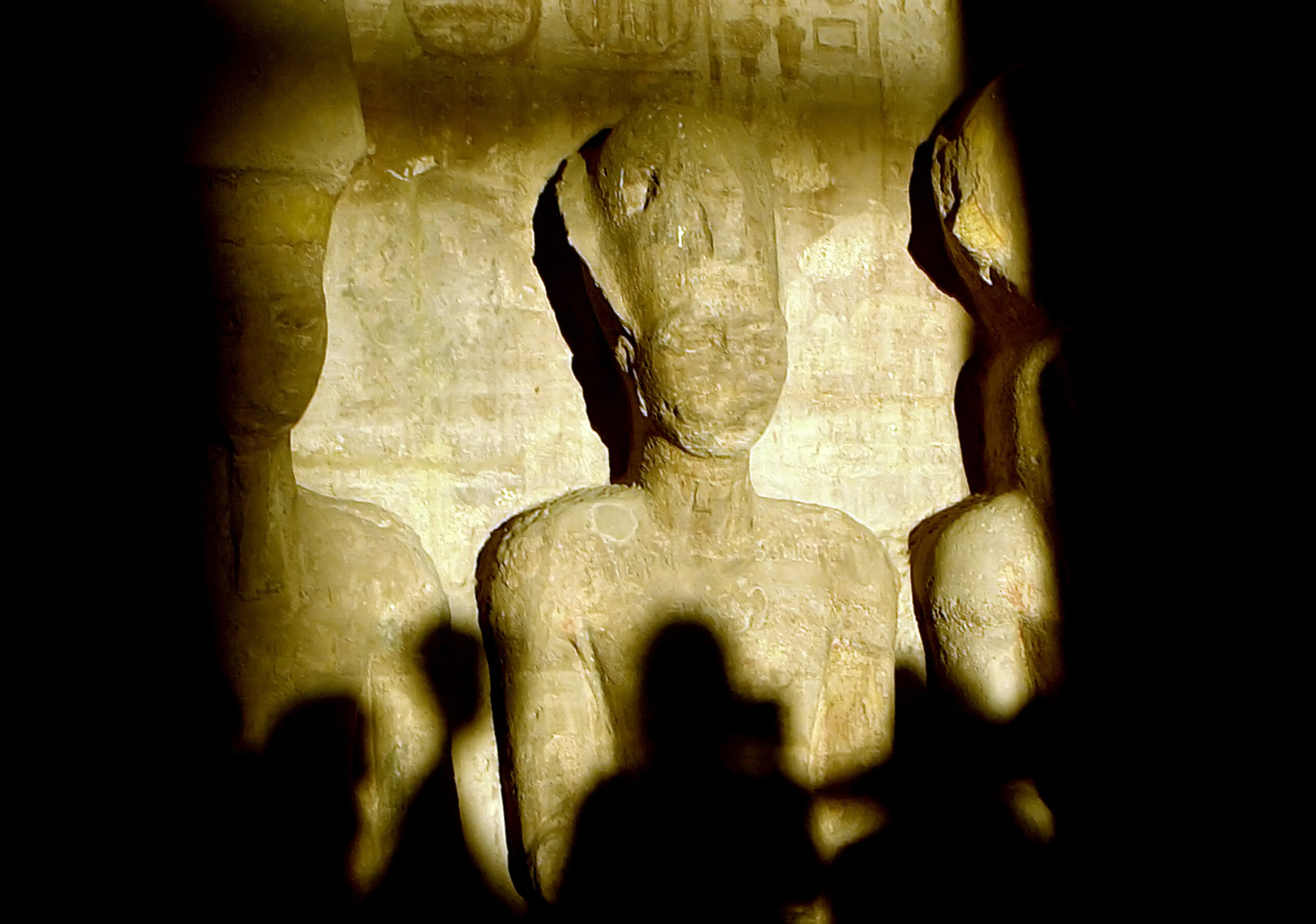
In a fascinating spectacle, golden sunlight illuminated a temple with over 3,000 years of history in Egypt, casting light upon the statues of pharaohs and deities. This rare occurrence, happening only twice a year, attracted visitors from all around the world.
According to reports from the Associated Press, at dawn on October 22nd, hundreds of tourists from various countries and locals gathered at the Great Temple of Ramses II in southern Egypt. Some even camped outside the temple overnight just to witness this phenomenon that has been occurring for thousands of years, only appearing twice annually.
The Great Temple of Ramses II, built on the order of Pharaoh Ramses II of the 19th Dynasty of Ancient Egypt in the 13th century BC, stands grand with a history of approximately 3,300 years.
On October 22nd and February 22nd each year (believed to correspond to Ramses II’s coronation day and his birth date respectively), sunlight penetrates the dim interior of the temple, illuminating the statues of the pharaoh himself and two deities by his side.
This spectacle lasts for around 20 minutes, a phenomenon resulting from the precise alignment of the temple with the position of the sun.
On the day of October 22nd, numerous visitors crowded the almost pitch-black interior of the temple, capturing the moment with their phones. A beam of sunlight pierced about 60 meters (200 feet) into the depths of the temple, illuminating the statues of Ramses II, Amun-Ra, and Ra-Horakhty.
On the outside of the temple, a large group of tourists gathered. Despite their large numbers, they appeared tiny compared to the colossal statues standing by the temple, overlooking the Nile River.
Local tour guide Hisham Khela, who specializes in welcoming Italian tourists, told the Associated Press, “As you can see, today is a very special day. It’s a celebration and a historically significant event.”
Janice Souudi, a visitor from Georgia, USA, expressed that it was her first visit to Egypt and certainly not the last. She remarked, “I came here today to see these enormous temple statues and admire how well they have been preserved. The intricate carvings, hieroglyphics, and colorful images left a deep impression on me. It’s simply beautiful and astonishing; this trip was definitely worth it!”
In the 1960s, Egyptian archaeologists undertook a massive project to dismantle and relocate the temple to protect it from the rising waters of the Aswan High Dam. The engineers preserved the original orientation of the temple to maintain its alignment with the sun, ensuring sunlight can still enter its interior twice a year.
Egyptian media emphasized that the temple showcases the extraordinary creativity of the ancient Egyptians, who ingeniously combined art, science, astronomy, and engineering to create such a spectacle.