
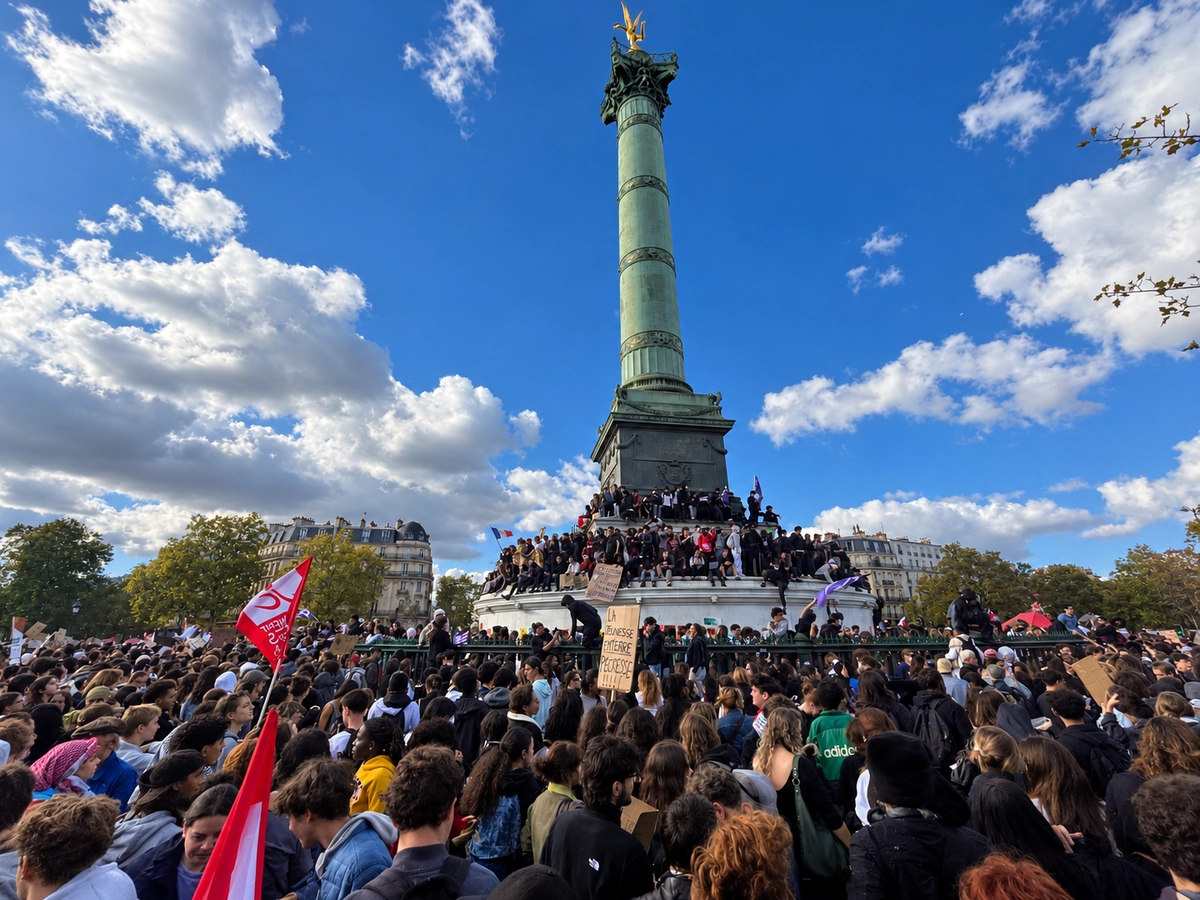
On Thursday, October 8th, high school and university students across France continued to stage strikes, block campuses, and called for a new round of demonstrations on the 13th. In Paris’s Bastille Square, clashes broke out between protesters and riot police, with many communist and pro-Palestine flags seen on site, drawing attention to the involvement of far-left forces.
According to the French Ministry of the Interior, a total of 71,500 people participated in marches and rallies nationwide that day, with 24,500 in Paris alone. Another 55,000 joined protests outside campuses, leading to the arrest of 504 individuals and injuries to 48 police officers and gendarmes.
Interior Minister Laurent Nuñez strongly condemned the violent incidents and praised the police for successfully thwarting attacks against officers. Bastille Square is an important historical landmark from the 1789 French Revolution. Protesters chanted “We have taken the Bastille” and waved communist and Palestinian flags, with banners calling for a new nationwide demonstration on October 13.
Some protesters referenced the Bolshevik Revolution of 1917, with signs reading “October Revolution” held up on site. Others drew on symbols from the French Revolution, with one banner reading “1789-2026, Let’s take back the Bastille.” Anti-government and anti-police slogans were shouted, while the Gaza conflict became a focal point of the demonstrations, with some chanting “We are all children of Gaza.”
Many protesters on site appeared to be older individuals, not typical high school or university students. By the afternoon, tensions escalated at Bastille Square. Shortly after 4:20 pm, police came under attack with stones and fireworks, prompting them to disperse the crowd with tear gas and high-pressure water cannons.
According to Le Figaro, one of the most serious incidents of the day involved someone throwing chimney debris at riot police from a residential rooftop. Some commentators suggested that such attacks could amount to attempted murder of the police.
By evening, the square was eventually cleared by the police. Walls and the base of memorial columns were covered in graffiti, including insults against the police, calls to overthrow the French government, slogans in solidarity with Palestine, and even a large graffiti calling for the beheading of French President Macron.
French government data indicated that the number of demonstrators decreased from 266,000 on October 6 to 71,500 on October 8. The Ministry of Education stated that out of approximately 3,700 high schools nationwide, 375 completely or partially suspended classes on Thursday, a decrease of around 30% from the previous day, with less than 1% of teachers participating in the strike.
According to the office of Prime Minister Sébastien Lecornu, French intelligence agencies have identified the far-left political party “Unbowed France” (LFI) led by Jean-Luc Mélenchon, as well as what officials referred to as its “far-left proxies,” playing some role in inciting protest activities.
Rubens Strachan, the national representative of the major right-wing student organization UNI, mentioned that the political nature of these protest activities did not come as a surprise. “It’s not even being co-opted because the far left is the one who initiated this movement,” he said.
“On the blockade lines, we saw a variety of slogans from Gaza to New Caledonia. Ultimately, no one really knows what the demands are now,” he noted.
Mélenchon, who has praised socialist governments in Cuba, Venezuela, and China multiple times, lauded the protests at Bastille Square and called on supporters to participate in demonstrations again on October 13.
This wave of protests has also reached university campuses, a type of protest activity not commonly seen in universities before. The conflicts are part of ongoing campus protest activities in France for several weeks, disrupting the normal teaching order in high schools and universities.
On October 8th, the blockades spread to the Catholic Institute of Paris – an institution where such actions are rare historically, and the prestigious Paris Second University known for its law programs and long-standing conservative student community.
Strachan mentioned that UNI members at these two campuses reflected that the majority of those participating in blockades were not enrolled students. “When we see so many people in black clothes waving ‘Antifa’ banners at the Paris Second University, things become clear,” he said, questioning if these protests truly reflect the views of the students from these institutions.
It was noted that some protesters participating in the blockade at the Catholic Institute of Paris had appeared the previous day near the blockade site at the Paris Institute of Political Studies.
Facing the escalating campus protests, the French government is trying to address the education issues that initially sparked the protests.
Lecornu promised in a television speech on October 7th that the government would announce the first set of measures by the end of October, but did not commit to additional funding beyond the already budgeted €1.2 billion increase for education in 2027. He also criticized politicians for exploiting students’ dissatisfaction for electoral gains.
On October 8th, French Education Minister Édouard Geffray announced that the government would dispatch 3,000 substitute teachers to 114 high schools facing severe shortages within the next few hours to days.
Strachan believed that the government’s current response was insufficient to address the fundamental issues in the education system and might fuel further protest activities. He criticized the Macron government for failing to effectively improve conditions in French secondary schools and universities over the past decade and accused the government of being too lenient on far-left organizations.
“I want to point out that far-left organizations in universities have received huge sums of government funding, which were then used to buy equipment for demonstrations against the same government that funded them,” he said.
Finally, Strachan emphasized that these protesters do not represent all high school and university students. “There is a silent majority opposing these actions. Our demand is to study in peace.”