
Taiwan National Palace Museum’s Northern Branch has launched the fourth season of its calligraphy and painting exhibition, showcasing the diverse aspects of giant calligraphy and painting works. The first wave features “Nourishing the Heart: Giant Masterpieces Exhibition,” presenting the grandeur of the museum’s massive calligraphy and painting pieces. “True Insight: Aesthetic Principles and Calligraphy Appreciation” guides viewers to discover the beauty of calligraphy through aesthetic principles. From the overall momentum of giant masterpieces to the beauty found in each stroke, the two new exhibitions at the museum offer a fresh perspective on viewing calligraphy and painting.
The Taiwan National Palace Museum stated that the “Nourishing the Heart: Giant Masterpieces Exhibition” expands the viewing scale to giant calligraphy and paintings. The exhibition centerpiece is the nearly three-meter-high scroll painting “Pure Land Bodhisattva Portrait” from the Qing Dynasty, accompanied by works such as “Strange Stones and Bamboo” by Xia Chang from the Ming Dynasty and “Eight-Couplet Poem with Generals and Ministers” by Wang Youdun from the Qing Dynasty. The “Pure Land Bodhisattva Portrait” originated from a water and ink Bodhisattva portrait copied by Emperor Qianlong in 1761 at Mount Wutai, Shanxi Province, and later completed by court painter Ding Guanpeng. It not only reflects Emperor Qianlong’s artistic taste but also holds religious and political significance in his self-conceived Bodhisattva incarnation.
Works in literati style like “Landscape Scroll” by Shan Zhou primarily depict mountains, valleys, winding rivers, and literary men strolling along mountain paths, small bridges, springs, and riverbanks, creating a sense of immersion in nature and poetic feelings. This brings to mind the image of Emperor Qianlong and his officials appreciating calligraphy and painting during moments of leisure and cultivating their inner selves, embodying the concept of “nourishing the heart.”
The Taiwan National Palace Museum noted that many viewers may find it challenging to articulate the aesthetic qualities of calligraphy works or believe that understanding the background knowledge of the author, period, and script style is essential. Is there a more intuitive way to appreciate calligraphy?
Fang Lingguang, Assistant Researcher at the Museum’s Calligraphy and Painting Documentation Department, mentioned that the special exhibition “True Insight” attempts to offer a different perspective. By combining cultural relics with explanatory aids, the exhibition utilizes aesthetic principles such as proportion, symmetry, contrast, gradation, unity, balance, and rhythm to explore how calligraphers arrange points, lines, radicals, characters, and rows to create visual relationships. Through a “seeing is believing” presentation, the exhibition aims to guide viewers from understanding individual characters to appreciating the aesthetic logic of calligraphy in complete passages, allowing aesthetic principles to become a practical way for the public to engage with the art of calligraphy.
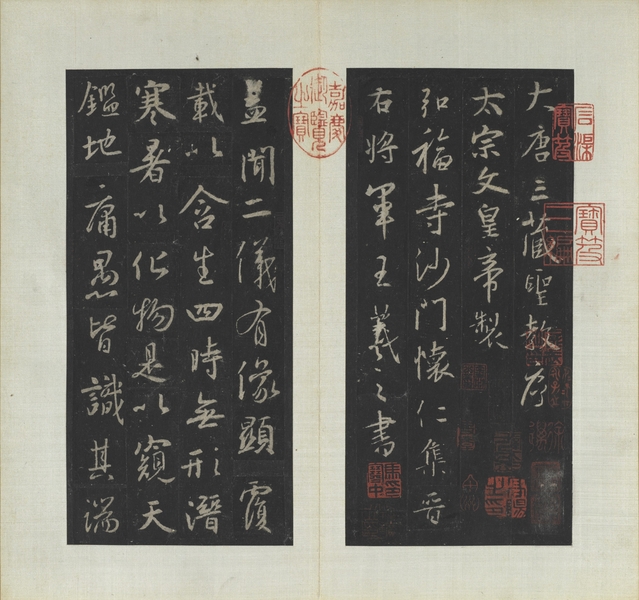
Fang Lingguang further illustrated that the exhibition includes a Song Dynasty rubbing of the “Preface to the Collection of the Wang Family” from the Tang Dynasty, inscribed by Monk Huai Ren based on the calligraphy of Wang Xizhi. Wang Xizhi’s calligraphy has always been highly respected, and the cleverness in character formation is evident even at the level of individual characters: for example, the character “波” intertwines variations in line thickness, squareness, and density to create multi-layered contrast; while the character “有” intentionally enlarges its upper half to create a novel form, demonstrating harmony and ingenuity through contrast and proportional changes.
Fang Lingguang mentioned that the exhibition also includes ink rubbings of Yan Zhenqing’s “Memorial for Nephew” and Su Shi’s “Cold Food Observance at Huangzhou,” complemented by detailed images of the original manuscripts for exhibition interpretation.
Regarding the “Memorial for Nephew,” Yan Zhenqing’s draft of a eulogy for his nephew Yan Jiming, it showcases the progression from thick to light ink shades and from large to small characters, with fluid brushstrokes revealing moments of hesitance and alteration, transforming emotional fluctuations into the rhythm of writing. Contrasting variations in line thickness, ink saturation, character size, and the connected or broken flow of lines give the calligraphy a visual tension.
Furthermore, Fang Lingguang discussed the work “Cold Food Observance at Huangzhou” by Su Shi during his exile in Huangzhou, where feelings of gloom, loneliness, and helplessness overflow through the brush; from the beginning phrase “Arrived at Huangzhou by myself” to “Intended to weep, got lost on the way,” the characters gradually grow in size, the lines become bolder, and the spacing tightens, enhancing the visual intensity layer by layer, as if the cries become louder with each stroke. Leaving large empty spaces below characters like “年” and “中” contrast sharply with the densely packed ink around them, creating a sense of breathability within the dense composition, and bringing out a soothing rhythm to the intense emotions.