
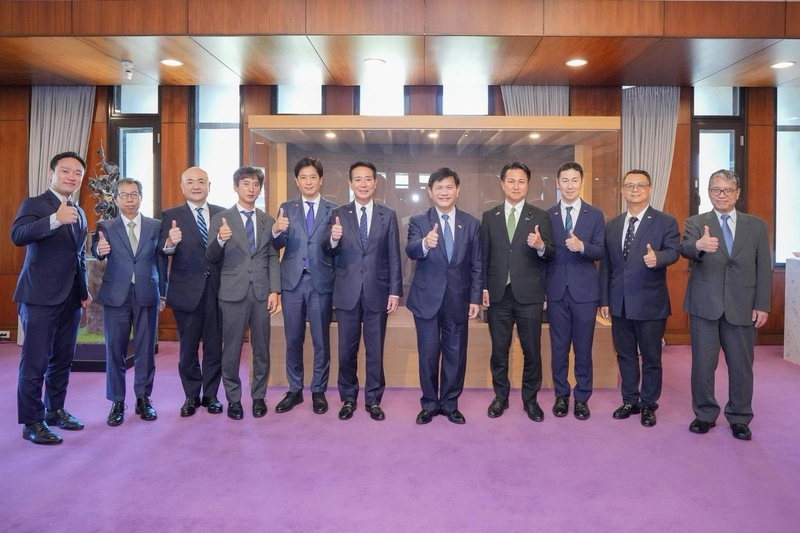
The Ministry of Foreign Affairs of the Republic of China stated that Foreign Minister Joseph Wu hosted a banquet for Japanese parliamentarians on the 24th, expressing the need for Taiwan and Japan to further enhance their economic security resilience and optimize bilateral dialogue platforms in the face of rapidly changing Indo-Pacific dynamics and challenges such as global supply chain restructuring. The focus was on collaborating in areas such as semiconductor technology to create a mutually prosperous situation for Taiwan and Japan.
The Ministry of Foreign Affairs of the Republic of China issued a press release stating that Minister Joseph Wu hosted a luncheon on the 24th for five members of the “Japan Innovation Party Public-Private Partnership Promotion Council,” including MPs Masaaki Maehara, Ryohin Iwaya, Yuzuru Urushima, Yoshi Hagihara, and Akira Takami. They had an in-depth exchange of views on Taiwan-Japan relations, regional security dynamics, and economic security resilience. Advisers from the Ministry of Foreign Affairs, President Lü Yao-chih of Taipei University of Marine Technology, and CEO Yichung Lai of Far Eastern Foundation were also in attendance.
During his speech, Minister Joseph Wu emphasized that Taiwan and Japan share fundamental values such as freedom, democracy, human rights, and rule of law. He highlighted the importance of both countries as significant partners and valued friends, with continuous dialogue and exchanges across various fields. The existing agreements between Taiwan and Japan, including the investment agreement, the double taxation avoidance agreement, and the customs cooperation and mutual assistance agreement, have laid a solid foundation that is rare among countries worldwide.
In the face of the rapidly changing Indo-Pacific situation and challenges like the restructuring of global supply chains, Minister Joseph Wu believes that Taiwan and Japan should work together to enhance their economic security resilience. He suggested optimizing bilateral dialogue platforms, focusing on areas of mutual interest such as semiconductors, AI, smart healthcare, and disaster prevention and reduction resilience. By establishing substantial cooperation in these strategic growth areas, both countries can create a mutually prosperous situation.
Masaaki Maehara mentioned that during his visit to Taiwan, he not only toured the Hsinchu Science Park and Industrial Technology Research Institute but also visited public facilities completed under the Build-Operate-Transfer (BOT) model, such as the Shuang Ho Hospital of the Ministry of Health and Welfare. He witnessed firsthand Taiwan’s robust economic and technological strength in public-private partnership development and believes there is still significant cooperation potential between Taiwan and Japan. He looks forward to further deepening bilateral relations in the future.