
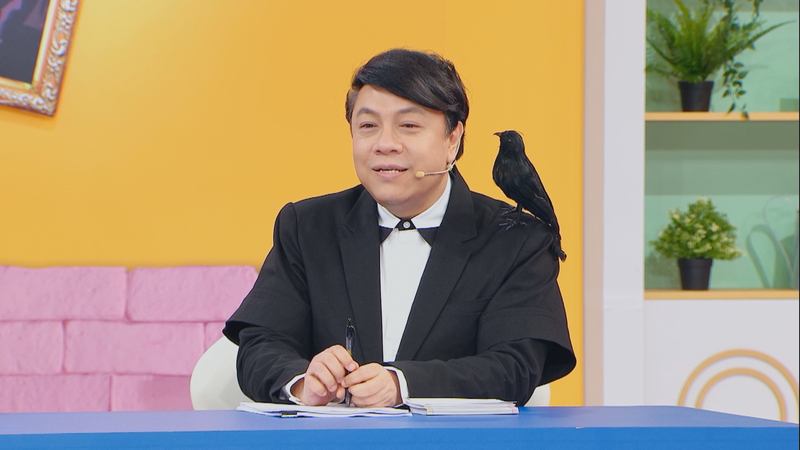
【Epoch Times October 8, 2026】Taiwanese artist Cai Kangyong’s appearance at a campaign event for Shen Boyang on October 4, which was classified by the Chinese Communist Party’s Taiwan Affairs Office as a “stubborn advocate for Taiwan independence,” has sparked strong backlash on mainland Chinese social media networks. In addition to brands swiftly cutting ties with him, Luo Yonghao, a mainland Chinese internet celebrity entrepreneur who had previously publicly praised Cai Kangyong as an “idol,” also faced attacks from Chinese nationalist internet users flooding his social media platforms.
Cai Kangyong was spotted wearing a mask at Shen Boyang’s campaign rally and later explained that he was considering visiting the two candidates for Taipei mayor, hoping to understand their beliefs. However, after the related images surfaced, it shattered the hearts of Chinese nationalists. Not only did the Chinese electric car brand “Leap Motor” swiftly remove collaborative content, but official Chinese media and numerous self-media accounts also posted articles criticizing and hurling insults, sparking strong backlash on Chinese social media, with the boycott sentiment continuing to escalate.
Some Chinese internet users dug up an episode of Luo Yonghao’s podcast “Luo Yonghao’s Crossroads” from April 29 this year, where Cai Kangyong was invited as a guest for an interview. In the nearly 4-hour conversation, Luo Yonghao referred to Cai Kangyong as his “idol,” praising him as the “most eloquent person in the entire Chinese-speaking hosting industry.”
As the situation surrounding Cai Kangyong intensified, other collaborative partners swiftly distanced themselves. However, as of October 5, Luo Yonghao’s account still retained the video of the interview, without deletion or public statement, prompting Chinese netizens to flood the comments section, demanding Luo Yonghao to clarify his stance, questioning why he remained silent, advising him not to idolize Cai Kangyong, and even criticizing him with “birds of a feather flock together.”
While Luo Yonghao and his team have not made any statements, a check of the “Luo Yonghao’s Crossroads” channel revealed that the six interview videos with Cai Kangyong have all disappeared, with the total number of videos on the channel reduced from 416 to 405, suggesting that under the overwhelming public pressure, Luo Yonghao quietly took down related content.
With Cai Kangyong facing boycotts and brand cuts from mainland China, the focus of public opinion in Taiwan is mainly on issues concerning “freedom of expression,” “the survival space of the entertainment industry,” and “contrasts in the cross-strait environment.”
Veteran Taiwanese artist Chen Meifeng praised Cai Kangyong as someone “very thoughtful,” believing that his willingness to continue learning and actively seeking to understand and observe various societal discussions is a commendable mindset and spirit, stating that she should “take a page from his book.”
When asked about Cai Kangyong being boycotted in China, Chen Meifeng calmly responded in Taiwanese saying, “I am in Taiwan, so I do not feel that pressure.” Despite some radical internet users threatening to boycott her for appearing with political figures, she displayed high emotional intelligence, stating that everyone has the right to freedom of speech, and it is impossible to please everyone.
Taiwanese internet celebrity host Chen Yiqiang emphasized, “Supporting the freedom of all individuals to express their opinions is the true democratic value.” She believes that since Cai Kangyong is not lacking in money or publicity, his breaking of long-standing sensitive boundaries may stem from intellectual ideals or character, but having made a choice, he must bear the corresponding commercial consequences of the market, stating that one cannot have it all.
Taiwanese scholar Shen Rongqin views the Cai Kangyong incident as a “demon-revealing mirror,” exposing the disparity in the mainland and Taiwanese public’s recognition of authoritarian and democratic social norms. He indicated that many mainland companies distanced themselves out of self-censorship and commercial risk aversion in the face of nationalism. The fact that the Chinese authorities did not immediately “completely shut down” Cai Kangyong may suggest that the CCP is also considering avoiding excessively provoking Taiwanese voters and influencing the Taipei mayoral election at the end of the year.